Endangered
Ceriagrion georgifreyi
Ceriagrion georgifreyi
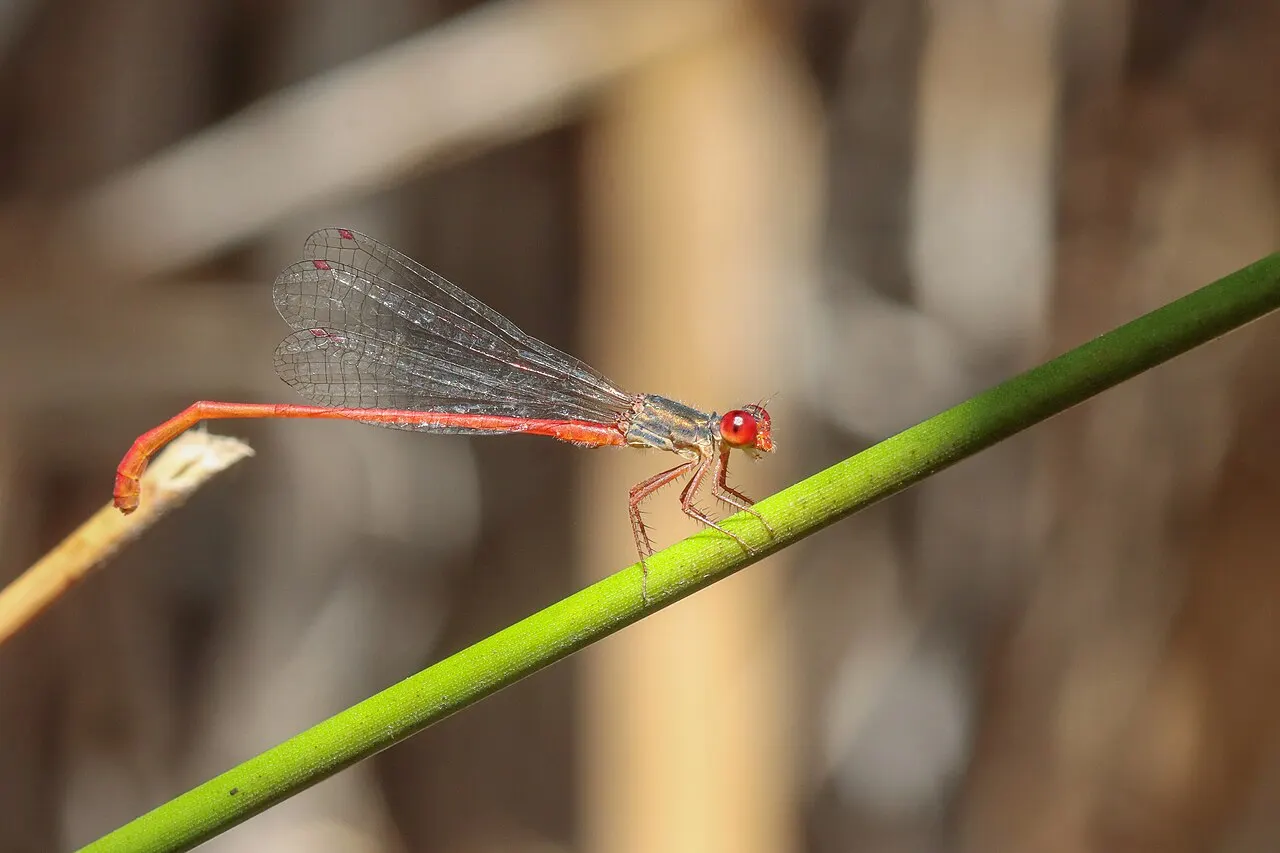
The Turkish red damsel (Ceriagrion georgifreyi) is a small red damselfly of streams and marshes in Turkey and Greece, with older records from Syria and Israel. The IUCN Red List rated it Endangered in 2020. In Europe, where only a few Greek populations remain, a 2024 regional assessment rated it Critically Endangered.
How to recognise it
It is a slim damselfly, roughly 35 to 40 mm long, with a hindwing of 17 to 20 mm. Males have red eyes, a red abdomen, red legs and a uniformly red wing spot. Females have brown eyes and come in three forms: a red and black abdomen, an all-red abdomen like the male's, and a rare all-black one.
It looks a great deal like the small red damselfly (Ceriagrion tenellum). Males are told apart by the shape of their lower appendages, and females by two small upright flaps just behind the front edge of the thorax, which the lookalike lacks. The two species' ranges don't appear to overlap.
Where it lives
The species was described by Schmidt in 1953 and is named for the German naturalist Georg Frey (1902 to 1976). Its recorded range runs from Israel through Syria to Turkey and Greece. Turkey and Greece are the countries where it is currently listed as present. Syria and Israel are listed as places where it is possibly extinct, and Lebanon and Palestine are uncertain.
In Europe it is known from Greek sites that include the islands of Thasos, Corfu and Zakynthos (new records in 2005) and Lesbos (reported in 2017). The first secure mainland record, from northeast of Athens, was published in 2017, and a Peloponnese record followed in 2019.
It lives along small streams. The global assessment lists permanent and seasonal streams and rivers, plus bogs, marshes and fens.
Pins are Wikidata “endemic to” fields. Orange dots, when present, are GBIF occurrence tiles — survey bias included.
Why it is in trouble
The 2020 global assessment counted 25 locations and an area of occupancy of about 116 square kilometres. It described the population as severely fragmented and still declining, with an estimated 40 percent reduction in the past and a projected further 30 percent, both tied to habitat decline. Threats listed include tourism and recreation areas, drought and other ecosystem modifications.
The Greek picture is starker. The 2024 European assessment rated it Critically Endangered, with about 4 locations, a European area of occupancy near 36 square kilometres, and a population estimate of roughly 150 individuals. The largest single group held about 49. It lists farming, water abstraction for irrigation, small dams, sewage, nutrient run-off and pesticides as threats.
What is being done
Little is in place. The European assessment records no recovery plan, no monitoring scheme and no identified conservation sites, though the species does occur in at least one protected area. It calls for site protection and management, habitat restoration, and awareness work.
Sources
Written for this catalog in our own words from the sources below, checked against them on 12 November 2026. Population figures are estimates and carry the year they were made. Status and assessment year: IUCN. 2026. The IUCN Red List of Threatened Species. Version 2026-1. iucnredlist.org.




