Endangered
Cephalophorus rubidus
Cephalophorus rubidus
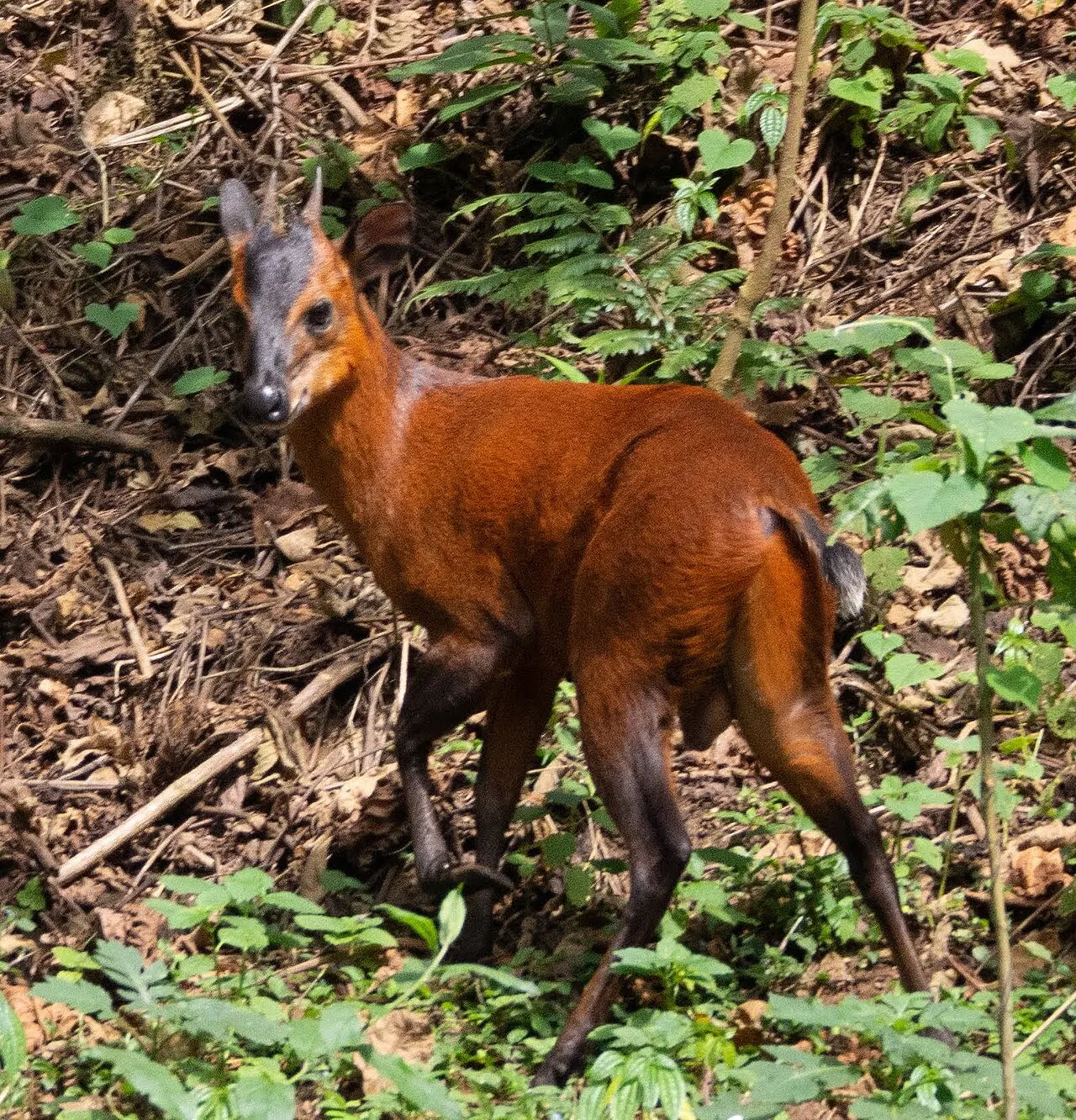
The Rwenzori red duiker is a small, bright red antelope that lives only in the Rwenzori Mountains, where it has been confirmed in Uganda. The IUCN's 2016 assessment, made under the name Cephalophus nigrifrons rubidus, rates it Endangered, with a decreasing population that hunting is driving down.
How to recognise it
It's a sturdy duiker, roughly 75 cm from head to rump, about 45 cm at the shoulder and around 15 kg, with a tail of 5 to 10 cm. The coat is soft, dense and woolly, bright red and without speckling. The underparts are paler, and the shoulders and lower legs are darker. There's no true back stripe, though darker underfur along the spine can give that impression. Both sexes carry horns of 8 to 9 cm.
The thick coat is thought to help it cope with the cold climate of the high mountains.
Where it lives
The species is endemic to the Rwenzori Mountains. It has been confirmed only on the Ugandan side, though it probably also occurs in the Democratic Republic of the Congo. The IUCN assessment gives an elevation range of 1,300 to 4,200 m, from montane forest with bamboo up through high-altitude shrubland toward the snowline. It counts one location and an extent of occurrence of about 3,172 square kilometres.
Accounts differ on how high it lives. One describes it mainly in the subalpine zone above 3,000 m, while another mentions moorland and tree-heather woodland, with animals seen feeding near bog margins.
How it lives
Very little has been observed. It's usually solitary, apart from mothers with young and courting pairs, and it is active by day and by night, perhaps varying with season and weather.
Its diet hasn't been recorded directly. Fruiting trees, the staple of most duikers, are absent where it lives, so it probably eats alpine herbs and lichens. African golden cats, and probably leopards, are its likely predators.
Where it fits in the family tree
Oldfield Thomas described it in 1901. Some authorities treat it as a subspecies of the black-fronted duiker, which is how the IUCN lists it, or of the red-flanked duiker. The Mammal Diversity Database treats it as a full species. That is why you'll see it under several scientific names.
Why it is in trouble
The IUCN names hunting, with the animal itself as the target, as the threat across more than 90 percent of the population, causing slow but significant declines. Snaring and illegal hunting are named as the main pressures in one summary, which also lists habitat loss. That summary estimates fewer than 2,500 mature animals. It's an estimate, not a count.
What is being done
The IUCN records that the species occurs in at least one protected area, with conservation sites identified over part of its range. Rwenzori Mountains National Park, in Uganda, was created in 1991. It covers roughly 1,000 square kilometres and became a World Heritage Site in 1994. Rebel groups occupied the mountains from 1997 to 2001, and the site was on the World Heritage in Danger list from 1999 to 2004.
The IUCN lists site protection and management, livelihood alternatives and national-level action as conservation actions. It records no species recovery plan and no systematic monitoring scheme.
Sources
Written for this catalog in our own words from the sources below, checked against them on 12 November 2026. Population figures are estimates and carry the year they were made. Status and assessment year: IUCN. 2026. The IUCN Red List of Threatened Species. Version 2026-1. iucnredlist.org.




