Critically Endangered
Catalina mountain snail
Radiocentrum avalonense
The Catalina mountain snail (Radiocentrum avalonense) is a small land snail found only on Santa Catalina Island, off southern California. The IUCN Red List rated it Critically Endangered in 1996. It was thought lost for nearly 80 years before live animals turned up again in 1982.
How to recognise it
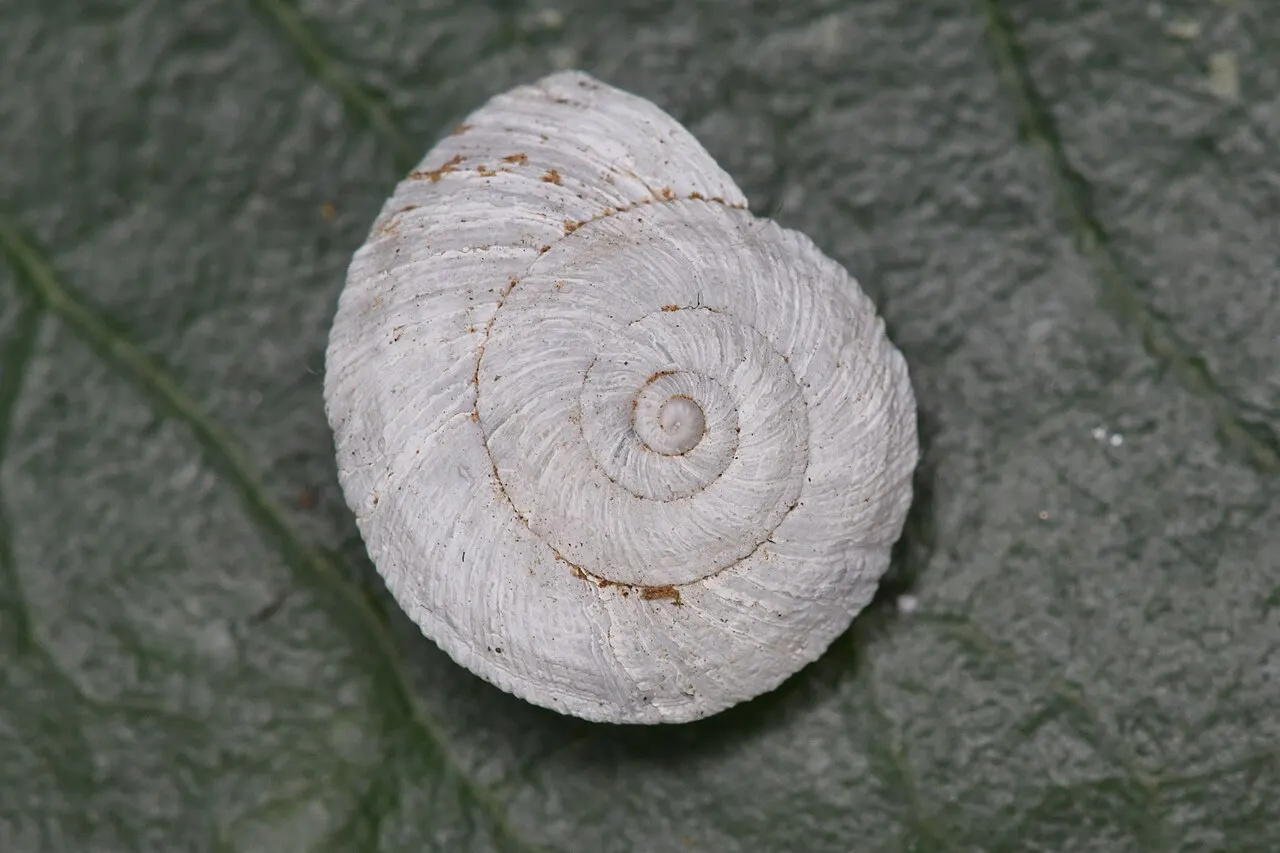
The shell is flattened and lens-shaped, with a sharp keel around the rim. Shells in the 1902 collection reached about 11 to 14 mm across, and the largest recently collected one was 12.3 mm. The spire is dull brown, while the last whorl is creamy white with light brown and gray streaks and two pale brown bands. The living animal is light tan, with a slightly grayish collar.
The first one and a half whorls, the embryonic shell, carry radial ribs, the one shell feature that marks the genus Radiocentrum. Otherwise the shell looks much like those of Oreohelix snails, so dissection was needed to settle the genus. The reproductive system is typical of Radiocentrum, but this species alone has a swollen lower penis with three lengthwise ridges.
Where it lives
Its known range is a small area near the southeast end of Santa Catalina Island, in Los Angeles County. Biologists found it on steep, south-facing slopes at roughly 300 to 380 m, in sparse coastal sage scrub dominated by black sage and prickly-pear cactus. Snails turned up under cactus patches and in rock rubble around sage clumps. Recently dead shells extended the known range by about 0.5 km to the northwest and 1.6 km to the southeast.
Extensive searching elsewhere on the island found none. No other member of its family lives anywhere near. The closest relatives are in Arizona, New Mexico, Chihuahua and Baja California Sur. In 1931 the malacologist S. Stillman Berry called the presence of an Oreohelix-type snail on the island one of the strangest anomalies in the distribution of western land snails. Hochberg, Roth and Miller judged it probably a relict outlier of a once more continuous genus, split up as the Sonoran and Chihuahuan deserts spread, likely in late Pleistocene time.
Pins are Wikidata “endemic to” fields. Orange dots, when present, are GBIF occurrence tiles — survey bias included.
How it lives
Little is recorded. Snails kept in terraria rarely moved, ignored fresh lettuce, and apparently fed on dead stems and leaf litter gathered from under sage. One wild snail was seen rasping a sage twig. Like others in its genus, it lays eggs.
The first living snails of the modern era were found on 5 January 1982, after a night of drenching rain. By 10 am they were out in the open, active and swollen with water, crawling over stems and the ground at the edge of sage clumps. Empty shells with broken bodies and chipped spires suggest that small mammals such as mice eat them.
Why it is in trouble
The conchologist Henry Hemphill collected over 100 shells on the island in early 1902 and then the species vanished from view. Repeated failures by visiting malacologists to find it led some to suggest it was extinct, perhaps through over-collecting or the growth of the town of Avalon. Some even suspected a mixed-up locality label. Recently dead shells found in December 1978, and six live snails in January 1982, showed it had survived in a much smaller area.
Hochberg, Roth and Miller could not tie its distribution to any specific environmental factor. They noted that fire-protected scrub has grown mature and woody and may hold less soft litter than younger scrub, and that feral goats were grazing the slopes. They also could not rule out lasting damage from early collecting, since no one had data on how fast the snail breeds. Because it is so rare and localized, they gave only general locality information.
The Red List assessment is from 1996 and lists one country, the United States. It has not been updated since, and it gives no population estimate.
Sources
Written for this catalog in our own words from the sources below, checked against them on 12 November 2026. Population figures are estimates and carry the year they were made. Status and assessment year: IUCN. 2026. The IUCN Red List of Threatened Species. Version 2026-1. iucnredlist.org.




