Endangered
Caseolus calvus
Caseolus calvus
Caseolus calvus is a small air-breathing land snail found only on the Portuguese island of Madeira, where it lives in temperate grassland and on rocky ground. The IUCN Red List rated it Endangered in 2025. Its whole range covers an area of about 12 square kilometres, split across five locations.
How to recognise it
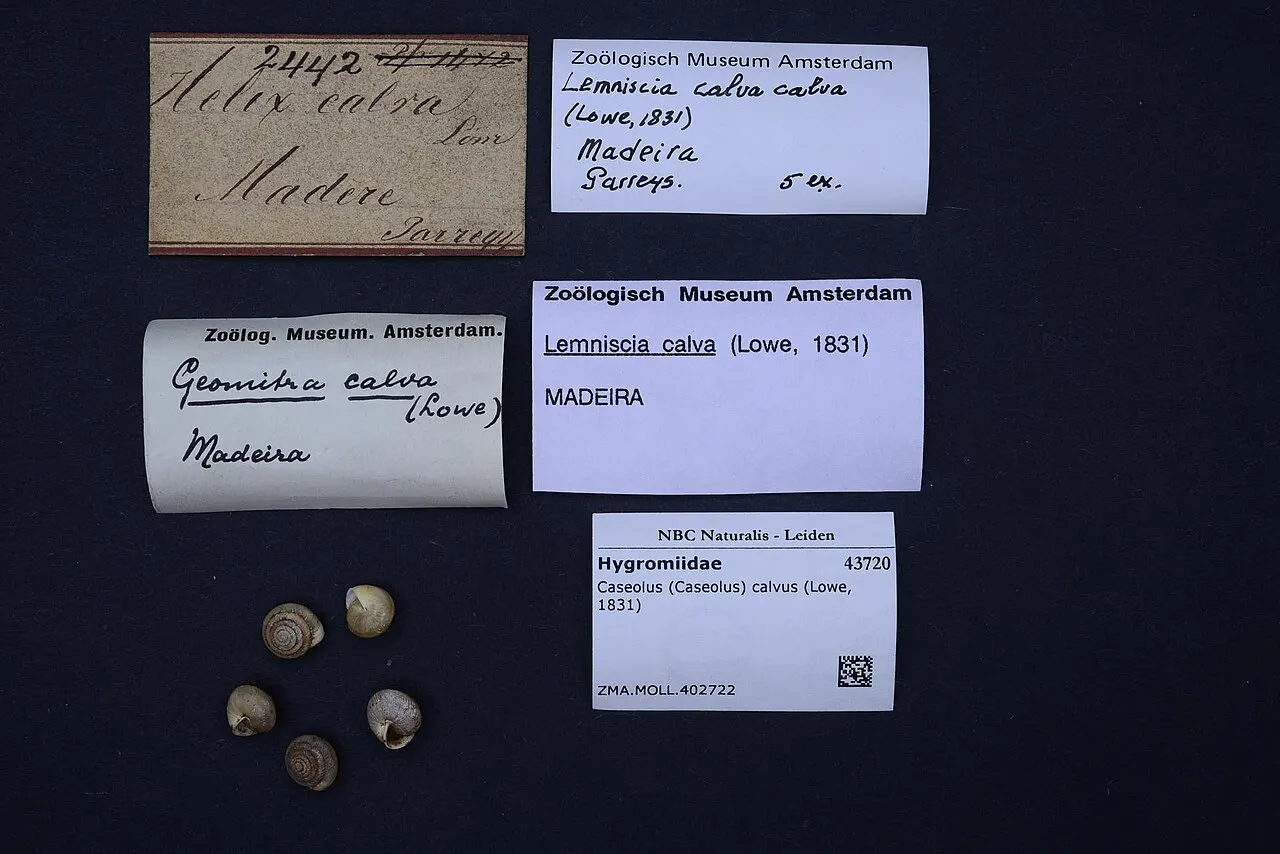
It's a small land snail in the family Geomitridae, the hairy snails and their relatives. The species was described by the English naturalist Richard Thomas Lowe in 1831 from Madeira, under the name Helix calva.
A second form, Caseolus calvus galeatus, was once treated as a subspecies. Lowe described it in 1862 from the Desertas Islands and Madeira. It is regarded as lost, with no record since 1867 or earlier according to one recent listing.
Where it lives
The Red List records the snail from Madeira and nowhere else, so it is endemic to Portugal. It is a resident of temperate grassland and rocky areas such as inland cliffs, at elevations from about 600 to 1,700 metres.
Museum specimens held in the GBIF database come mostly from the mountains of central Madeira, including the Curral das Freiras valley, Eira do Serrado, Ribeira Brava and Monte, with others from Faial and Ponta de Sao Lourenco. The dated ones were collected between 1936 and 1992. The assessment counts five separate locations.
Pins are Wikidata “endemic to” fields. Orange dots, when present, are GBIF occurrence tiles — survey bias included.
Why it is in trouble
The 2025 assessment lists several pressures. The most heavily weighted is an increase in the frequency and intensity of fire, which affects most of the range and is linked to rapid declines. Storms and flooding and drought affect nearly all of the range, and landslides affect most of it.
Introduced animals and plants add to the load. The assessment names feral brown rats and house mice, along with unspecified non-native plants. How many snails remain, and whether the population is rising or falling, is unknown, though the assessment records a continuing decline in the area of habitat.
What is being done
Much of the population lives on protected land. The assessment puts the share of the population within protected areas at 71 to 80 percent, and records an area-based regional management plan and a systematic monitoring scheme. No international trade controls apply to it.
Sources
Written for this catalog in our own words from the sources below, checked against them on 12 November 2026. Population figures are estimates and carry the year they were made. Status and assessment year: IUCN. 2026. The IUCN Red List of Threatened Species. Version 2026-1. iucnredlist.org.




