Endangered
Careoradula perelegans
Careoradula perelegans
Careoradula perelegans is a tiny pale-yellow land snail from the granitic islands of the Seychelles. It is the only member of its genus and has no radula, the toothed tongue nearly all snails use to feed. The IUCN Red List assessed it as Endangered in 2009.
How to recognise it
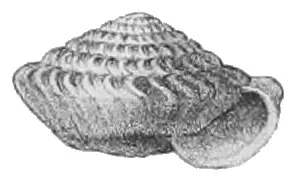
The shell is a flattened disc, about 4.4 to 6.1 mm across and 1.9 to 3.1 mm high, with 6 to 8 whorls, regular ribs and an open navel on the underside. The body is pale yellow. Two snails measured on Praslin and La Digue in 2011 and 2021 were 4.5 and 4.2 mm wide.
The real oddity is inside. Careoradula perelegans has no radula, and reportedly none of the muscles that normally work it. When Justin Gerlach and Adolph van Bruggen set up the genus in 1999, complete absence of a radula was what set it apart from every other streptaxid. A 1998 record is described as the first pulmonate snail known to lack one. The genus name comes from the Latin for 'lacking' and 'radula'.
Where it lives
Eduard von Martens described the species from the Seychelles in 1898. It belongs to the family Streptaxidae, a group of carnivorous land snails that has diversified widely on the granitic islands, where 18 of the 20 known streptaxid species are endemic.
For decades it was known only from Mahe and Silhouette, in high forest above 400 m. Surveys from 2011 to 2021 then found it on Praslin and La Digue, including lowland woodland at about 50 m above sea level, so it is less tied to high forest than first thought. The IUCN assessment, based on older data, gives an elevation range of 500 to 900 m and counts four locations.
Pins are Wikidata “endemic to” fields. Orange dots, when present, are GBIF occurrence tiles — survey bias included.
How it lives
It feeds on dead animal matter. One record describes it eating dead Subulina octona, another small land snail. Without a radula it is reported to rely on strong muscular ridges between the mouth and oesophagus and on an extendable rostrum, moving food along by muscle contractions alone. On Praslin it was found in leaf litter in palm forest, and on La Digue under a rock overhang. Details of its breeding and lifespan are not published.
Why it is in trouble
The 2009 assessment lists small-holder farming and plantations as the main pressures on the forest it lives in. It rates the population as stable and gives an estimate of roughly 29,000 individuals, but also records a continuing decline in the area it occupies. Its criteria (B1ab(iii) and B2ab(iii)) reflect a small range, few locations and declining habitat quality rather than a counted collapse.
What is being done
The assessment lists invasive species control and site protection as actions, and its structured data records a recovery plan for the species and conservation sites identified across its range. The lowland populations found on Praslin and La Digue suggest the animal may be more widespread than the 2009 assessment assumed, though that has not changed its category.
Sources
Written for this catalog in our own words from the sources below, checked against them on 12 November 2026. Population figures are estimates and carry the year they were made. Status and assessment year: IUCN. 2026. The IUCN Red List of Threatened Species. Version 2026-1. iucnredlist.org.




