Endangered
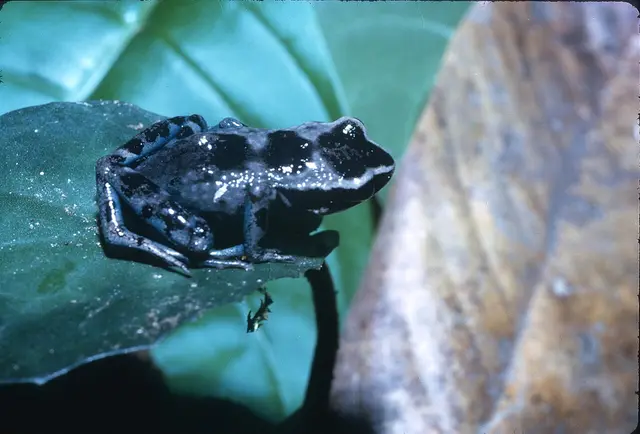
Cardioglossa oreas
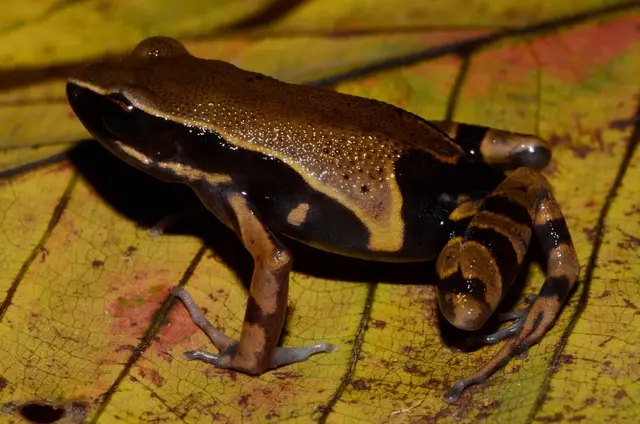
Cardioglossa oreas
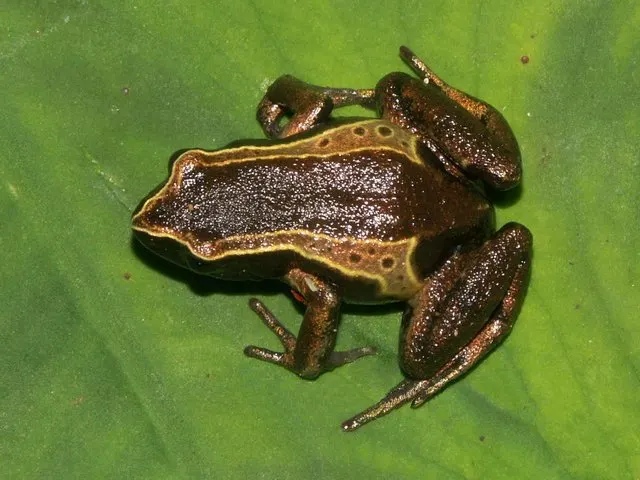
The Mount Okou long-fingered frog (Cardioglossa oreas) is a small frog of the mountain forests of western Cameroon, living at 1,900 to 2,650 m near fast streams. The IUCN's 2015 assessment lists it as Endangered because its range is small, fragmented and shrinking.
How to recognise it
Females measure about 27 to 30 mm from snout to vent, and males reportedly about 23 mm. Males have spines on their fingers and females don't. Unlike other long-fingered frogs, the male's third finger isn't elongated, despite the group's name.
It also lacks the dorsal markings and the white line under the eardrum seen in relatives, and its eardrum is small and hard to see. Genetic data still place it firmly in the genus Cardioglossa. Jean-Louis Amiet described it in 1972.
Where it lives
It is endemic to Cameroon, known from the Western High Plateau between Mount Oku and the Bamboutos Mountains. Records from Mount Manengouba belong to a different species, Cardioglossa manengouba. The IUCN gives its extent of occurrence as about 1,383 km2 and its elevation range as 1,900 to 2,650 m.
It lives in montane forest, often bamboo forest, and in degraded patches that still have trees. The IUCN lists permanent streams among its habitats, and fast-flowing streams are where it breeds.
Pins are Wikidata “endemic to” fields. Orange dots, when present, are GBIF occurrence tiles — survey bias included.
What field surveys found
A survey on Mount Bamboutos from March 2014 to May 2016, published in Oryx, spent 389 surveyor hours, divided equally among forest, pasture and cultivated land. It found Cardioglossa oreas only in forest, never in farmland or pasture. The same paper noted that the mountain has no official protection and that a related frog, Cardioglossa pulchra, last recorded there in 2006, was not found.
Mount Oku, Bamboutos, Lefo and Mbam are the four main peaks of the Bamenda Highlands, and C. oreas is named as one of the highland's endemic amphibians.
Why it is in trouble
The IUCN says the population is severely fragmented and the area it occupies is still shrinking. The listed threats are small-holder farming and grazing, housing and urban areas, and herbicides and pesticides.
On Mount Bamboutos, the Oryx survey describes forest cleared for crops, stream water diverted for irrigation, widely used pesticides (mainly against weeds and potato blight), livestock grazing and fire set by herders. The population trend is recorded as unknown, though the species is reportedly common within its small range.
What is being done
The frog occurs in at least one protected area, and the Red List entry lists site and area management, and resource and habitat protection, as conservation actions. Those are recommendations rather than a record of programmes aimed at this species. It reportedly occurs in the Bafut-Ngemba Forest Reserve.
Sources
Written for this catalog in our own words from the sources below, checked against them on 12 November 2026. Population figures are estimates and carry the year they were made. Status and assessment year: IUCN. 2026. The IUCN Red List of Threatened Species. Version 2026-1. iucnredlist.org.