Critically Endangered
Capys penningtoni
Capys penningtoni
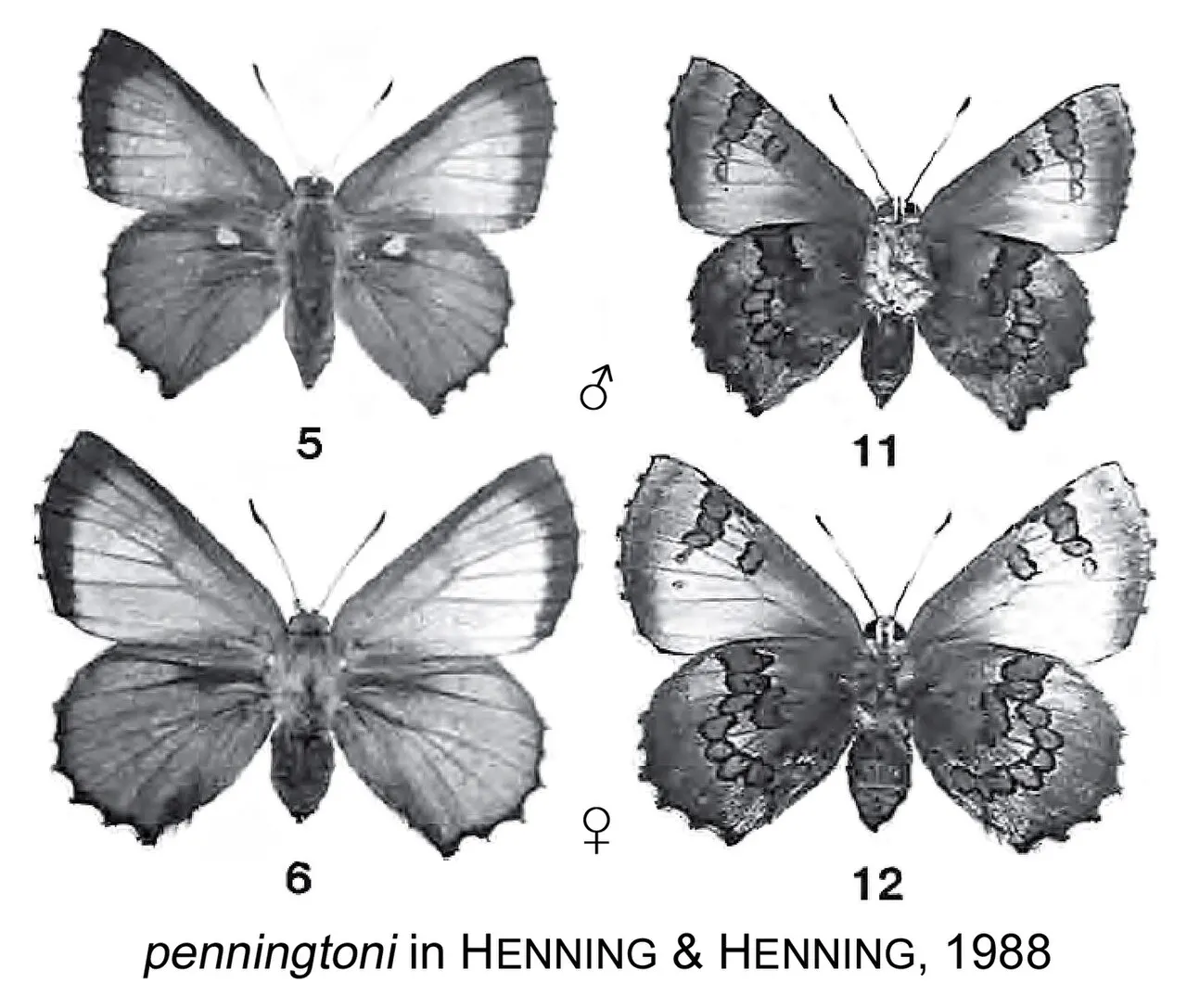
Pennington's protea (Capys penningtoni) is a small butterfly confined to the midlands and Drakensberg foothills of KwaZulu-Natal, South Africa. The IUCN rated it Critically Endangered in 2020, with a decreasing population estimated at 249 mature individuals. Its caterpillars develop inside the flower buds of one tree, the common sugarbush.
How to recognise it
It is a lycaenid, a family of small butterflies. Males are reported to have a wingspan of 32 to 40 mm and females 34 to 47 mm. The British entomologist Norman Denbigh Riley described the species in 1932, and the type locality is Nhlozane Mountain. Adults reportedly fly for a short season, from mid-September to early November, with one generation a year.
Where it lives
Everything known about its range sits in the greater Mkhomazi River basin, from near Richmond in the south-east to Lotheni Nature Reserve in the north-west. It lives in montane protea savanna, roughly 1,000 to 2,100 m above sea level, wherever the common sugarbush (Protea caffra) grows. The IUCN counts eight subpopulations but treats them as one location.
Males are often found higher up, above the proteas and even on mountain peaks. Surveys led by Adrian Armstrong of Ezemvelo KZN Wildlife found the butterfly at seven previously unknown sites, six of them in 2014 and 2015. A habitat model suggests it could occur more widely in the midlands and foothills, though that still needs checking on the ground.
Pins are Wikidata “endemic to” fields. Orange dots, when present, are GBIF occurrence tiles — survey bias included.
How it lives
Females lay their eggs on the flower buds of Protea caffra. The caterpillars develop and pupate inside the buds, and adults emerge nearly a year later. In one field record, a male emerged nine months and three weeks after an egg was found. The larvae pass the winter in diapause, a resting state. Some general references name other protea species as hosts, but in recent fieldwork only butterflies from P. caffra were reared.
Why it is in trouble
In a 2020 paper in Metamorphosis, Armstrong described how its Red List status slid from Rare in 1989 to Vulnerable in 2009, Endangered in 2013 and now Critically Endangered. Between 2016 and 2020 the species persisted at only two of eight monitored sites, Bulwer and Nkawini mountains. At Sevontein Prison Farm, where a collector took more than 40 adults on a single day in 1946, only one adult was seen in 2015 and 2016.
Two threats stand out. One is the invasive harlequin ladybird (Harmonia axyridis), which was widespread in highland KwaZulu-Natal by the end of 2011 and has been seen crawling over the very buds where eggs are laid. Nobody has yet watched it eat the butterfly's eggs, but it feeds on butterfly eggs and caterpillars elsewhere. The other is fire. Intense fires kill sugarbush trees and hinder young ones, and annual burning to improve grazing for subsistence cattle farmers may add to the problem. The IUCN also lists agriculture, plantations, roads and collecting.
What is being done
The butterfly has been recorded in protected areas such as Marwaqa Nature Reserve on Bulwer Mountain. In 2025 Ezemvelo KZN Wildlife was reported to have created the 180 ha iNkonjane Nature Reserve near Impendle, a biodiversity offset and the third reserve in the province set up for threatened butterflies, a group that includes this species.
Armstrong's paper recommends continued surveillance, research on the ladybird and on fire effects, and cooler, well-timed burning. It also notes a small hope: eight individuals were photographed at one site on a single day in September 2019, the most he had seen there.
Sources
Written for this catalog in our own words from the sources below, checked against them on 12 November 2026. Population figures are estimates and carry the year they were made. Status and assessment year: IUCN. 2026. The IUCN Red List of Threatened Species. Version 2026-1. iucnredlist.org.




