Endangered
Capoetobrama
Capoetobrama kuschakewitschi
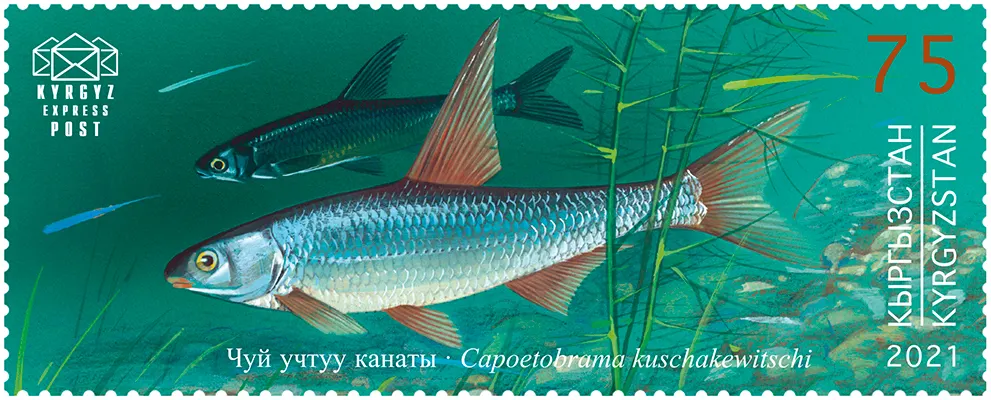
The sharpray (Capoetobrama kuschakewitschi) is a small freshwater fish of Central Asian rivers and the only member of its genus. The IUCN assessed it as Endangered in 2020 after an estimated decline of about 70 percent, linked to dams, water abstraction, pollution and introduced predatory fish.
How to recognise it
The sharpray belongs to the Leuciscidae, the minnow family. Its Russian name refers to the last unbranched ray of the dorsal fin, which is a stiff, smooth, pointed spine. Adults reach about 21 centimetres by one measure and up to 25 centimetres by another, and weigh up to roughly 150 grams. A strip of dark dots runs from the top of the gill opening to the base of the tail, and mature males grow small tubercles on the head, body and fins.
Two subspecies are recognised: the nominate form, described by Kessler in 1872, and the Chu sharpray, Capoetobrama kuschakewitschi orientalis, described by Nikolskii in 1934.
Where it lives
It is native to the Aral Sea basin, including the Amu Darya, Syr Darya and Kashkadarya rivers, and the IUCN records it in permanent rivers and streams. It is listed as present in Uzbekistan, Turkmenistan, Tajikistan and Afghanistan, and as gone from Kazakhstan and Kyrgyzstan since 1500, although some older lists still include those countries.
Pins are Wikidata “endemic to” fields. Orange dots, when present, are GBIF occurrence tiles — survey bias included.
How it lives
It is a bottom-dwelling fish of temperate water, recorded at 16 to 20 degrees Celsius, and it is not a migrant. It feeds on silt, detritus and plant remains from land. Fish mature at about 3 years old and 10 to 14 centimetres long, and spawn between April and June in shallows over soft muddy bottoms. A Russian reference gives a clutch of 6,000 to 90,000 eggs, while FishBase estimates a much lower 3,000 to 4,000. The IUCN gives a generation length of 4 to 5 years.
Why it is in trouble
The IUCN estimates the population fell by about 70 percent in the past, and the area it occupies is still shrinking. It names dams, groundwater abstraction, pesticides and herbicides, nutrient pollution, and two introduced fish, the northern snakehead (Channa argus) and the pike-perch (Sander lucioperca). A Russian reference adds that numbers dropped sharply in many waters once river flow was regulated. The remaining fish are split between two subpopulations at two locations.
What is being done
The assessment lists resource and habitat protection and site protection as the needed actions, and records no conservation measures already in place. The sharpray is listed in the Red Book of Uzbekistan.
Sources
Written for this catalog in our own words from the sources below, checked against them on 12 November 2026. Population figures are estimates and carry the year they were made. Status and assessment year: IUCN. 2026. The IUCN Red List of Threatened Species. Version 2026-1. iucnredlist.org.




