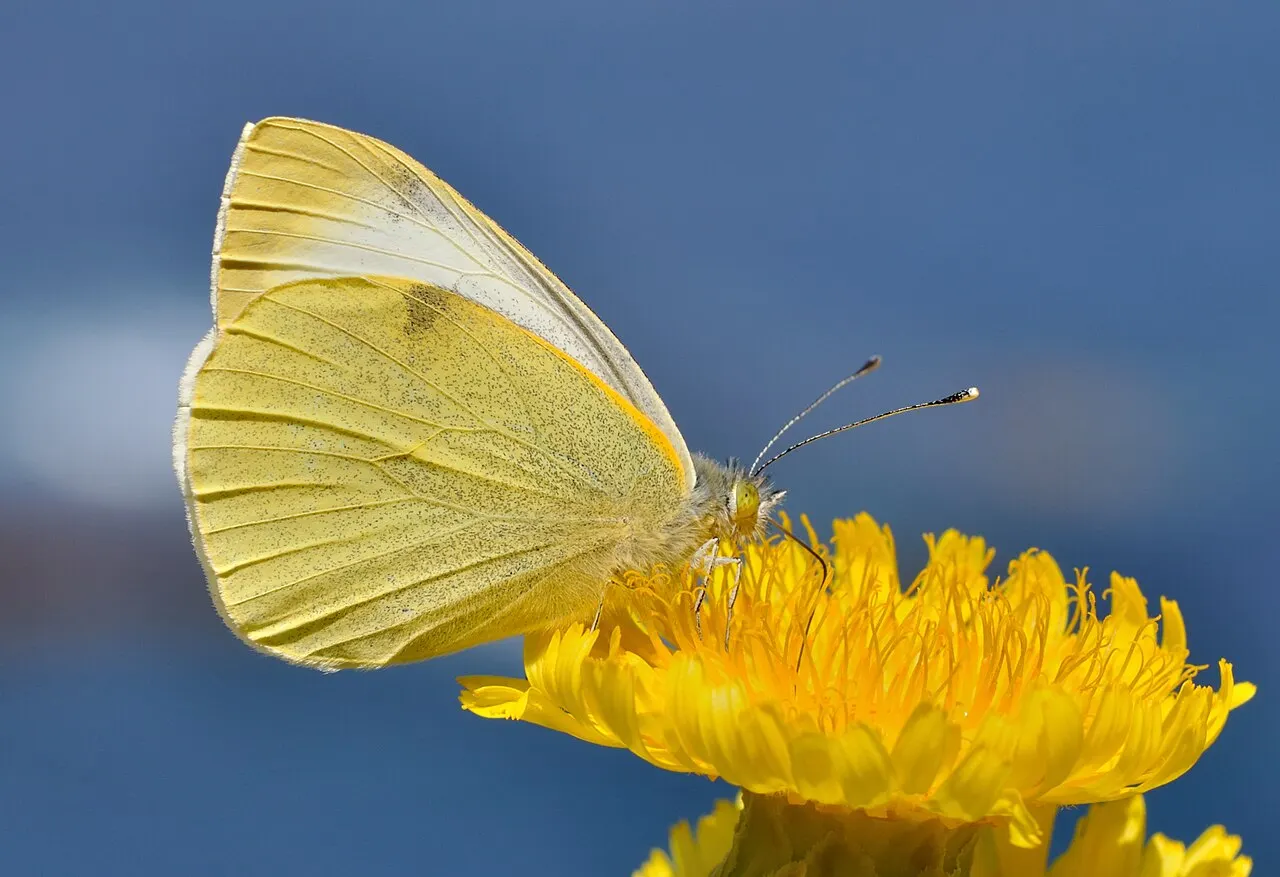
Endangered
Canary Islands Large White
Pieris cheiranthi
The Canary Islands large white (Pieris cheiranthi) is a butterfly found only in the Canary Islands, Spain. The IUCN Red List rated it Endangered in 2025. It now survives mainly on La Palma, and a 2026 interview with a researcher describes a collapse on Tenerife.
How to recognise it
It looks much like the European large white (Pieris brassicae). The main difference is the black patches on the forewings, which are much larger and run together. Its size is reportedly 57 to 66 mm.
Where it lives
It lives in wet, shady ravines in laurel forest, and also on wet cliffs with a similar damp microclimate. The IUCN gives an elevation range of 300 to 2,200 m, an extent of occurrence of about 7,338 km2 and an area of occupancy of about 372 km2.
It has been lost from La Gomera, where the last records date from 1975 or 1979, depending on the source. On Tenerife it was limited to the northern coast. In a June 2026 interview with IUCN Save Our Species, the researcher Yeray Monasterio Leon reports no confirmed record there since a sudden collapse that began in May 2023, and says La Palma now holds its last confirmed population. Sightings reported from Gran Canaria have never been verified.
Pins are Wikidata “endemic to” fields. Orange dots, when present, are GBIF occurrence tiles — survey bias included.
How it lives
Females lay clusters of 5 to 50 eggs on the underside of leaves. The caterpillars are light green with black dots and a pale yellow stripe. The only natural host plant appears to be Crambe strigosa, a Canary Islands endemic, though caterpillars also feed on garden nasturtium (Tropaeolum majus) and reportedly on Canary silverwort. There are seven or eight overlapping generations a year with adults on the wing all year, and the IUCN notes extreme fluctuations in numbers.
Why it is in trouble
The pressures are many. The IUCN lists housing, tourism areas, groundwater abstraction, drought, fire and other ecosystem changes among the threats. Monasterio Leon adds that nasturtium, a South American plant, acts as a trap: parasitoid wasps attack most caterpillars and pupae on it, and the introduced small white (Pieris rapae) is said to help those wasps build up.
He links the Tenerife collapse to severe drought between 2023 and 2025, and calculates that La Palma's population fell by about 40% over 2023 to 2025. He also flags a risk that imported cabbage plants could bring in the European large white, which could compete and hybridise, as he says happened in Madeira, and that non-native wasps released for pest control could harm eggs and larvae.
What is being done
A conservation plan for four Canary pollinators for 2023 to 2028, under the EU Pollinators Initiative, covers this butterfly. Its actions include distribution surveys, a study of Crambe host plants, a genetic study and a project website. A species recovery plan commissioned by the Canary Islands Government in 2019 was never published.
The Tenerife subspecies has been in the regional protection catalogue since 2010, but the La Palma population has no legal protection. A 2022 proposal for national protection was rejected, and a new one was sent in March 2026. Monasterio Leon's priorities include removing nasturtium, restoring Crambe on La Palma, an in-habitat breeding centre, and searching Tenerife for survivors.
Sources
Written for this catalog in our own words from the sources below, checked against them on 12 November 2026. Population figures are estimates and carry the year they were made. Status and assessment year: IUCN. 2026. The IUCN Red List of Threatened Species. Version 2026-1. iucnredlist.org.
- IUCN Red List assessment, Pieris cheiranthi (2025)
- On the brink: an expert perspective on saving the Canary Islands large white, IUCN Save Our Species (23 June 2026)
- Canarian Islands endemic pollinators of the laurel forest zone, EU Green Forum action plan tracker
- Canary Islands large white, Wikipedia
- GBIF, Pieris cheiranthi




