Endangered
Spineless forest lizard
Calotes liocephalus
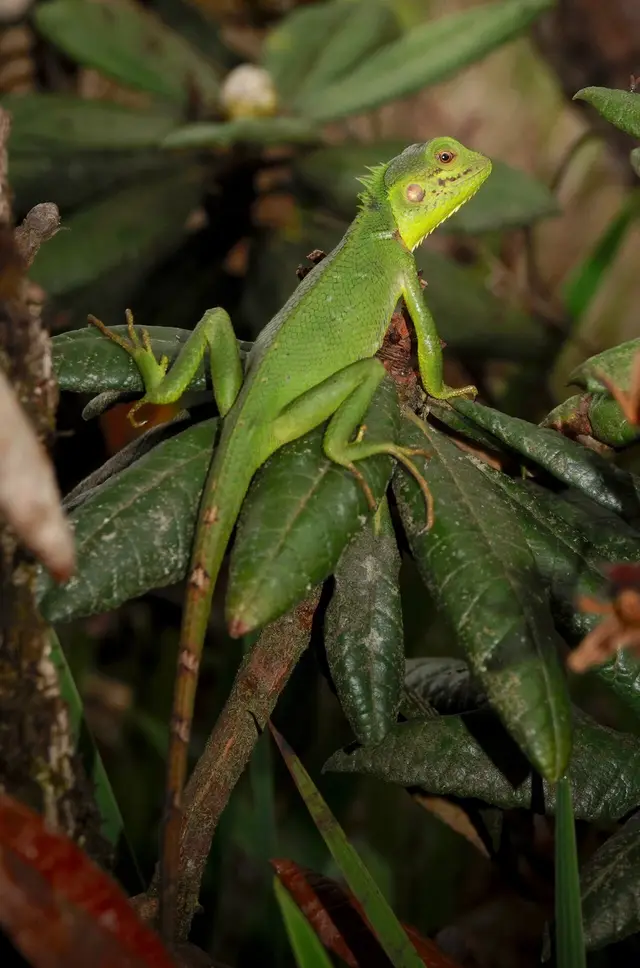
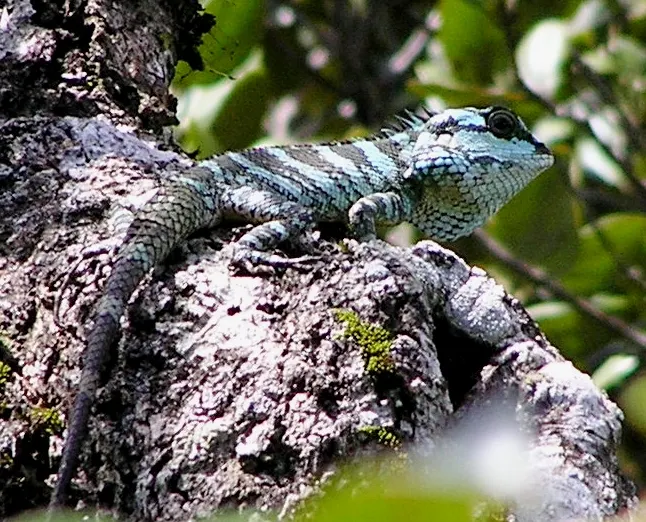
The crestless lizard (Calotes liocephalus), also called the spineless forest lizard or lionhead agama, is a slim, tree-dwelling lizard found only in the central highlands of Sri Lanka. The IUCN rated it Endangered in 2021, with a decreasing population. It has been recorded at only four localities in the past 50 years.
How to recognise it
It's a slim lizard that reaches roughly 91 mm from snout to vent and about 33 cm with the tail, according to a general reference. The body is reportedly marked with indistinct stripes of pale moss-green, dark green and brown, and the limbs and tail carry rings of pale moss-green and dark brown to black.
The head is fairly short with swollen-looking cheeks, and the scales on the flanks point backwards, or backwards and downwards. Fully grown males have a tail that is markedly swollen at the base. Most Calotes lizards have a spine above the ear opening. This one has none, or at most a rudimentary one, and its crest along the neck and back is poorly developed, which gives it its English names. The scientific name comes from Greek words for smooth and head. It closely resembles the green garden lizard (Calotes calotes).
Where it lives
The lizard is endemic to Sri Lanka. The IUCN places it in the central highlands, at the Peak Wilderness (Sri Pada), Upcot and Agrapatanas, in subtropical and tropical moist montane forest. Recent records have been confirmed only from the Peak Wilderness region, at about 1,500 to 1,700 m. The assessment counts four locations and an extent of occurrence of about 588 square kilometres.
A 2014 paper in Zootaxa lists older localities including Pundaluoya (about 1,000 m), Dickoya (about 1,200 m) and Upcot (about 1,400 m). The Pundaluoya and Dickoya populations appear to be locally extinct and are known only from museum specimens collected more than 120 years ago.
The same 2014 paper described a new species, Calotes pethiyagodai, from the Knuckles Massif above 900 m, and it is the closest relative of this lizard. Older studies reported the crestless lizard from the Knuckles, but the IUCN's 2021 assessment treats those records as the new species. Findings from older Knuckles studies may therefore describe the other species.
Pins are Wikidata “endemic to” fields. Orange dots, when present, are GBIF occurrence tiles — survey bias included.
How it lives
At the Peak Wilderness, females were recorded laying 3 to 4 eggs in October and November (2010 to 2012), in cool, shady weather. The eggs took 65 to 72 days to hatch.
A 2009 field study in the Journal of Threatened Taxa covered both the Knuckles and Peak Wilderness, before the Knuckles lizards were split off, so some of its observations may refer to the other species. It describes a daytime, mostly tree-living lizard, sometimes perched about 5 m up and usually held vertically on a branch. When alarmed it climbs quickly, flattens against the bark, and adults can turn black. It reportedly eats young leaves, buds, insects and worms. Hatchlings are light green, which hides them in Strobilanthes bushes.
Why it is in trouble
The IUCN lists small-holder farming and recreational activity as ongoing, low-impact threats, and dam building as a past one. It records a decreasing population, a continuing decline in the area it occupies and a continuing decline in the number of locations. No population estimate exists, and the 2009 study described the species as rare.
With only four known localities and two historic sites apparently lost, the species depends on what is left of the montane forest around the Peak Wilderness.
What is being done
The IUCN notes that the lizard occurs in at least one protected area. It lists site and area protection and habitat protection as conservation actions in place or needed.
Sources
Written for this catalog in our own words from the sources below, checked against them on 12 November 2026. Population figures are estimates and carry the year they were made. Status and assessment year: IUCN. 2026. The IUCN Red List of Threatened Species. Version 2026-1. iucnredlist.org.