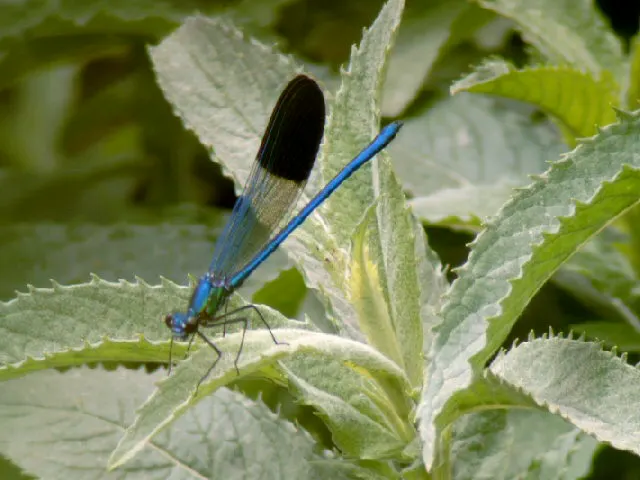
Endangered
Calopteryx syriaca
Calopteryx syriaca
The Syrian demoiselle (Calopteryx syriaca) is a damselfly of the southern Levant, found along rivers and streams in Israel, Jordan, Lebanon, Palestine and Syria. The IUCN Red List published an Endangered assessment in 2010 and records a decreasing population. Rising water demand and polluted or dammed waterways are behind the decline.
What it is
This is a damselfly in the family Calopterygidae, the demoiselles, a group of river insects. Rambur described it in 1842.
Its rank is not fully settled. Some authorities treat it as a subspecies of the banded demoiselle (Calopteryx splendens). A 2009 atlas of Mediterranean dragonflies says the status of many banded demoiselle subspecies is unclear and calls for more genetic work. The IUCN assessment and the atlas both list it as a species, and the atlas calls it a Levantine endemic.
Where it lives
The IUCN gives its range as Israel, Jordan, Lebanon, Palestine and Syria. A 2009 Mediterranean regional assessment lists it among eight dragonflies endemic to the Levant, a group that occurs mainly in Lebanon, Israel, Jordan, the Palestinian Territories and western Syria. It is reportedly found along the Orontes, Litani and Jordan rivers.
The assessment lists permanent and seasonal rivers and streams, freshwater springs and oases, inland deltas, and man-made canals and ditches. It puts the number of locations at about 50 and describes the population as severely fragmented.
Pins are Wikidata “endemic to” fields. Orange dots, when present, are GBIF occurrence tiles — survey bias included.
Why it is in trouble
The Mediterranean atlas says the species has declined strongly because people are taking more and more of the region's water. The IUCN assessment lists a wider set of ongoing pressures: sewage, drought, dams, groundwater pumping, housing and urban development, and tourism and recreation areas. Its Endangered rating rests on criterion A2c, an inferred population reduction tied to shrinking and degrading habitat.
Both the global assessment and the 2009 Mediterranean assessment rate it Endangered. No population count exists, and the assessment itself flags population trends and basic life history as research gaps.
What is being done
The assessment records no specific conservation measures in place. It calls for site protection, area management, restoration of river habitat and public awareness, and for research on population trends and ecology.
Sources
Written for this catalog in our own words from the sources below, checked against them on 12 November 2026. Population figures are estimates and carry the year they were made. Status and assessment year: IUCN. 2026. The IUCN Red List of Threatened Species. Version 2026-1. iucnredlist.org.
- IUCN Red List assessment, Calopteryx syriaca
- Boudot et al. 2009, Atlas of the Odonata of the Mediterranean and North Africa (Libellula Supplement 9)
- Riservato et al. 2009, Status and distribution of dragonflies of the Mediterranean Basin (IUCN)
- Calopteryx syriaca (encyclopedia entry)
- GBIF backbone record




