Endangered
Painted tree-rat
Callistomys pictus
The painted tree-rat (Callistomys pictus) is a white, black-capped rodent that lives high in the trees of southern Bahia, Brazil. The IUCN Red List rated it Endangered in 2025. It is so elusive that only 23 records are known, and DNA places it among unexpected relatives, including the coypu.
How to recognise it
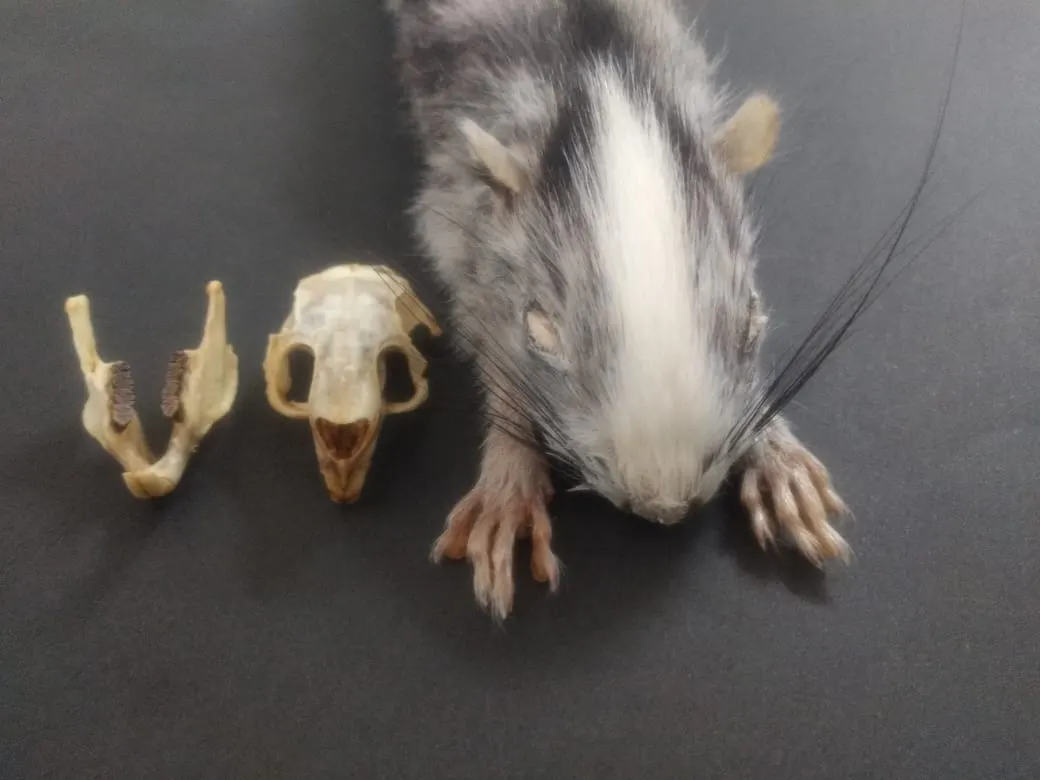
It is large for a spiny rat, about 30 cm long in total, and weighs roughly half a kilogram. The fur is long, dense and coarse but not spiny, and mostly white or silvery, with a glossy black cap, a black back and a black band running toward the forelimbs. Museum specimens often look brown where they should be black, which is attributed to fading.
The genus name means something like very beautiful rat. It is the only living species in its genus.
Where it lives
The species is restricted to a small part of the Atlantic Forest of eastern Brazil, in southern Bahia. It lives in lowland moist forest and also in shaded cacao plantations where native trees have been left standing.
A 2025 PLOS ONE study compiled 23 records in total, including three new ones: a sighting in 2006 in the Una Biological Reserve (the first from a strictly protected area), an animal captured in 2011 in a shaded cacao plantation in Ilhéus, and a female attacked by domestic dogs near Camamu in 2018. The Red List lists 13 specimens before that. One older record, from Elísio Medrado in 1997, lies about 200 km north of Ilhéus.
Pins are Wikidata “endemic to” fields. Orange dots, when present, are GBIF occurrence tiles — survey bias included.
How it lives
It is strictly arboreal and probably nocturnal. The 2025 study suggests the animal is elusive and not drawn to bait, which may explain why standard trapping surveys have never found it. A Brazilian mammalogist with extensive fieldwork across the country had reportedly never seen one in the wild, according to a Pesquisa FAPESP feature.
A 2014 genetic study in Natureza on line found it in a clade with the semi-aquatic coypu and the Amazonian spiny rat genus Proechimys, though the relationships among the three were uncertain. The grouping is surprising given how different their lifestyles are, and it suggests tree-living evolved more than once among spiny rats. The same paper notes that the species' range extended more than 700 km farther southwest in the late Pleistocene to early Holocene.
Why it is in trouble
The assessment estimates the area it occupies at about 60 square kilometres, across three locations, and records ongoing decline in that area. The 2025 study names a port complex for iron ore export with its access roads, urban growth, and more intensive management of shaded cacao as causes of habitat loss. The assessment also lists intentional use of the species and persecution as threats, and domestic dogs attacked at least one animal.
Population trend and size are unknown. Protected areas cover only about 2.8 percent of the potential range modelled in the 2025 study.
What is being done
It has been recorded in at least one protected area, and site protection is the only conservation action the assessment lists. The 2025 study calls for surveys around Itacaré and Valença, habitat protection between Una and Ilhéus, more protected land including private reserves, and cacao growing that keeps shade trees.
Sources
Written for this catalog in our own words from the sources below, checked against them on 12 November 2026. Population figures are estimates and carry the year they were made. Status and assessment year: IUCN. 2026. The IUCN Red List of Threatened Species. Version 2026-1. iucnredlist.org.




