Critically Endangered
Burmese star tortoise
Geochelone platynota
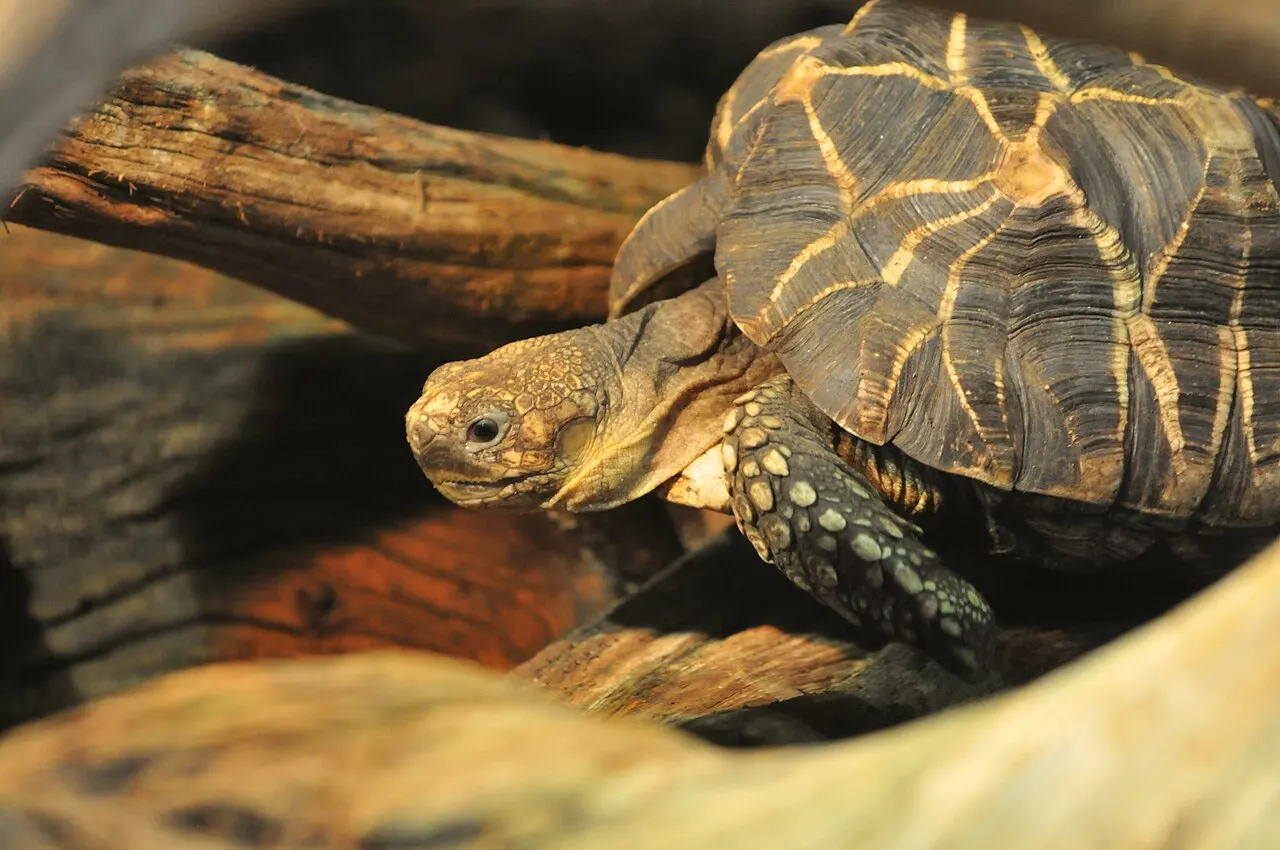
The Burmese star tortoise (Geochelone platynota) is a tortoise of the dry forests and scrub of central Myanmar. Collection for food, medicine and the pet trade drove steep declines from the late 1990s. The IUCN Red List rated it Critically Endangered in 2020, and captive breeding and releases are now under way.
How to recognise it
Like other star tortoises, it has a strongly domed shell marked with a star-shaped pattern. It can be told from the more common Indian star tortoise by comparing the plastron, the lower shell. It is listed on CITES Appendix I, and it is highly valued in the illegal wildlife trade.
Where it lives
It is native only to Myanmar, in the dry zone of the centre of the country. The Red List describes its habitat as tropical and subtropical dry forest and dry shrubland, at roughly 50 to 500 metres above sea level, and the 2020 assessment lists Myanmar as its only country.
Shwe Settaw Wildlife Sanctuary, on the western edge of the dry zone, still had tortoises in 1999 and 2000, but poaching wiped most of them out soon afterward. The Wildlife Conservation Society says the species is thought to be ecologically extinct in the wild.
Pins are Wikidata “endemic to” fields. Orange dots, when present, are GBIF occurrence tiles — survey bias included.
Why it is in trouble
Demand first came from food and traditional medicine markets in southern China, and later from pet buyers around the world. The Red List threat entries also include clearing for shifting agriculture, farming and grazing, roads, mining, fire and civil unrest, and the assessment records a continuing decline in habitat area.
Theft remains a live problem. In September 2015, several tortoises were stolen from acclimation pens at Minzontaung Wildlife Sanctuary and sold to traffickers in Mandalay. Some later appeared on Thai pet-market websites, and two traffickers were arrested in Thailand in late December 2015.
What is being done
Myanmar's Forest Department, the Wildlife Conservation Society and the Turtle Survival Alliance built assurance colonies of captive tortoises. Taipei Zoo hatched a few in 2003, and Yadanabon Zoological Gardens began a breeding programme with 200 tortoises in 2004. Almost 10,000 tortoises were held in three colonies by about 2015, and by October 2017 about 14,000 were in breeding programmes.
Reintroduction began at Minzontaung Wildlife Sanctuary, with releases in May 2014, November 2014 and May 2015. Captive-bred subadults spend 6 to 18 months in pens of 1 to 2 hectares before release, and each carries a radio transmitter and is marked with a tattoo and a microchip. Early monitoring found that most stayed within a kilometre of the release site, that fewer than 10 had been lost, several of them to predators, and that two young females released in 2014 laid eggs. About 1,000 tortoises had been released by October 2017. Shwe Settaw was prepared as a second release site, with 150 tortoises placed in pens there in late 2015.
Releasing animals is not a finished job. The 2020 Red List assessment still records a continuing decline in habitat and, unusually for a Critically Endangered species, lists the population trend as increasing, which possibly reflects the managed releases rather than a secure wild population.
Sources
Written for this catalog in our own words from the sources below, checked against them on 12 November 2026. Population figures are estimates and carry the year they were made. Status and assessment year: IUCN. 2026. The IUCN Red List of Threatened Species. Version 2026-1. iucnredlist.org.




