Endangered
Buprestis splendens
Buprestis splendens
Buprestis splendens is a large, metallic green jewel beetle whose grubs grow in dead conifer wood. It was once spread thinly across Europe, but the IUCN Red List (assessed 2025) lists it as Endangered, with a shrinking range, a decreasing population and living records now concentrated in a handful of countries.
How to recognise it
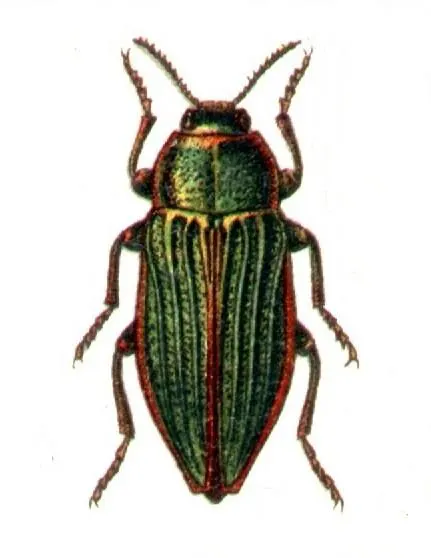
It's a large beetle, metallic green with coppery red along the edges and seam of the wing cases. Spanish references describe the wing cases as having four faint ribs, with broad, flat spaces between them that are densely dotted with pits. The sexes look almost alike.
Where it lives
The range is wide on paper but patchy in practice. The 2025 Red List counts it as present in Greece (mainland), Italy, Austria, Romania and Poland. Sweden, Germany, Czechia and Ukraine are marked as places where it has died out since 1500, and it is possibly extinct in Spain, Bosnia and Herzegovina, Albania, Croatia, Hungary and Slovenia. Its status in Russia and Belarus is uncertain.
The Red List puts its area of occupancy at only 88 square kilometres, inside an extent of occurrence of about 1.1 million square kilometres. That gap shows how scattered the surviving sites are. Some Iberian records may in fact refer to a different North American beetle that arrived in packing timber.
Pins are Wikidata “endemic to” fields. Orange dots, when present, are GBIF occurrence tiles — survey bias included.
How it lives
Larvae develop in the wood of conifers, mainly pines but also larch (Larix decidua) and spruce (Picea abies). They use large, sun-exposed trunks that are weakened, dead or nearly dead, and often stripped of bark. Adults fly around the tops of pines, and females lay eggs there or on very dry dead wood.
The grub's early stages and exact life cycle are poorly known, but it's thought to take more than a year. One old account tells of an adult emerging from a school desk, where the larva had spent over 20 years in the timber. The Red List lists temperate and boreal forest as its habitat.
Why it is in trouble
Beetle collectors are a recognised pressure. The Red List lists collecting as an ongoing threat affecting most of the population, and illegal trade is reportedly involved. Logging that removes dead wood, and cleaning of old trunks and stumps from forests, hurt a beetle that needs dying wood to finish its life cycle. Increasing forest fires are another listed threat, and pine forests are especially exposed.
The assessment records continuing declines in extent, area of occupancy and population, and a severely fragmented distribution.
What is being done
It has legal protection as a strictly protected species under Appendix II of the Bern Convention and is on Annexes II and IV of the EU Habitats Directive, which requires special conservation areas to be set up. It occurs in at least one protected area. The Spanish red book argues that the only effective measure is looking after its habitat, including leaving dead wood and old stumps in place.
Sources
Written for this catalog in our own words from the sources below, checked against them on 12 November 2026. Population figures are estimates and carry the year they were made. Status and assessment year: IUCN. 2026. The IUCN Red List of Threatened Species. Version 2026-1. iucnredlist.org.




