Critically Endangered
Buffy-headed marmoset
Callithrix flaviceps
The buffy-headed marmoset (Callithrix flaviceps) is a small monkey of the Atlantic Forest in south-eastern Brazil, with the smallest range of any marmoset. The IUCN Red List rated it Critically Endangered in 2021, estimating fewer than 2,500 mature animals and a continuing decline.
How to recognise it
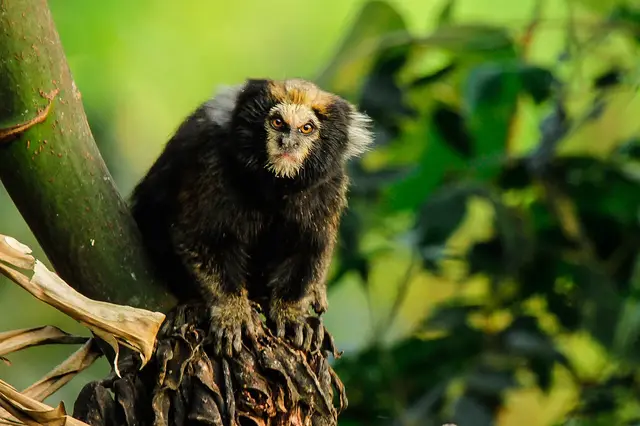
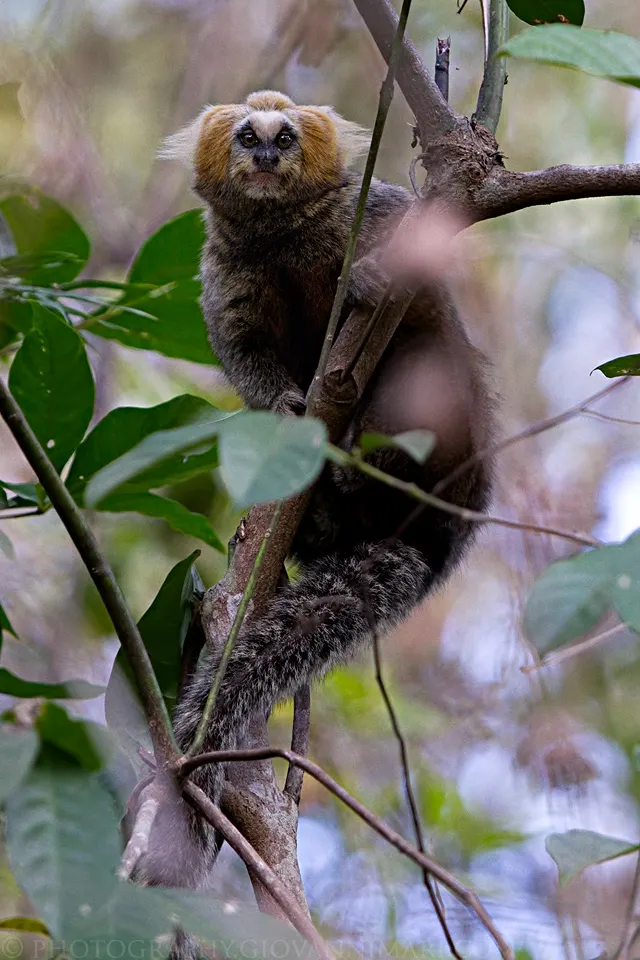
It's a kitten-sized monkey with a pale, buff-coloured head, smudged-looking black markings around the eyes and hair that sticks out at the sides like an uncombed mop. A conservationist who works with the species has called its coat a mocha coffee outfit.
It belongs to the marmoset and tamarin family (Callitrichidae). Groups are extended families of 3 to 20 animals, and breeding is concentrated in one dominant female.
Where it lives
The species is found only in Brazil, in the states of Espírito Santo and Minas Gerais, with one 2011 specimen from the far north of Rio de Janeiro state that has yet to be followed up. Its range covers roughly 28,500 square km, and it lives in moist montane and lowland Atlantic Forest at altitudes up to about 1,200 m. It tolerates some disturbed forest and is rare in old growth with a sparse understorey.
Only about 11 to 16 percent of the Atlantic Forest is left, and what remains is split into scattered patches.
Pins are Wikidata “endemic to” fields. Orange dots, when present, are GBIF occurrence tiles — survey bias included.
How it lives
Its diet is unusual for a marmoset. It eats fruit, flowers and plant exudates such as gum, and hunts insects and tree frogs, and takes bird eggs and nestlings. It also relies heavily on fungi, which are often found at the base of bamboo. An enlarged cecum, a gut chamber, helps it digest fibrous food.
Predators include ocelots, hawks, toucans and green anacondas. Groups yelp loudly together at large predators such as the tayra, a weasel relative.
Why it is in trouble
Forest loss and fragmentation come first. The IUCN lists farming, ranching, tree plantations, housing and mining among the pressures, notes that animals are captured for the local pet trade, and records a continuing decline in the area the species occupies.
Two newer threats make it worse. Common marmosets (Callithrix jacchus) and black-tufted-ear marmosets (Callithrix penicillata), originally pets, have been released into forests where the buffy-headed marmoset lives, and they can breed with it. Surveys in Minas Gerais suggest the introduced marmosets are displacing it.
Yellow fever, which reached the region in late 2016, also hit hard. At one private 1,000-hectare reserve, about 200 marmosets lived there before the outbreak and the owner saw none afterwards. A 2019 survey study by Possamai and colleagues documented a 90 percent population decline there since 2005, largely attributed to yellow fever.
What is being done
The species lives in several protected areas, including Caparaó National Park, and is listed in Appendix I of CITES, which controls international trade. Education programmes have also run in its range.
The Mountain Marmosets Conservation Program, working with Brazilian government partners and funded largely by European zoos, is mapping forests that could serve as safe havens kept free of hybrid animals. A 2022 grant of US$7,000 backs work around the town of Caparaó to reduce invasive marmosets inside protected areas, discourage releases and feeding of wild marmosets, and assess numbers after the yellow fever outbreak. As of 2021 no captive breeding programme held the species, though specialists say one is needed.
Sources
Written for this catalog in our own words from the sources below, checked against them on 12 November 2026. Population figures are estimates and carry the year they were made. Status and assessment year: IUCN. 2026. The IUCN Red List of Threatened Species. Version 2026-1. iucnredlist.org.