Endangered
Buff-rumped Woodpecker
Meiglyptes tristis
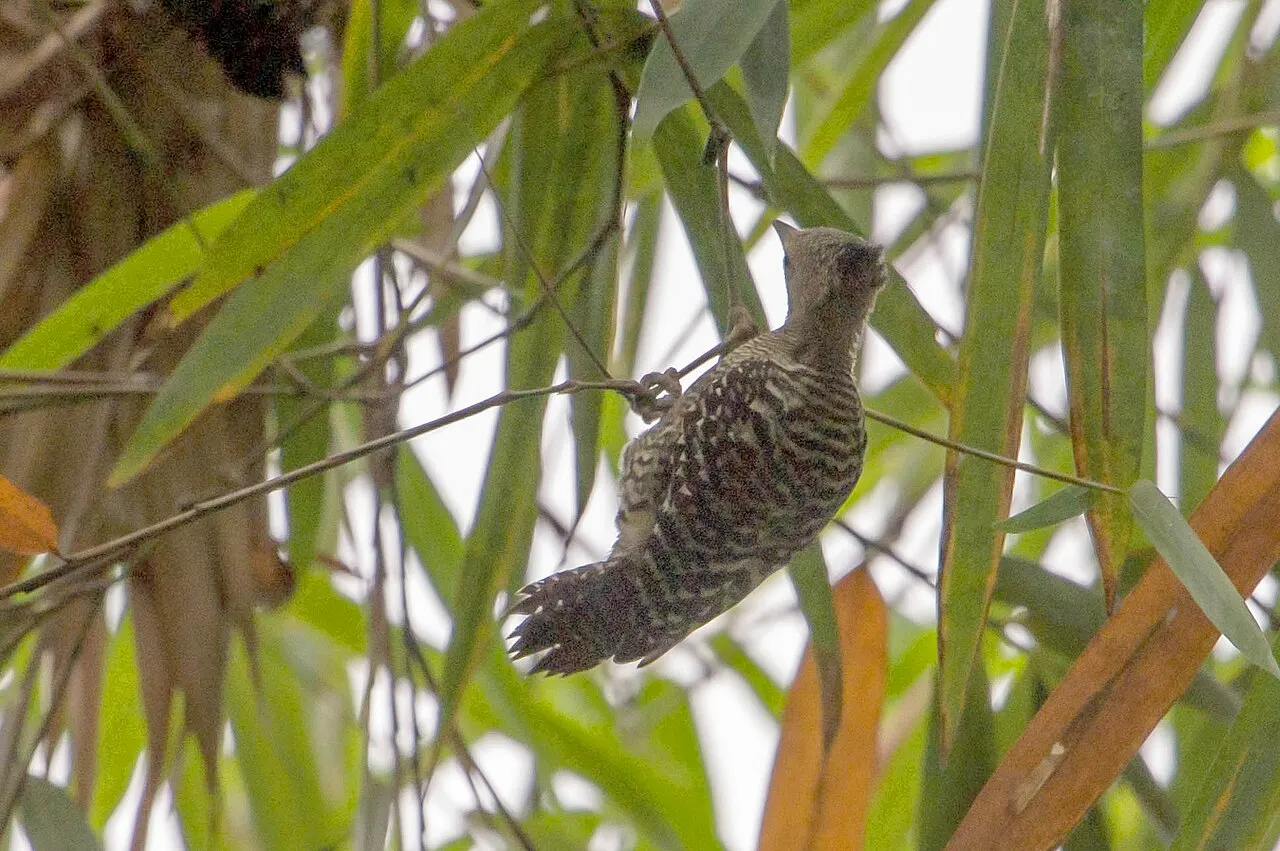
The zebra woodpecker (Meiglyptes tristis), also called the white-rumped woodpecker, is a small, barred woodpecker found only on Java, Indonesia. The IUCN Red List assessed it as Endangered in 2025, with a population of 250 to 1,000 that is still falling. It tolerates some disturbed habitat, but not well enough to be safe.
What it is
Thomas Horsfield described this woodpecker in 1821 as Picus tristis, from a specimen collected on Java. The species name is Latin for "sad" or "gloomy". William Swainson set up the genus Meiglyptes in 1837, and the bird sits there with no recognised subspecies.
It used to be lumped with the buff-rumped woodpecker (Meiglyptes grammithorax), the two being treated as races of one species. That bird lives in southern Myanmar, Thailand, the Malay Peninsula, Sumatra and Borneo. Older books and websites still blend the two, so figures labelled "buff-rumped woodpecker" often describe mainland birds, not the Javan one. The Red List now treats them separately.
How to recognise it
It is a small woodpecker, about 17 to 18 cm long according to one European bird reference and barred in pattern, as the zebra name suggests. That reference may partly reflect the older, wider species concept, so the figure is approximate.
Where it lives
The Red List records it from Indonesia only, and the original specimen came from Java. It does not migrate. The assessment gives its extent of occurrence as roughly 32,000 to 177,000 square kilometres, and lists 4 to 10 subpopulations, the largest holding an estimated 50 to 200 birds.
The Red List habitat entries are tropical dry forest, moist lowland forest, dry scrub, plantations and rural gardens. Other accounts mention coconut, rubber and Albizia plantations, mangroves and villages next to secondary forest. Whether it also lives in primary forest is disputed.
Pins are Wikidata “endemic to” fields. Orange dots, when present, are GBIF occurrence tiles — survey bias included.
Why it is in trouble
The 2025 assessment estimates 250 to 1,000 birds and says the number is decreasing. It qualifies as Endangered under criterion C2a(i), a rating for small populations that keep declining. Earlier assessments in 2014 and 2016 also rated it Endangered, so this is not a recent slide.
The listed pressures are habitat conversion for housing and for commercial and industrial development, which were in the past, and ongoing small-holder farming and agro-industry plantations. The assessment also lists the unintended effects of harvesting, such as accidental capture. Whether the bird is deliberately targeted is unknown.
What is being done
The assessment records that the bird occurs in at least one protected area, and that conservation sites have been identified across its whole range. No recovery plan exists, there is no systematic monitoring scheme, no captive population, and no international trade controls or awareness programmes are in place.
Sources
Written for this catalog in our own words from the sources below, checked against them on 12 November 2026. Population figures are estimates and carry the year they were made. Status and assessment year: IUCN. 2026. The IUCN Red List of Threatened Species. Version 2026-1. iucnredlist.org.




