Endangered
Brown-capped Rosy Finch
Leucosticte australis
The brown-capped rosy finch (Leucosticte australis) is a medium-sized, pink-washed finch of the southern Rocky Mountains that nests in cliff cavities near alpine snowfields. The IUCN Red List lists it as Endangered (2018 assessment), mainly because climate change threatens its high-mountain habitat, even though recent Colorado surveys found plenty of birds.
How to recognise it
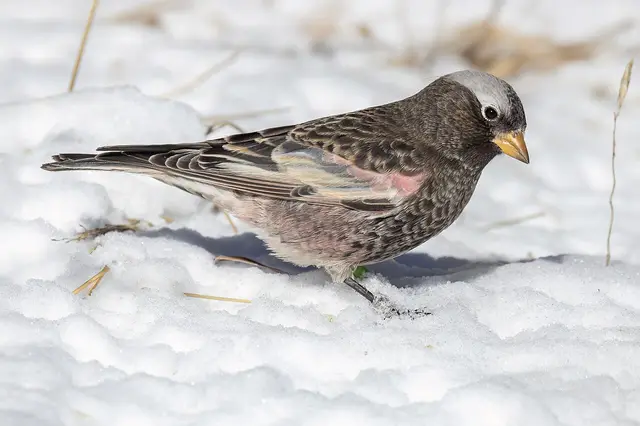
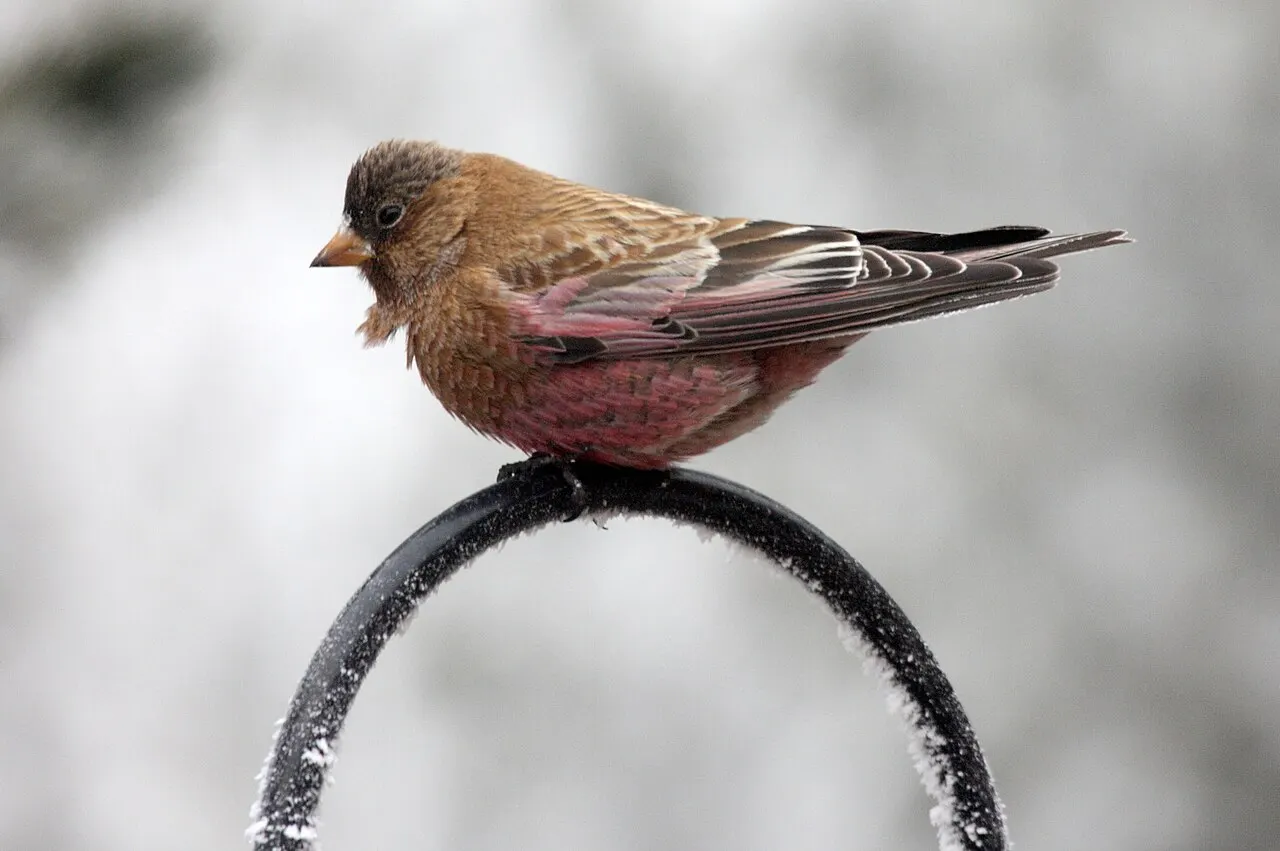
It's a medium-sized finch, about 14 to 16 cm long, weighing roughly 26 to 37 g. The head, back and breast are brown, with pink on the belly, rump, wings and tail that is brighter in males. The forehead is black or grayish brown, and the bill turns from black in summer to yellow in winter.
The legs are short and black, and the tail is long and forked.
Where it lives
This species breeds only in the United States, on the high peaks of the Rockies from Wyoming south to New Mexico. The IUCN gives its elevation range as 3,000 to 4,300 m. In Colorado, surveys found it most often between about 11,500 and 13,200 feet.
In winter it moves downhill, farther in snowy years, and doesn't seem to travel south of its breeding range. Flocks then turn up at feeders in mountain towns, and all three rosy finch species winter at Sandia Crest in New Mexico.
Pins are Wikidata “endemic to” fields. Orange dots, when present, are GBIF occurrence tiles — survey bias included.
How it lives
Seeds of grasses and weeds make up nearly the whole winter diet. In summer the birds eat many insects too, and the young are fed mostly insects. They forage mostly on the ground or snow and sometimes snatch insects in flight.
Nests are bulky cups of moss, grass and rootlets tucked into cliff crevices, under rocks, in mine shafts or in old buildings. The female lays 3 to 5 white eggs and incubates them for about 12 to 14 days, and the young leave the nest about 18 days after hatching. There is one brood a year.
Why it is in trouble
The Red List assessment names habitat shifting and alteration, meaning climate change, as the threat and lists the population trend as decreasing. A 2019 National Audubon report projected that at about 2 degrees C of warming the species would lose 99 percent of its currently suitable habitat.
The numbers are less bleak than the category suggests. The IUCN used a population figure of 45,000 birds. A Colorado Parks and Wildlife survey of 57 randomly chosen mountain basins, funded from 2018 and reported in 2023, estimated 115,000 to 150,000 birds in Colorado alone, more than three times a 2016 Partners in Flight figure. A genetic study of 11 breeding sites found no sign of inbreeding or worrying loss of diversity.
What is being done
At the time of the assessment the IUCN recorded no recovery plan and no systematic monitoring scheme. Since then, Colorado Parks and Wildlife has said it plans to repeat its survey periodically, and the Rosy-Finch Working Group, formalized in 2021, is developing standard survey methods. Volunteers in 11 states send winter feeder counts to the Rosy-Finch Conservation Project. Colorado also named the bird a tier one species in its Wildlife Action Plan in 2015.
Sources
Written for this catalog in our own words from the sources below, checked against them on 12 November 2026. Population figures are estimates and carry the year they were made. Status and assessment year: IUCN. 2026. The IUCN Red List of Threatened Species. Version 2026-1. iucnredlist.org.