Endangered
Brazilian blind characid
Stygichthys typhlops
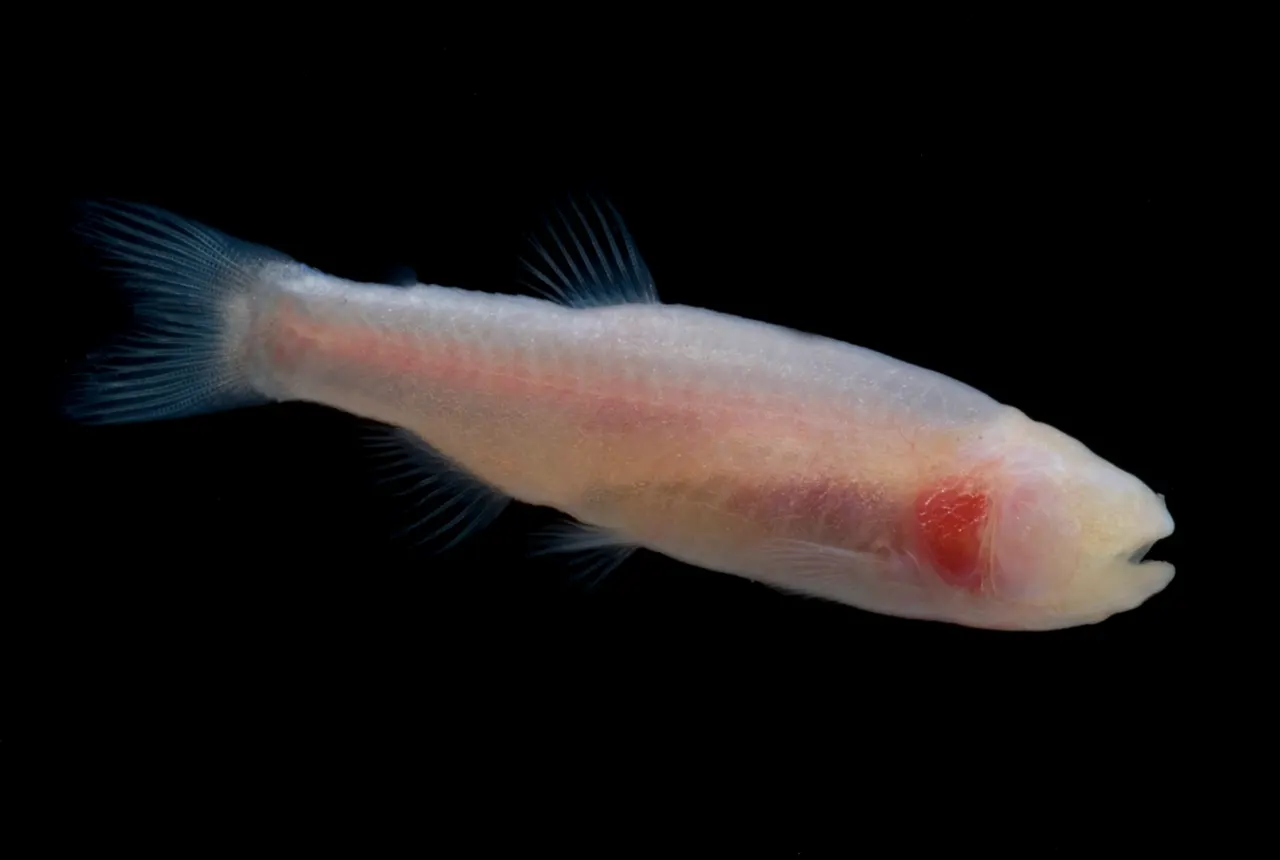
The Brazilian blind characid (Stygichthys typhlops) is a tiny, eyeless, colourless fish that lives in groundwater near Jaíba in northern Minas Gerais, Brazil. The IUCN Red List assessed it as Endangered in 2022. It is the only member of its genus, and falling water tables are its main threat.
How to recognise it
This is a small, pale fish with no working eyes and no skin pigment, the usual look of an animal that has lived in the dark for a very long time. Adults reach about 4.6 cm in standard length. Measured specimens in museum collections run from roughly 23 mm to 46 mm.
One feature sets it apart from other characins. Its anal fin is very short, with only eight rays, which is unusual for the family. It is the only species in its genus, Stygichthys, and its closest relatives are still debated. A 2018 study placed it in a tribe called Grundulini.
Where it lives
It is endemic to Brazil and known only from the Jaíba region of northern Minas Gerais, in the Verde Grande part of the São Francisco river basin. Despite the common description of it as a cave fish, it lives in the water table. The first specimen came up in water drawn from a well about 30 m deep during drilling, and later fish were found in hand-dug farm wells.
The IUCN treats the whole aquifer as a single location and estimates the area the fish occupies at just 12 square kilometres. Other estimates put it near 15 square kilometres, based on a stream length of about 15 km. The IUCN habitat category is karst and other subterranean water systems.
Pins are Wikidata “endemic to” fields. Orange dots, when present, are GBIF occurrence tiles — survey bias included.
A fish found twice
Only one specimen was known for decades. It was collected in 1962 and described in 1965 by Brittan and Böhlke as a new genus and species. Nobody recorded another until 2004, when a team led by Cristiano Moreira of the University of São Paulo collected 34 fish from two shallow, hand-dug wells about 13 km southwest of Jaíba.
Their 2010 paper in the Journal of Fish Biology gave the first life-history information on the species. The fish is reportedly solitary: individuals kept together in aquariums show no interest in one another.
Why it is in trouble
Large-scale farming around Jaíba, banana among the crops, draws heavily on groundwater. Residents reportedly say the fish was fairly common until the early 1990s. After that, heavy pumping lowered the water table and many wells and springs dried up.
The 2022 assessment lists pumping of groundwater for farming and household use, plus herbicides and pesticides, as ongoing threats, each rated low impact. It records a continuing decline in the occupied area and a decreasing population trend. Because the fish depends on a single aquifer, one problem can affect the entire species.
What is being done
Brazil reportedly listed the species as endangered in a 2014 ministry decree. The IUCN recommends protecting the habitat, with national-level action to control groundwater pumping so recharge can match what is taken out. It also calls for a hydrological study to work out how much water can safely be removed, a check for farm chemical contamination, and research on the fish's behaviour, ecology and distribution, with monitoring of subpopulations. No conservation actions were recorded as already in place.
Sources
Written for this catalog in our own words from the sources below, checked against them on 12 November 2026. Population figures are estimates and carry the year they were made. Status and assessment year: IUCN. 2026. The IUCN Red List of Threatened Species. Version 2026-1. iucnredlist.org.




