Endangered
Brahminy river turtle
Hardella thurjii
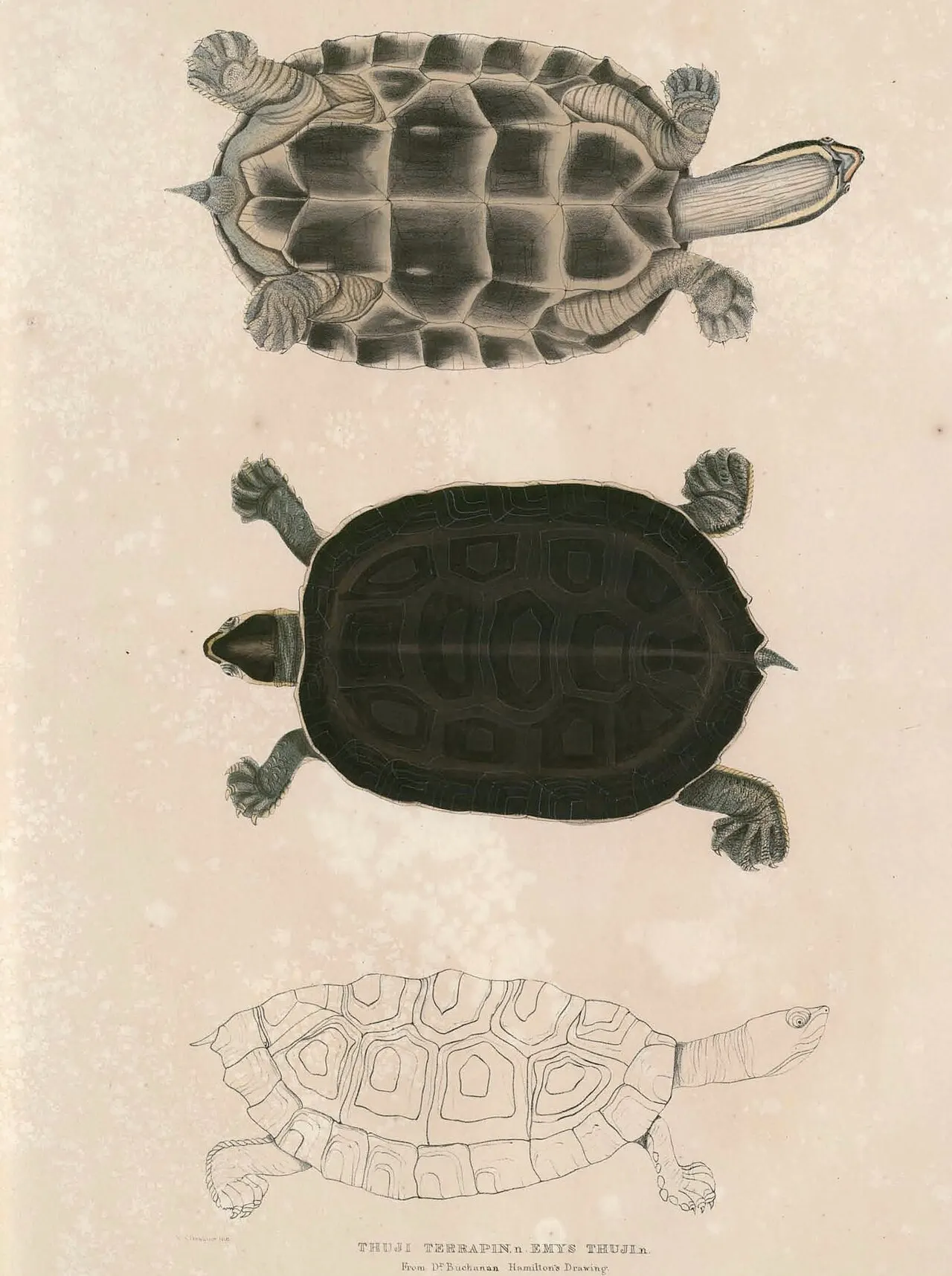
The Brahminy river turtle (Hardella thurjii), also called the crowned river turtle, is a large freshwater turtle of the Indus, Ganges and Brahmaputra basins in Pakistan, India and Bangladesh. The IUCN Red List classed it as Endangered in 2021. Females grow far larger than males and lay eggs that spend time underwater.
How to recognise it
The shell is large and moderately flat, dark brown or black above, with a yellow or black underside. The lower jaw is strongly notched. The sexes differ a lot in size. Females are roughly three times the size of males, and published maximum lengths for females vary between sources, from about 46 cm to 65 cm of carapace.
Hatchlings measure 41 to 46 mm.
Where it lives
The species is native to South Asia and lives across the watersheds of the Indus, Ganges and Brahmaputra. It is found in Pakistan, India and Bangladesh, and the Red List lists Nepal as a place where it possibly still occurs. The Reptile Database also counts Nepal in the range. It is the only member of its genus.
It prefers still or slow water such as ponds, oxbow lakes, marshes, canals and slow river stretches. The Red List gives an elevation range of 10 to 600 m.
Pins are Wikidata “endemic to” fields. Orange dots, when present, are GBIF occurrence tiles — survey bias included.
How it lives
Most of its diet is plant material, including grasses, sedges, algae and water hyacinth. It also takes small animals such as prawns and fish now and then, and one source also lists insects and snails.
Its nesting habits are unusual. Females lay eggs in autumn that sit underwater for 40 to 45 days. Water levels drop in winter and leave the eggs exposed for about five months, then rising spring water covers the nearly ripe eggs again and the young hatch in the river. The Indian zoologist Dhruvajyoti Basu documented this in 2011. Clutch sizes are reported as 8 to 19 eggs in one study and 4 to 7 in another.
Why it is in trouble
The 2021 Red List assessment (criteria A2bcd+4bcd) records a decreasing population, with a past decline put at 50 to 75 percent and a similar drop expected to continue. Listed threats include harvest at both large and small scale, large dams, renewable energy projects, commercial and industrial development, and herbicides and pesticides. Other sources add harmful fishing methods, sand and stone extraction, pollution, hunting for meat and egg collection.
A 2025 modelling study in Ecology and Evolution estimated that only about 10 percent of the species' range, roughly 110,000 square km, has suitable habitat today. Suitable habitat on a model does not prove turtles are there.
What is being done
The species is in CITES Appendix II and, in India, in Schedule I of the Wildlife Protection Act. The Red List records that it occurs in at least one protected area and is subject to international trade controls, and notes there is no recovery plan or harvest management plan. Captive breeding is among the actions it lists as needed. The Prague Zoo hatched the first captive-born turtle in 2012. The 2025 study recommends protecting riverbank zones, regulating harmful fishing methods and running community education to reduce hunting and egg collection.
Sources
Written for this catalog in our own words from the sources below, checked against them on 12 November 2026. Population figures are estimates and carry the year they were made. Status and assessment year: IUCN. 2026. The IUCN Red List of Threatened Species. Version 2026-1. iucnredlist.org.




