Endangered
Bottlenose skate
Rostroraja alba
The bottlenose skate (Rostroraja alba), also called the white or spearnose skate, is a big, slow-growing seabed ray of the eastern Atlantic and Mediterranean. Fishing has depleted or wiped it out across much of its range. The IUCN's 2024 global assessment rates it Endangered, with the population decreasing.
How to recognise it
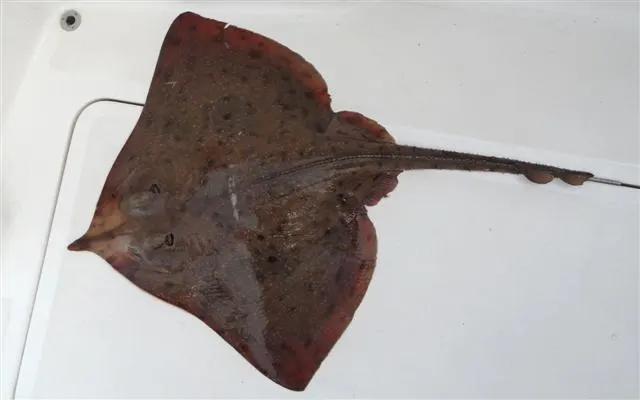
Most adults measure 60 to 150 cm, and the largest recorded were about 2 m in the Mediterranean and up to 2.4 m off South Africa. The snout is drawn out into a sharp, thorny point, which explains the common names. The wing-like pectoral fins are about 1.4 to 1.5 times as wide as they are long.
Young skates carry only a few thorns, and adults have more along the tail. Large juveniles and adults are grey or bluish above, often with small white spots, and white underneath with dark disc edges. Hatchlings are reddish brown, sometimes with blue spots.
Where it lives
The range runs down the eastern Atlantic from the western and southern coasts of the British Isles to South Africa, round into the southwestern Indian Ocean as far as Madagascar and the Seychelles, and through the Mediterranean. The IUCN lists about 50 countries and territories, from Ireland and France through West Africa to Namibia and South Africa. It treats records from Indian waters as questionable.
It lives on sandy, muddy and in places rocky seabeds on the continental shelf and upper slope. Depth records differ by source: the IUCN gives 10 to 750 m, while others describe it mainly at 40 to 400 m. Younger fish tend to stay shallower.
Pins are Wikidata “endemic to” fields. Orange dots, when present, are GBIF occurrence tiles — survey bias included.
How it lives
It is a bottom hunter that eats bony fish, other rays and sharks, crabs, shrimps, octopus and cuttlefish. Like other skates it lays eggs, in horned oblong cases set down on sandy or muddy ground in spring. The IUCN gives litters of 55 to 158 egg cases and an incubation of about 15 months.
It grows and breeds slowly. A study of fish landed in Tunisia's Gulf of Gabès in 2007 found females up to 35 years old and males up to 32. Half of males were mature at about 119 cm and around 20 years, and half of females at about 129 cm and around 23 years. The IUCN puts a generation at 30 years. A long life, late maturity and a big body are a poor mix against trawl nets.
Why it is in trouble
Fishing is the cause. The IUCN names targeted harvest and accidental catch in large-scale fisheries, mostly trawls but also gillnets and set nets, plus coastal development. French diners prized the skate in the 17th century. Targeted fisheries in the English Channel and off Brittany ended after local depletion, and populations in the Bay of Biscay and Irish Sea reportedly collapsed around the 1960s.
The IUCN rates it Critically Endangered in the Northeast Atlantic, with an inferred decline of more than 80% over 90 years, and Endangered in the Mediterranean. There it is now absent or rarely caught except around the Balearic Islands, where it shows signs of recovery after protection. It is described as fairly common off southwest Ireland, though the IUCN notes only two locations with confirmed reports from 2005 to 2014.
Globally the decline is suspected at 50 to 79% over three generations (90 years). The earlier global assessment, in 2006, was also Endangered.
What is being done
Under EU and UK fishing rules in place since 2009, now set by Regulation (EU) 2019/1241, vessels may not fish for, keep, land or sell white skate in ICES areas 6 to 10 (broadly, Atlantic waters from Scotland and Ireland south to the Azores). Accidental catches must be released unharmed. It is also protected in UK territorial waters and has been in Spanish Mediterranean waters since 2015.
The IUCN lists harvest and trade management, species recovery, site protection and national measures among the actions. It adds that compliance in the Mediterranean is uncertain, and that survival of released skates is unknown.
Sources
Written for this catalog in our own words from the sources below, checked against them on 12 November 2026. Population figures are estimates and carry the year they were made. Status and assessment year: IUCN. 2026. The IUCN Red List of Threatened Species. Version 2026-1. iucnredlist.org.




