Endangered
Bothriechis thalassinus
Bothriechis thalassinus
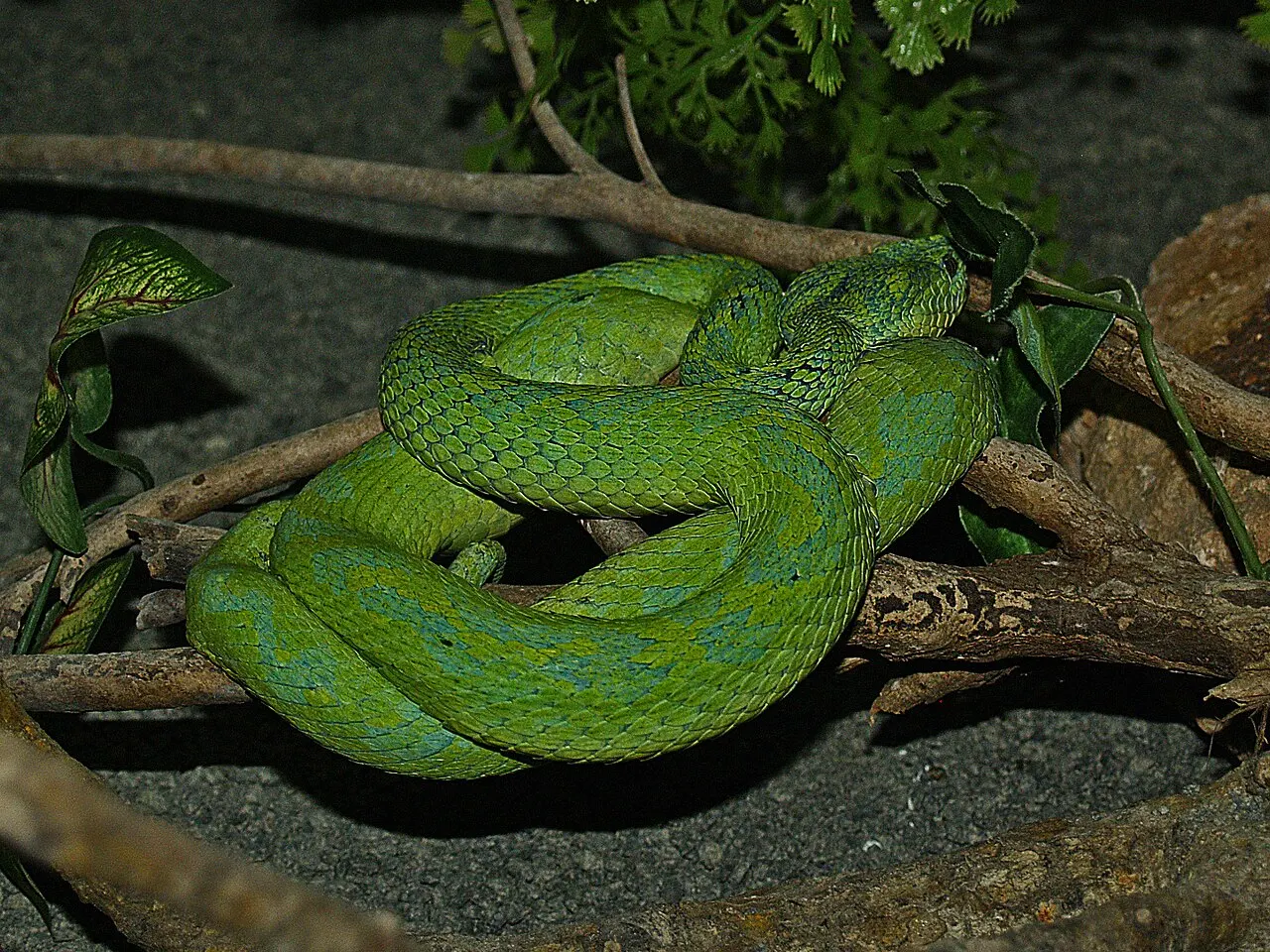
The Merendon palm pitviper (Bothriechis thalassinus) is a slender, blue-green tree snake from the cloud forests of eastern Guatemala and western Honduras. The IUCN Red List assessed it as Endangered in 2022, with a decreasing population. Its small range and its habit of living in trees make it hard to study.
How to recognise it
This is a medium-sized, slim-bodied pitviper with a strong prehensile tail. Adults are mostly 60 to 80 cm long, and the largest recorded reached 97 cm. The back is green, shading to yellow-green on the flanks, sometimes with turquoise to black blotches or speckling. The belly is cream or pale green, and the head has two black stripes. Its scientific name comes from a Greek word for blue-green.
Campbell and Smith described it as new to science in 2000, from the Sierra de Caral in Guatemala (type locality about 900 m up).
Where it lives
The snake occurs in eastern Guatemala, including the Sierra de Caral and reportedly the Sierra del Merendon, and in western Honduras. The IUCN gives its elevation range as 885 to 1,730 m, and the only habitat listed is moist montane forest. The Reptile Database and the World Land Trust quote a narrower band of about 1,370 to 1,750 m. National Geographic describes one found in the leaves of a bromeliad on a tree trunk.
Pins are Wikidata “endemic to” fields. Orange dots, when present, are GBIF occurrence tiles — survey bias included.
How it lives
It is arboreal and mostly active at night. Frogs and lizards make up most of its diet, with the occasional small mammal or bird. Females give birth to live young, and litters are probably under 10 to 12 snakes. It is not known to be aggressive, though like other pitvipers it can strike fast if surprised. The venom is poorly studied and appears to act mainly on blood and tissue. Few bites on people have been reported, and none are confirmed fatal.
Many basic questions, such as how many survive and how far individuals range, are still unanswered.
Why it is in trouble
The 2022 assessment, under criterion B1ab(iii,v), records a continuing decline in the area it occupies and a population that is severely fragmented. Small-holder farming and grazing convert and degrade the forest, and the snakes are also taken directly. National Geographic names coffee plantations and cattle pasture as major causes of cloud forest loss across its range, and the World Land Trust lists the illegal pet trade, timber clearing and the loss of its prey as further threats.
National Geographic reported in June 2026, citing Global Forest Watch, that Honduras lost a quarter of its humid primary forest between 2002 and 2024.
What is being done
The IUCN notes that the species occurs in at least one protected area. In Guatemala, the organisation FUNDAECO, a World Land Trust partner, protects the Sierra Caral area, including the roughly 6,000-acre Sierra Caral Amphibian Reserve. In Honduras, a group called HonduHerp, founded in 2023, has conserved about 300 acres across two reserves, including the Tierra del Tamagas Reserve, and co-manages protected areas with the national forest agency. It has also set up several breeding pairs, each from a different mountain, at the Rosy Walther Zoo in Tegucigalpa.
Sources
Written for this catalog in our own words from the sources below, checked against them on 12 November 2026. Population figures are estimates and carry the year they were made. Status and assessment year: IUCN. 2026. The IUCN Red List of Threatened Species. Version 2026-1. iucnredlist.org.




