Endangered
Blue swallow
Hirundo atrocaerulea
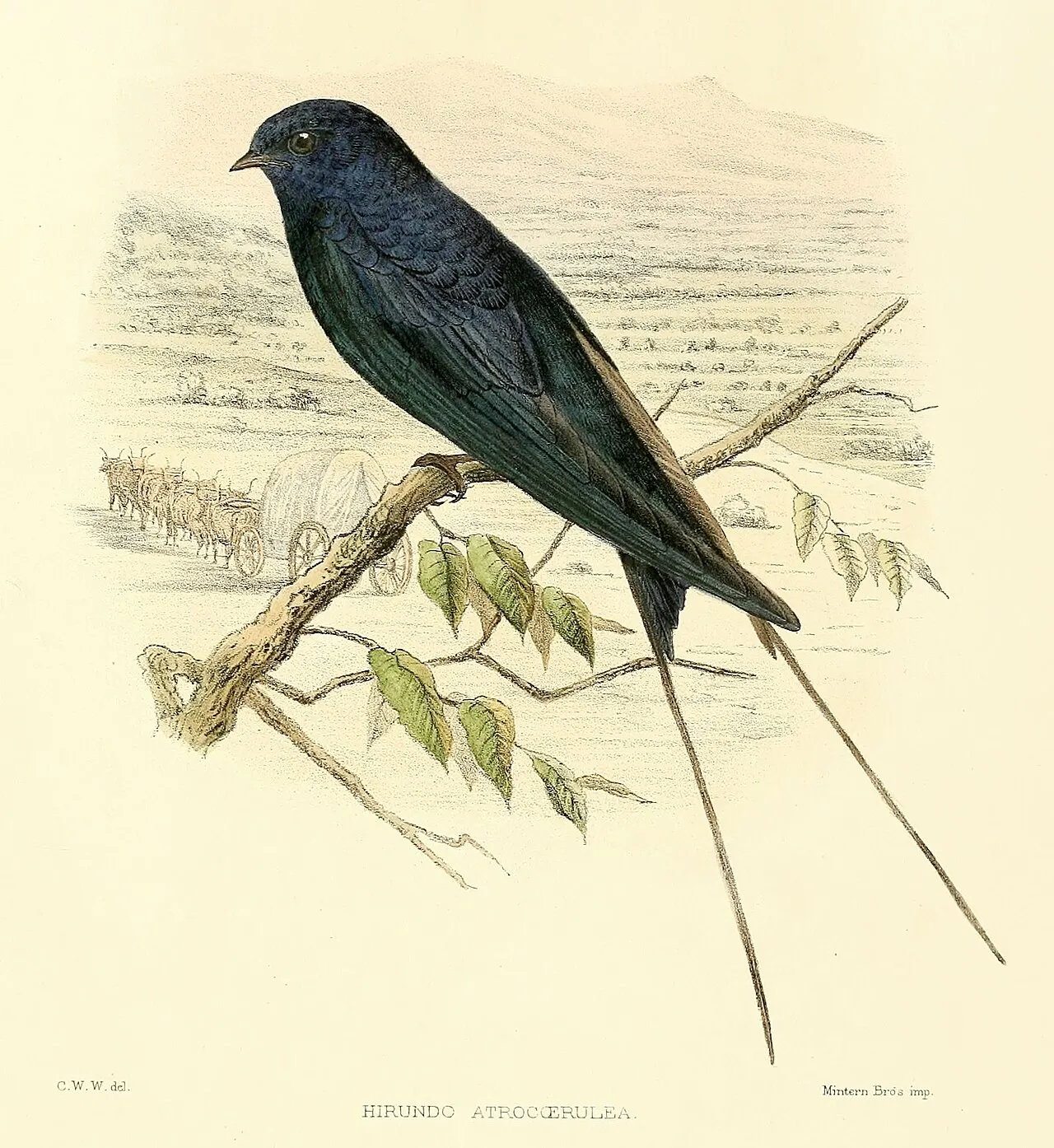
The blue swallow (Hirundo atrocaerulea) is a glossy steel-blue swallow that breeds in highland grassland from South Africa to Tanzania and spends the southern winter further north. It is listed as Endangered on the IUCN Red List (2024 assessment), with an estimated 1,500 to 3,000 birds and a falling trend.
How to recognise it
A blue swallow measures about 18 to 25 cm including its long outer tail feathers, which are most striking on males. Females and young birds have shorter tails. Adults look dark and lustrous, deep metallic blue in sunlight. In poor light they can seem almost black and be mistaken for the black sawwing, which is matt black with a shorter, less deeply forked tail.
White feathers on the rump and flanks show during preening and courtship. Young birds start out brownish grey and turn blue as they mature. The contact call is a short chip, and males give a musical bee-bee-bee-bee in display flight.
Where it lives
It breeds in eastern South Africa, western Eswatini, eastern Zimbabwe, Malawi, north-eastern Zambia, south-western Tanzania, western Mozambique and south-eastern DR Congo, at roughly 850 to 3,000 m. About 74 percent of the breeding population is in Zimbabwe, Malawi and southern Tanzania.
In the breeding season it favours high-rainfall, undulating montane grassland, with wetlands, pans and small dams for feeding. Most birds spend the non-breeding season in Uganda and Kenya, with smaller numbers in north-eastern DR Congo and northern Tanzania, mainly in open grassland with bushes and trees. Birds reach the breeding grounds around the end of September and most leave again in April.
Pins are Wikidata “endemic to” fields. Orange dots, when present, are GBIF occurrence tiles — survey bias included.
How it lives
Blue swallows catch small flies and other soft-bodied insects on the wing. The nest is a cup of mud and grass, lined with fine grass, hair and white feathers, built in a cavity: a disused aardvark burrow, a natural sinkhole or an old mine shaft. Pairs return to the same site year after year, in some cases for up to 30 years.
The usual clutch is three white eggs. The female incubates for about 14 days and the chicks are fed for around 22 days. Most pairs raise a second brood. A study in Eswatini (then Swaziland) by Monadjem and colleagues found a mean clutch of 2.8 eggs, with about 61 percent of eggs producing fledglings.
Why it is in trouble
Habitat loss is the main driver. Grassland is lost to timber plantations, cultivation (especially sugarcane), settlement, heavy grazing and burning, and invading trees and bracken. The Eswatini study named exotic timber plantations as the main cause there. At five study sites in KwaZulu-Natal, 55 percent of suitable grassland was transformed between 1980 and 2000, and the number of active nests halved.
South Africa and Eswatini together now hold perhaps 35 to 50 pairs (a 2015 figure), and their range there has contracted by about 74 percent. Only 19 active nests were found in KwaZulu-Natal in 2019 and 2020, down from 45 in 2003 and 2004. Breeding has stopped at several former sites. Global estimates have varied: about 1,000 breeding pairs in older reports, and 1,500 to 3,000 birds in the 2024 assessment.
What is being done
An international working group has existed since 1986, an international action plan was published after a 2002 workshop, and the species is listed on the Convention on Migratory Species. The group has helped block plantations and mining in key areas. Artificial nest cavities have been dug in Mpumalanga and KwaZulu-Natal, and some are in use.
BirdLife South Africa runs a long-term monitoring programme in the KwaZulu-Natal Midlands and works with private and communal landowners to declare breeding sites nature reserves or protected environments.
Sources
Written for this catalog in our own words from the sources below, checked against them on 12 November 2026. Population figures are estimates and carry the year they were made. Status and assessment year: IUCN. 2026. The IUCN Red List of Threatened Species. Version 2026-1. iucnredlist.org.




