Endangered
Blue-bearded Helmetcrest
Oxypogon cyanolaemus
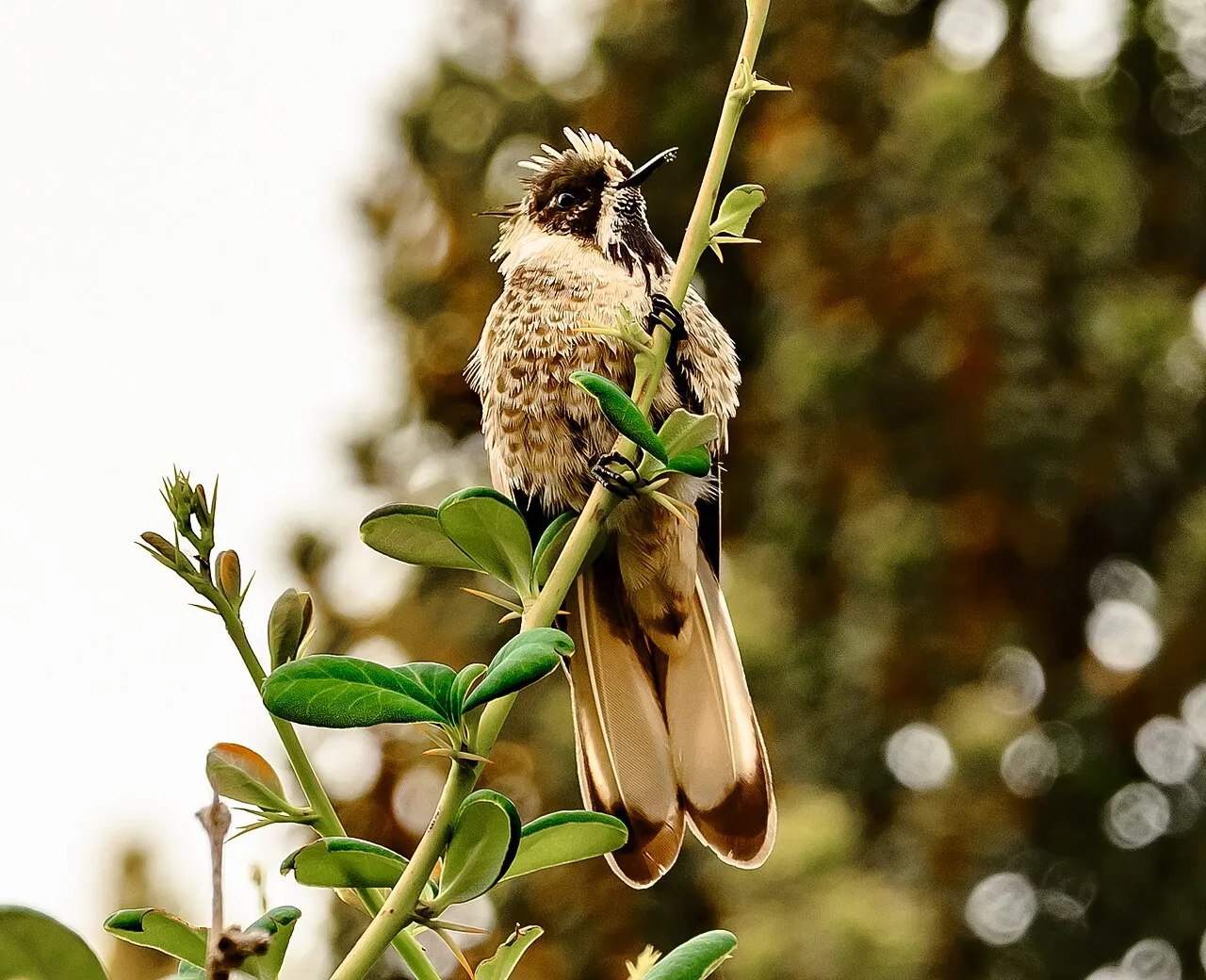
The blue-bearded helmetcrest (Oxypogon cyanolaemus) is a crested hummingbird that lives only in the high grasslands of Colombia's Sierra Nevada de Santa Marta. Unseen for almost 70 years, it was found again in 2015. The 2023 Red List assessment rates it Endangered.
How to recognise it
It's a medium-sized hummingbird, about 11.5 cm long, with a short, straight bill. The male carries a long black-and-white crest and a dusky face. His throat has a thin white beard with a purplish-blue stripe down the middle.
Females are duller, with no crest or beard and a white throat. For decades this bird was treated as a form of the bearded helmetcrest. A 2013 study of measurements and plumage split that bird into four species, and this became one of them.
Where it lives
It's found nowhere except the Sierra Nevada de Santa Marta, an isolated mountain range in northern Colombia that rises from the Caribbean coast. It lives in páramo, the open high-altitude grassland above the treeline, between about 3,000 and 4,800 m.
The 2023 assessment puts its extent of occurrence at around 1,800 square kilometres, in two to five locations, with all birds counted as one subpopulation.
Pins are Wikidata “endemic to” fields. Orange dots, when present, are GBIF occurrence tiles — survey bias included.
How it lives
Very little is known. Birds have been seen taking nectar from several flowering herbs and shrubs, hovering at some flowers and clinging to others. A páramo plant called frailejón, Libanothamnus occultus, appears to be its main food source. Its breeding season and any seasonal movements are poorly documented, and only a few sound recordings exist.
Lost and found
The species was described in 1880. Sixty-two museum specimens exist, the last collected in 1946. Surveys in 1999 to 2003, 2007 and 2011 all failed to find it, and in 2014 it was listed as Critically Endangered (Possibly Extinct).
On 4 March 2015, Carlos Julio Rojas and Christian Vasquez of Fundación ProAves saw and photographed it while surveying fires high on the mountain. They found three birds in three small, scattered patches on steep hillsides, within less than 10 hectares.
Why it is in trouble
Its páramo keeps being burned and grazed. Fires are set to make cattle pasture, even though the range lies within Sierra Nevada de Santa Marta National Park, and frailejón is collected for firewood, which removes the bird's main food plant. The Red List also names small-holder farming among the threats and records a continuing decline in habitat.
Nobody knows how many are left. The Red List gives 250 to 999 mature individuals as a rough figure, but BirdLife's 2023 review noted that no true population estimate exists. Daniel Lebbin of American Bird Conservancy, commenting on that review, put it at 13 to 22 birds from clusters of eBird reports at three places, and called the higher figure very likely an over-estimate. The 2016 Colombian Red Book allowed for a few hundred under optimistic assumptions.
The category has also changed. It was Critically Endangered in the 2014 to 2018 assessments, and Endangered in 2023, a revision the Red List team coded as a correction rather than a real improvement. Lebbin argued against the lower rating.
What is being done
All of its known range lies in conservation sites, and the Red List says 91 to 100 percent of the population is inside protected areas. There's an area-based regional management plan, but no recovery plan and no systematic monitoring. Awareness work, alternative livelihoods and habitat restoration are listed as actions, none yet reported in place, and the species is covered by CITES Appendix II.
Sources
Written for this catalog in our own words from the sources below, checked against them on 12 November 2026. Population figures are estimates and carry the year they were made. Status and assessment year: IUCN. 2026. The IUCN Red List of Threatened Species. Version 2026-1. iucnredlist.org.




