Critically Endangered
Blomberg's toad
Rhaebo blombergi
Blomberg's toad (Rhaebo blombergi), also called the Colombian giant toad, is one of the largest toads in the world, living in the rainforests of western Colombia and northwestern Ecuador. The IUCN Red List moved it to Critically Endangered in 2023, with a decreasing population.
How to recognise it
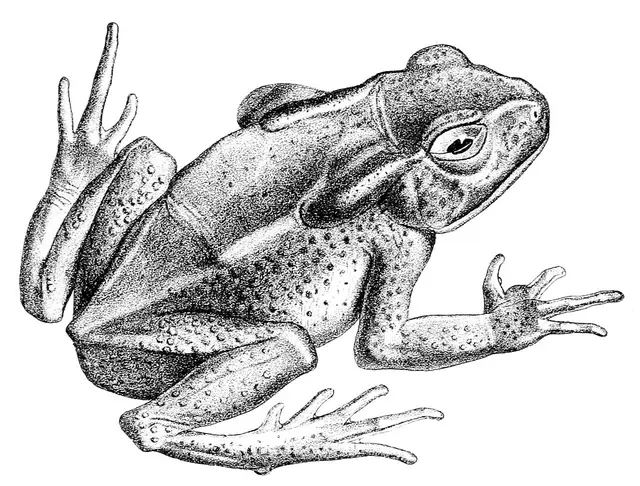
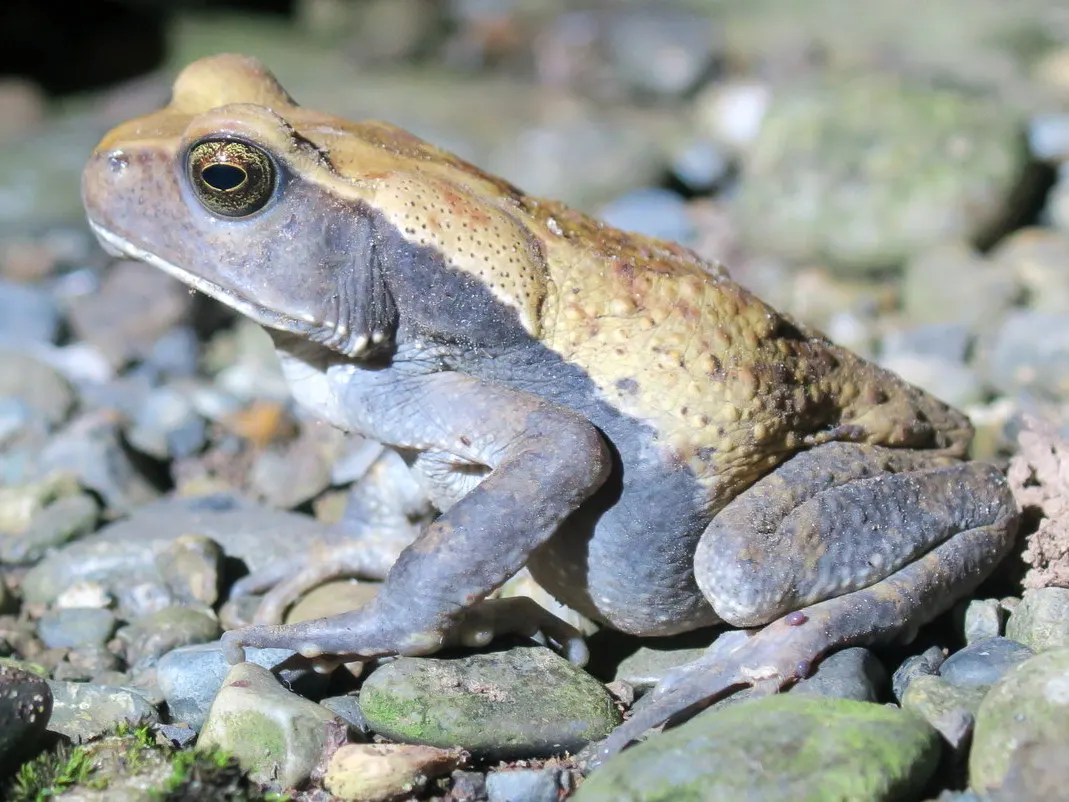
It is huge and broad-headed. Adults are reported to reach roughly 15 to 25 cm from snout to vent. The first specimen collected, in 1950, measured 207 mm and weighed a kilogram. Local people told its collector that larger ones existed, and the largest of three live toads obtained the following year measured 23 cm.
In the original description the back and upper sides were a dirty yellowish-gray, the lower sides and parotoid glands (the big poison glands behind the eyes) a dark dull brown, and the limbs dusky with darker warts. The head is very broad and flat, the eardrum small, and the belly skin rough and warty. The toes are broadly webbed.
Where it lives
The species lives on the western flank of the western Andes. In Colombia it is recorded from Nariño, Cauca and Valle del Cauca, and in Ecuador from Esmeraldas, Imbabura and Carchi. The 2023 assessment gives an elevation range of 200 to 1,050 m and an extent of occurrence of about 28,900 square kilometres. It has been recorded in a few protected areas in Colombia, and is presumed to occur in Cotacachi Cayapas Ecological Reserve in Ecuador.
The toad was named in 1951 after Rolf Blomberg, a Swedish explorer based in Quito, who went looking for rumours of a giant toad near Nachao in Nariño and brought back the type specimen, from about 550 m.
Pins are Wikidata “endemic to” fields. Orange dots, when present, are GBIF occurrence tiles — survey bias included.
How it lives
It lives in closed-canopy lowland and foothill rainforest, often along streams, and has been found in natural forest with little human disturbance. It breeds in temporary and permanent pools, sometimes near rivers, and females can produce thousands of eggs a season. In Ecuador it can be locally common where forest remains, but in Colombia it is rare.
At Nachao in 1950, local people said the toads were much more plentiful in the wet season. The area's annual rainfall was thought to exceed 150 inches (about 3,800 mm).
Why it is in trouble
The 2023 assessment (criterion A4acde) suspects a decline of more than 80 percent over the ten years from 2015 to 2025, and the forest area it occupies is still shrinking. The species has also not been recorded in recent surveys across its range.
Listed pressures include small-scale farming and grazing, mining and quarrying, housing, herbicides and pesticides, drought and harvesting. The assessment adds that illegal mining overlaps about a third of its Colombian range, oil palm is expanding in northern Ecuador, and introduced predators such as tilapia are a problem.
The toad is collected from the wild for the pet trade and for pharmacological research, and local communities also eat it. One was reportedly recorded in Florida in 1963, probably an escaped or released pet. No population became established there.
What is being done
Some animals are held in captivity. Zoos have bred it, but only first-generation offspring have been produced. The species is not subject to international trade controls.
The assessment calls for harvest and trade management, regulation of international trade, protection of suitable habitat and restoration of degraded forest, plus more research on its population trends, ecology and distribution.
Sources
Written for this catalog in our own words from the sources below, checked against them on 12 November 2026. Population figures are estimates and carry the year they were made. Status and assessment year: IUCN. 2026. The IUCN Red List of Threatened Species. Version 2026-1. iucnredlist.org.