Endangered
Blackspotted catshark
Halaelurus buergeri
The blackspotted catshark (Halaelurus buergeri), also called the darkspotted catshark, is a slender little shark under 50 cm long that lives on the sea floor of the north-west Pacific, from Japan and Korea to China, Taiwan and the Philippines. The IUCN rated it Endangered in 2020 because of fishing pressure.
How to recognise it
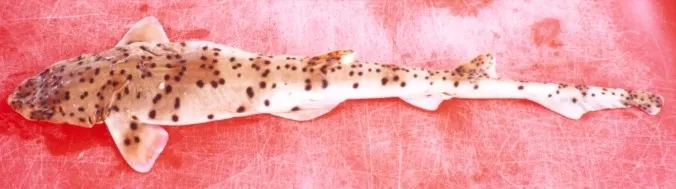
It grows to about 49 cm and reaches maturity at roughly 40 cm. The body is long and slim with a light ground colour, dusky saddles along the back outlined by large black spots, and dark spots across the body and fins. Adult males are mostly 36 to 43 cm, and a pregnant female measured 45 cm. It is harmless to people.
Where it lives
It is a bottom-living shark of the continental shelf in warm-temperate and subtropical water, roughly between 20 and 39 degrees north. The IUCN lists it from Japan, both Koreas, China, Taiwan, the Philippines, Malaysia and Sarawak, with Thailand uncertain. It has been recorded at depths from about 27 to 100 metres, over sand, mud, gravel and kelp.
FishBase notes that it may be a complex of more than one species in the region, which could mean the real ranges are smaller.
Pins are Wikidata “endemic to” fields. Orange dots, when present, are GBIF occurrence tiles — survey bias included.
How it lives
Not much is documented. The diet is presumed to be small bottom invertebrates and perhaps small fish. Divers report that it partly buries its mid-body in soft sediment to avoid predators and holds still when approached, then bolts. It is rarely seen by divers, though it turns up now and then near Ushibuka in Kyushu, Japan.
It is classed as an egg layer, but not in the usual way. Females lay 6 to 12 egg cases, and several cases are held in the body until the embryos are well developed, a strategy partway between egg laying and live birth. FishBase rates its resilience to fishing as low, with a population doubling time of 4.5 to 14 years.
Why it is in trouble
The IUCN lists the population as decreasing and estimates a past reduction of 50 to 79 percent. The threats it records are large-scale and small-scale fisheries catching it accidentally, plus coastal housing and industrial development. It is taken by bottom trawls in the Taiwan Strait and now and then by offshore longlines, and the meat is used but worth little because the sharks are so small.
Trends reportedly differ by place. Catch data from Taiwan suggest numbers have been steady over roughly 15 years, but the shark has declined in Japan, where it was once common. Fishing pressure is described as heavy across its range.
What is being done
Very little aimed at this species. The 2020 assessment records no recovery plan, no monitoring scheme and no conservation sites identified for it, and lists site protection, species recovery, harvest management and trade management as needs. Seasonal fishing bans in Taiwan and China may give some relief.
A first complete mitochondrial genome for the species was published in 2016, which adds to the basic science.
Sources
Written for this catalog in our own words from the sources below, checked against them on 12 November 2026. Population figures are estimates and carry the year they were made. Status and assessment year: IUCN. 2026. The IUCN Red List of Threatened Species. Version 2026-1. iucnredlist.org.
- IUCN Red List assessment, Halaelurus buergeri (2020)
- FishBase summary, Halaelurus buergeri
- Sharks and Rays, Blackspotted Catshark
- Shark References species page, Halaelurus buergeri
- Blackspotted catshark (Wikipedia)
- Complete mitochondrial genome of the blackspotted catshark, Mitochondrial DNA Part B 2016 (Europe PMC record)




