Endangered
Blackside Dace
Chrosomus cumberlandensis
The blackside dace (Chrosomus cumberlandensis) is a small, colourful minnow of cool, clear headwater streams in the upper Cumberland River basin of Kentucky and Tennessee. The IUCN rated it Endangered in 2014, with a decreasing population, and the United States lists it as threatened.
How to recognise it
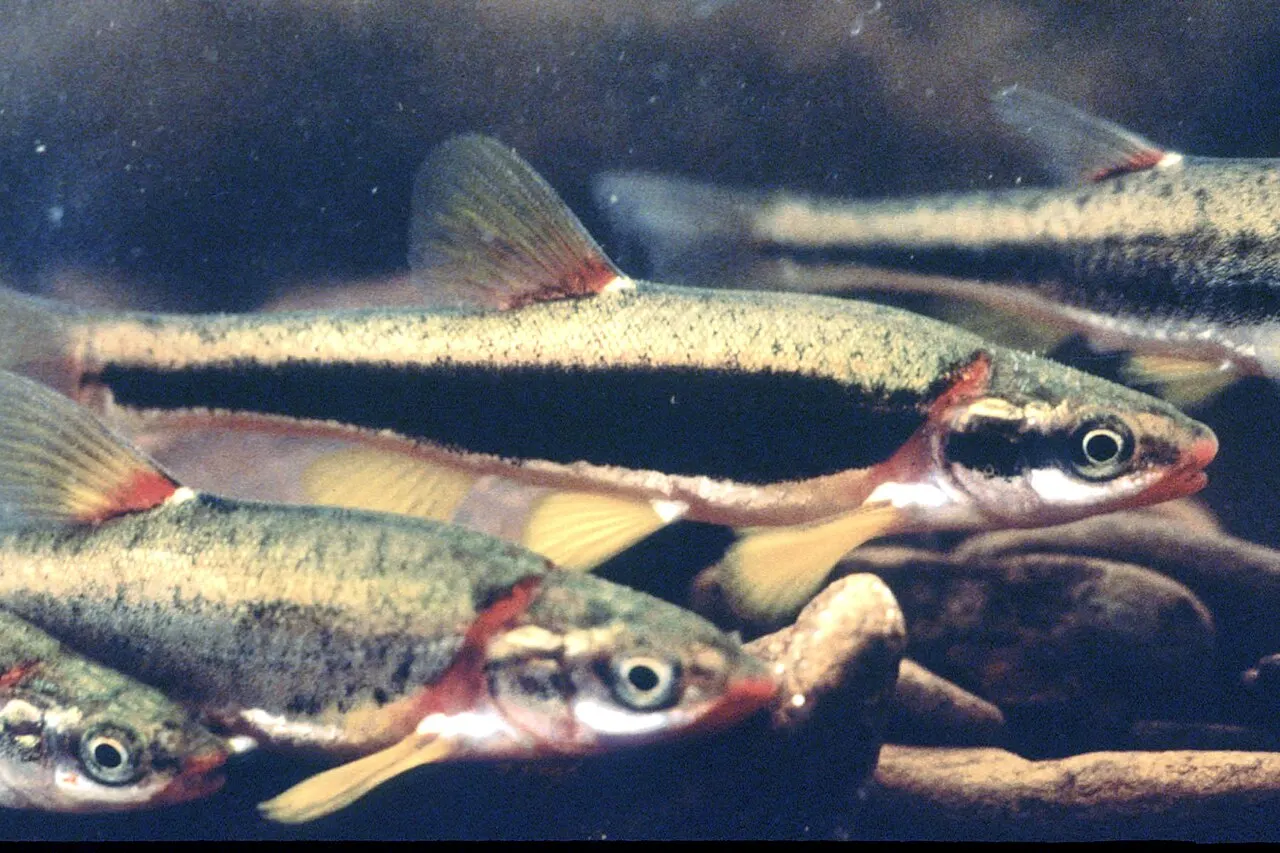
Adults are small, around 5 to 6.5 cm long. The body is olive green, speckled with black, with a dark stripe along each side. In the spring breeding season the stripe darkens, the upper body picks up red patches, and the fins turn yellow, which makes breeding fish hard to mistake for other minnows.
Where it lives
The dace is native to the upper Cumberland River drainage in Kentucky and Tennessee. A population in the Powell River drainage in Virginia is also recorded, though it may have been introduced by people. About 105 streams across Kentucky and Tennessee reportedly hold the species, but many of those populations have fewer than ten fish.
It lives in small, permanent streams with cool, clear water, rocky bottoms and plants overhanging the banks. It reportedly lives in schools and shelters beneath banks and rock ledges.
Pins are Wikidata “endemic to” fields. Orange dots, when present, are GBIF occurrence tiles — survey bias included.
How it lives
Blackside dace spawn in spring. Conservation Fisheries reports that the species lays eggs in the gravel nests of other minnows, such as creek chubs, rather than building its own. Females reportedly lay on average about 1,540 eggs, fish mature in their first year, and most live two to three years. The diet is reportedly mainly algae, with the odd insect.
Captive work at Conservation Fisheries in Knoxville, Tennessee, from 2011 to 2013 spawned the fish in April and May, starting at about 16 degrees Celsius and ending near 20 to 21. Each year the team cut back the other minnows and their cues, and in 2013 the dace spawned with none present. In 2012 the facility produced 38.2 fry per breeding adult, against 13.75 in a 1999 study.
Why it is in trouble
Streams that are muddied or polluted lose the clean gravel the fish needs. The Red List names dams, soil erosion and sedimentation, and seepage from mining, plus introduced fish including rainbow trout and the redbelly dace, and it notes that numbers swing sharply from year to year.
In 2007 a mass die-off of stream life in Kentucky's Acorn Fork, including blackside dace, was linked by federal scientists to a spill of fracking fluid from nearby gas wells.
What is being done
The dace has been listed as threatened under the US Endangered Species Act since 1987. The Red List records habitat restoration, invasive species control, site management and protection, captive breeding and species recovery measures. Conservation Fisheries resumed work with the species in 2023 for monitoring, propagation and restoration, with partners including the US Fish and Wildlife Service and Wolf Creek National Fish Hatchery.
Sources
Written for this catalog in our own words from the sources below, checked against them on 12 November 2026. Population figures are estimates and carry the year they were made. Status and assessment year: IUCN. 2026. The IUCN Red List of Threatened Species. Version 2026-1. iucnredlist.org.




