Endangered
Black squirrel monkey
Saimiri vanzolinii
The black squirrel monkey (Saimiri vanzolinii) is a small Amazon primate with probably the smallest range of any Neotropical primate, about 870 square kilometres of flooded forest in Amazonas state, Brazil. The IUCN rated it Endangered in 2021, mainly because climate change is expected to wreck that habitat.
How to recognise it
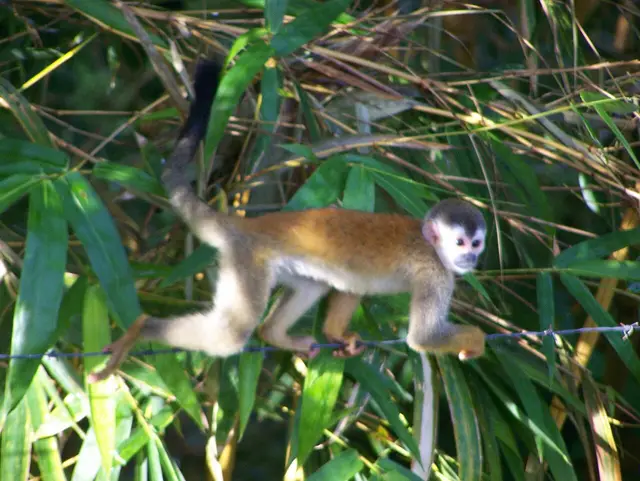
Squirrel monkeys are small, long-tailed and active. This one is named for the strip of black running from the head down the back to the tail. The fur is blackish grey over most of the body, the legs are yellow or reddish, and the belly has a yellow tint. Bare black skin surrounds the nostrils and lips, and the tail is much thinner than a common squirrel monkey's.
Adults measure about 27 to 32 cm without the tail. Males weigh roughly 0.65 to 1.2 kg and females about 0.65 to 0.9 kg.
Where it lives
The species is found only in the flooded forests where the Japurá and Solimões rivers meet in Amazonas state. It prefers seasonally flooded and river-edge forest, and a dense, low vegetation type called chavascal. The IUCN counts a single location, with an area of occupancy of 870 square kilometres.
That area is split into three isolated subpopulations with no exchange between them: the Mamirauá Sustainable Development Reserve, and the Capucho and Tarará islands. Most of the range lies inside the reserve. Two other squirrel monkey species reportedly share the reserve, and no interbreeding has been seen.
Pins are Wikidata “endemic to” fields. Orange dots, when present, are GBIF occurrence tiles — survey bias included.
How it lives
Black squirrel monkeys live in mixed troops of males and females, usually 20 to 75 animals. Bigger gatherings are thought to be temporary mergers. They forage mainly in the lower canopy and understory and often travel with capuchin monkeys, whose movements flush out insects.
They eat fruit and insects, and figs are available all year. When food is scarce they add flowers, seeds, leaves, eggs and small vertebrates. Gestation lasts about 140 to 170 days, and births are reported from February to April, when rain and food peak. Snakes and birds of prey hunt squirrel monkeys, and jaguars reportedly do too.
Why it is in trouble
The IUCN calls climate change the most imminent threat. The whole range is one floodplain, so a single extreme flood season can reach every animal within one generation, about 8 years. Flood peaks are projected to grow more intense and frequent, and modelling predicts the suitable habitat will shrink by nearly 100% within about 30 years. The assessment therefore predicts a population fall of at least 50% over that time.
Selective logging along the Solimões is another worry. A conservation group reports that capture for biomedical research and the local pet trade continues even inside protected areas, though the IUCN describes the reserve as well managed and free of hunting.
Today the picture is less grim. The IUCN notes the monkeys are common over much of their small range, with densities of 293 to 439 per square kilometre that did not change over a 2009 to 2013 survey. It recommends a new survey to check trends since then.
What is being done
Nearly the whole range sits inside the 1,124,000-hectare Mamirauá reserve, which was set up to work with local communities. The species is on CITES Appendix II, and the IUCN records awareness and communication work. The chief gaps are a fresh population survey and any plan for the shifting flood regime.
Sources
Written for this catalog in our own words from the sources below, checked against them on 12 November 2026. Population figures are estimates and carry the year they were made. Status and assessment year: IUCN. 2026. The IUCN Red List of Threatened Species. Version 2026-1. iucnredlist.org.