Endangered
Black pond turtle
Geoclemys hamiltonii
The black pond turtle (Geoclemys hamiltonii), also called the black spotted turtle, is a large freshwater turtle of the Indus, Ganges and Brahmaputra river region. The IUCN Red List rated it Endangered in 2019. Its yellow-flecked black shell makes it a target for the illegal pet trade.
How to recognise it
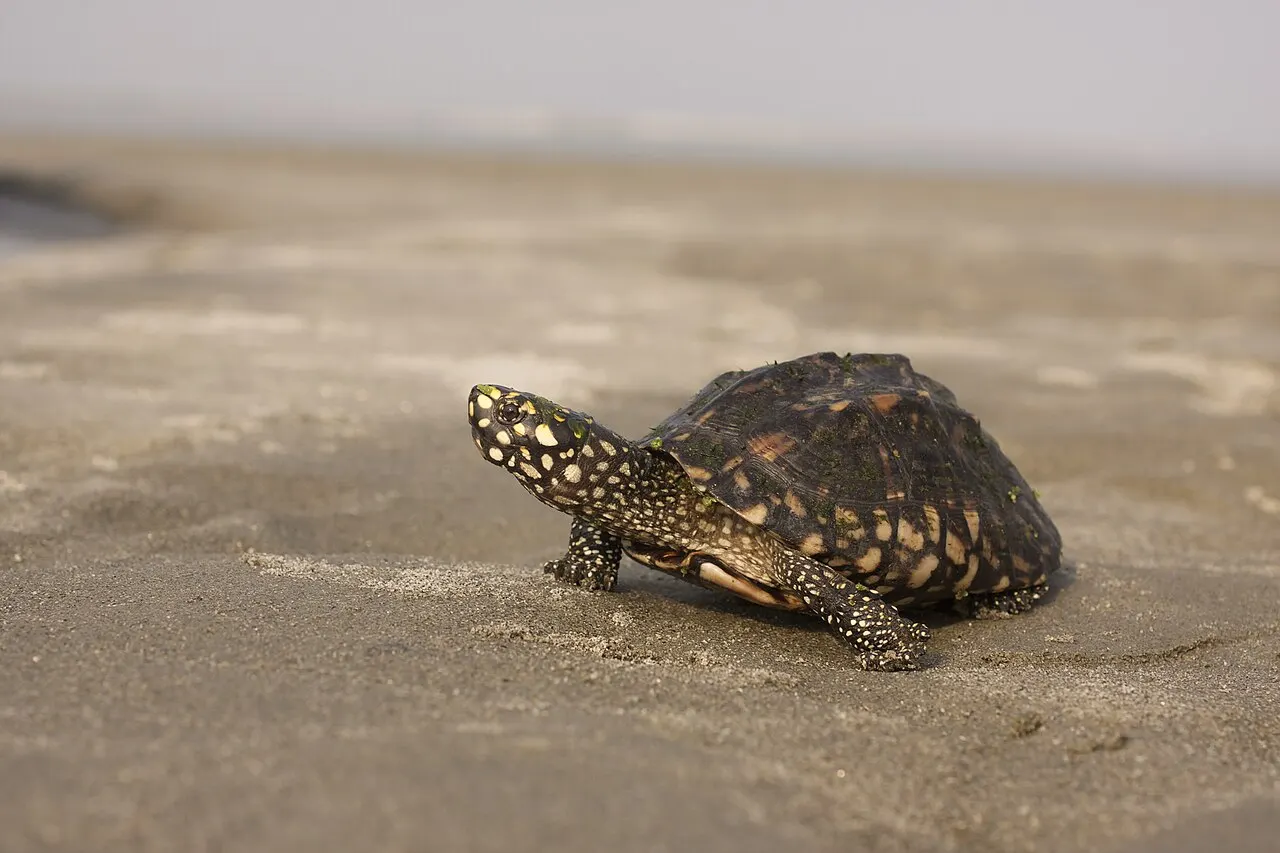
The shell is dark brown to black, dotted and streaked with yellow, and it is tall and domed with three interrupted ridges along the back. The rear edge is strongly serrated in young turtles and only slightly so in adults. The head is large with a short snout, the tail is very short, and the toes are webbed all the way to the claws. Round yellow spots mark the dark skin, biggest on the head and neck.
Adults reach a straight shell length of up to about 41 cm. Hatchlings are around 37 mm.
Where it lives
The IUCN lists the species from Pakistan, India, Bangladesh and Nepal. It is the only member of its genus. It uses rivers and streams, lakes, marshes and seasonal pools, and man-made ponds and water storage areas. The Turtle Survival Alliance also names tropical oxbows and flooded forest.
Pins are Wikidata “endemic to” fields. Orange dots, when present, are GBIF occurrence tiles — survey bias included.
How it lives
Snails are the main food, supplemented by dragonfly larvae, other insects, freshwater crustaceans and some plant matter. A female lays two clutches a year, each of 12 to 36 eggs, with the second clutch usually smaller. The IUCN gives a generation length of 20 years, so populations that lose adults recover slowly.
Why it is in trouble
The Red List criteria (A2cd+4cd) rest on a population reduction, and the trend is decreasing. The Turtle Survival Alliance describes the turtle as increasingly rare or locally extinct in many areas but still somewhat common inside protected areas, and estimates a population reduction of more than 50%, without giving a period.
Collection is among the biggest pressures. Since 1975 the turtle has been in CITES Appendix I, which bars commercial international trade, yet a 2014 TRAFFIC study found more than 1,960 seized between January 2008 and March 2014, about 95% of them in the last 15 months of that stretch. A follow-up by Leupen covering April 2014 to March 2016 counted 53 seizures and 10,321 turtles in seven countries or territories, with seizures and specimens in 2015 about triple those of 2013. India had the most seizures (20 of 53). Turtles were sourced mainly in India, Pakistan and Bangladesh and sent on to East Asia, often through Southeast Asian hubs such as Thailand and Malaysia. Demand has shifted from meat toward pets. Of at least 55 people arrested, about one in five faced a known conviction.
Other threats include accidental drowning in fishing gear, sewage, rubbish, pesticides and herbicides, and changes to wetlands.
What is being done
The IUCN records site protection and management, awareness work, livelihood alternatives, a genome resource bank and reintroduction among its conservation actions, and notes the species is subject to ex situ conservation. The Turtle Survival Alliance lists captive breeding and assurance colonies. TRAFFIC calls for intelligence-led investigations, stronger prosecution and better reporting. Because few hatchlings show up in trade, captive breeding is not supplying the pet market in any significant way.
Sources
Written for this catalog in our own words from the sources below, checked against them on 12 November 2026. Population figures are estimates and carry the year they were made. Status and assessment year: IUCN. 2026. The IUCN Red List of Threatened Species. Version 2026-1. iucnredlist.org.




