Endangered
Black-billed Amazon
Amazona agilis
The black-billed amazon (Amazona agilis) is a small green parrot found only in Jamaica, mostly in the limestone forest of Cockpit Country. It is the smallest of its genus. The IUCN moved it from Vulnerable to Endangered in 2020, estimating 6,000 to 15,000 birds and a steep decline.
How to recognise it
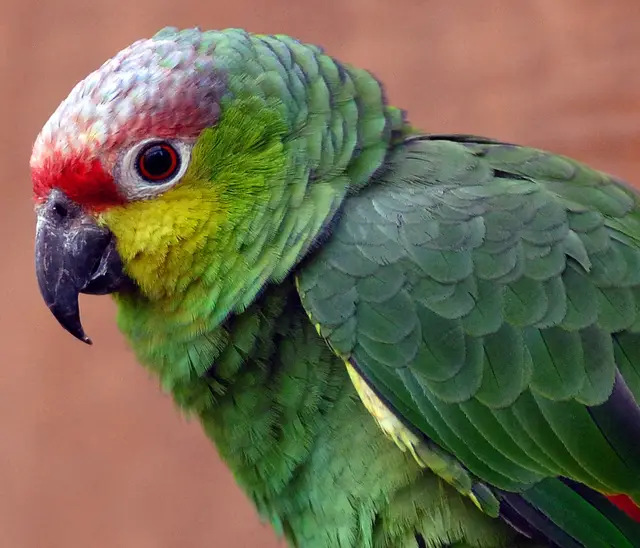
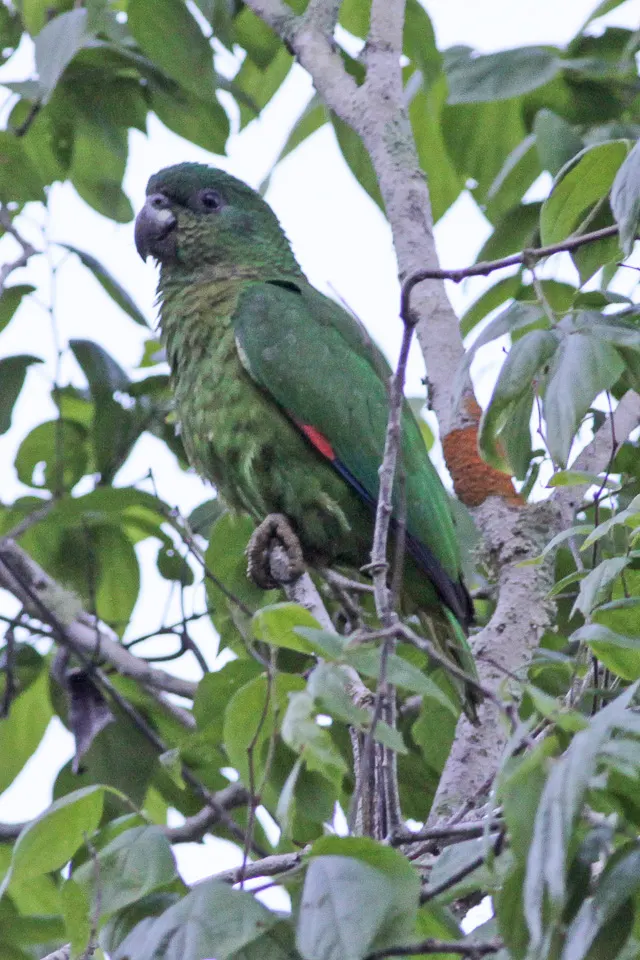
At about 25 centimetres (10 inches), it is smaller than Jamaica's other amazon, the yellow-billed parrot. The plumage is mostly green with a scaled look on the head, sometimes with a few stray red feathers, a red patch on the wing, bluish flight feathers and a black bill. Males have a pronounced red wing patch; females are similar but show some green in that patch.
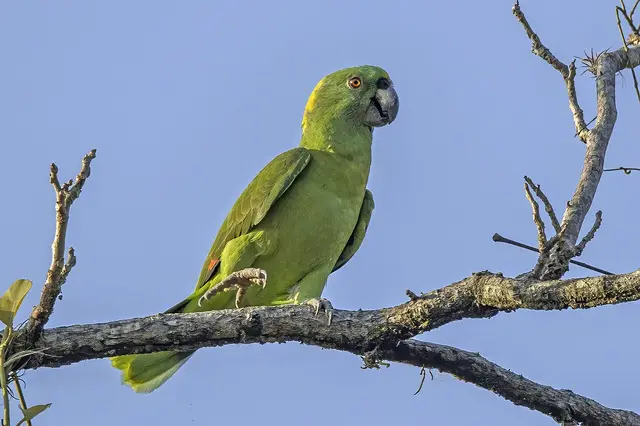
Jamaica's other amazon, the yellow-billed parrot, is larger, with a pale bill and whitish face, and its wingbeats are slower. The black-billed parrot is best located by sound. It screeches, gives a bugling call in flight that is higher pitched than its relative's, and growls and rumbles when perched.
Where it lives
The species is endemic to Jamaica and lives in moist forest from about 100 to 1,400 metres elevation, mainly limestone rainforest. The IUCN treats the birds as a single population, and about 95 per cent are believed to live in Cockpit Country in the island's interior, the only place where both Jamaican amazons occur together in significant numbers. The occupied area is estimated at 3,156 square kilometres, within an extent of 5,100 square kilometres.
Pins are Wikidata “endemic to” fields. Orange dots, when present, are GBIF occurrence tiles — survey bias included.
How it lives
It eats fruit, seeds and nuts, and will raid cultivated mangos, papayas and cucumbers. Nests are in tree hollows, so the birds depend on native forest. Fieldwork by the Jamaica Parrot Project in the 1990s found that pairs start exploring and defending nest cavities in early March, and females begin laying in late March and early April. Eggs are laid every two days and incubated for about 26 days by the female alone, while the male brings her food three or four times a day. The chicks stay in the nest for 55 to 60 days.
Breeding is often unsuccessful. In that study fewer than one pair in three raised a chick, and of 61 attempts 34 lost every nestling. The most likely nest predator is the Jamaican boa, though that was inferred rather than caught on camera. A 2020 study in Oryx also recorded feral cats, black rats and mongooses on camera in the forest interior.
Why it is in trouble
The IUCN estimates a decline of 50 to 79 per cent over three generations (about 32 years), both now and in the future, and lists the population as still decreasing. Earlier figures were lower than today's: estimates from 1981 and 1991 put the species at 1,000 to 2,000 birds, and an unpublished later survey suggested at least 4,000. Those numbers came from different methods, so they are not directly comparable.
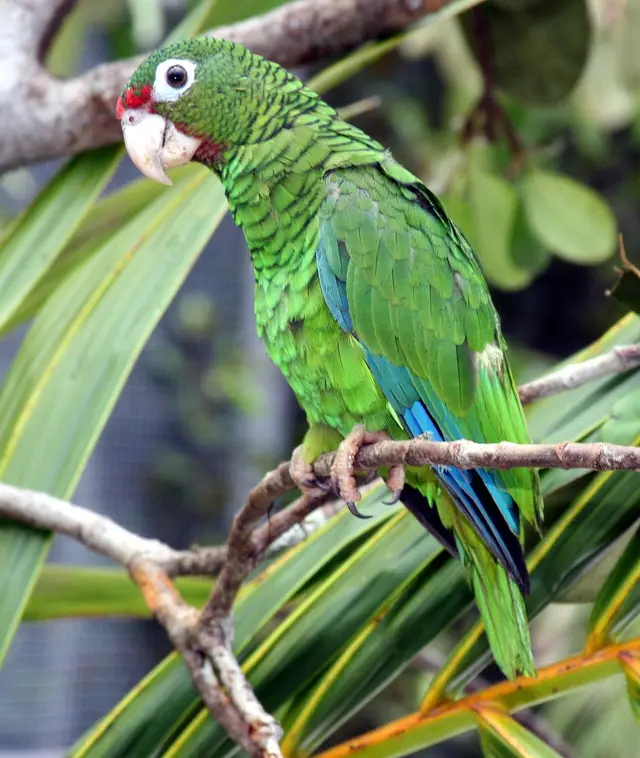
The IUCN lists mining and quarrying, shifting agriculture, drought, small-scale harvest and hunting among the pressures. Birds are taken for food and for the pet trade, and timber harvesting and the cutting of saplings for yam stakes reduce forest. A 2020 study in Oryx found that hunting records from 2018 and 2019 suggested a significant decline, and that two of the three black-billed parrots caught in 2019 appeared to be hybrids with the Puerto Rican parrot. Hurricane damage that fragments the forest is also reported.
What is being done
The species is listed on Appendix II of CITES, which controls international trade, and possession is regulated under Jamaica's Wildlife Protection Act. The IUCN records that it occurs in at least one protected area and that a monitoring scheme is in place. Some birds are held in captivity, and education campaigns have been run. There is no formal recovery plan.
The Jamaica Parrot Project, set up in 1995 by BirdLife Jamaica (then the Gosse Bird Club), aims to map distribution and to study limits on breeding such as predators, nest cavities and poaching.
Sources
Written for this catalog in our own words from the sources below, checked against them on 12 November 2026. Population figures are estimates and carry the year they were made. Status and assessment year: IUCN. 2026. The IUCN Red List of Threatened Species. Version 2026-1. iucnredlist.org.