Endangered
Ethiopian mountain adder
Ethiopian mountain adder
The Ethiopian mountain adder is a large, boldly patterned viper known from only a handful of forest and highland sites in Ethiopia. The IUCN Red List rated it Endangered in 2021. Its life in the wild is poorly studied, and its whole occupied area adds up to only about 20 square km.
How to recognise it
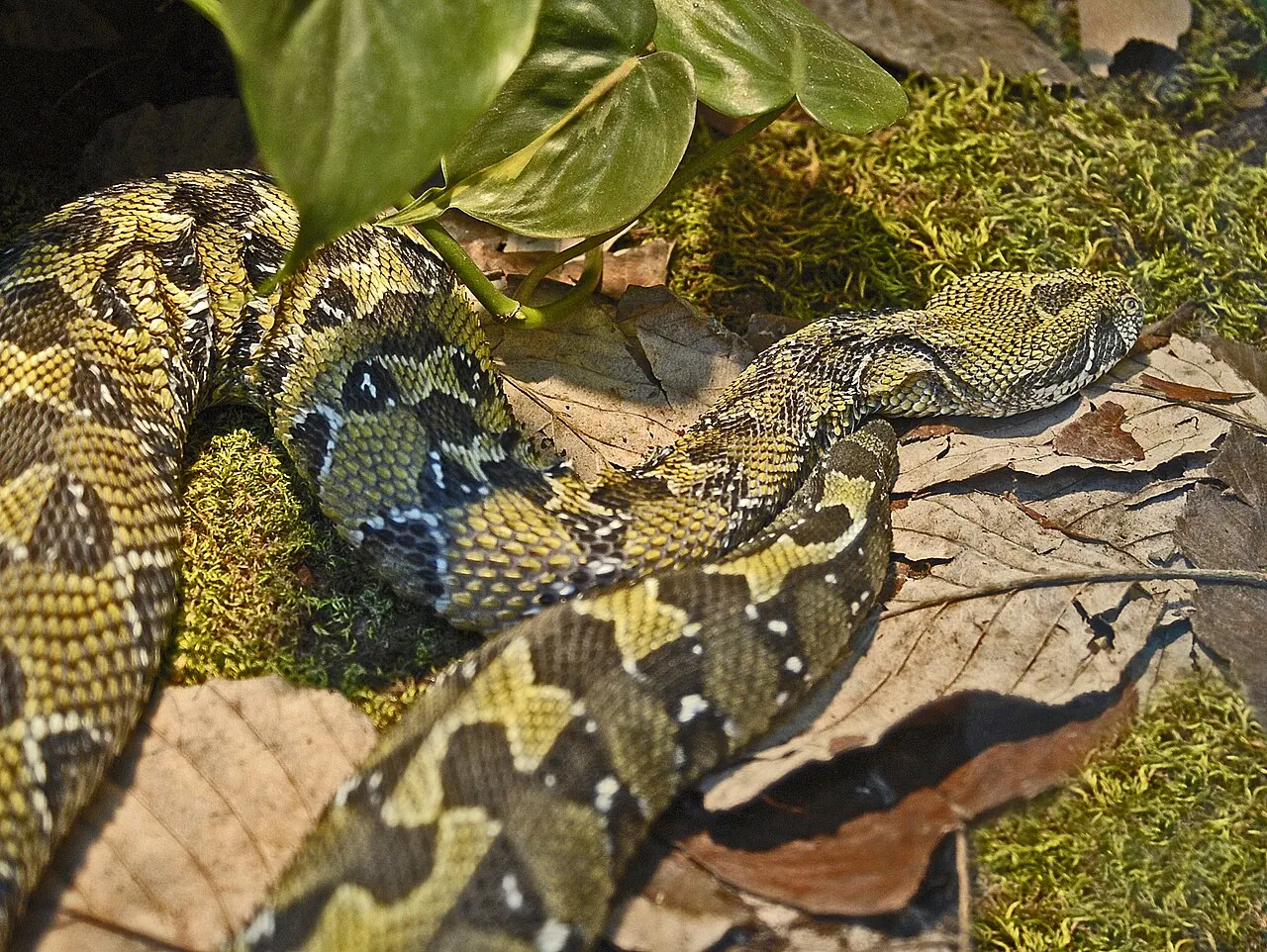
This is a large viper with a brown back carrying a row of black hexagons or diamonds. The upper flanks have black spots with white centres, the lower flanks carry greenish-grey triangles edged in yellow, and the head shows a dark triangle between the eyes.
The first three museum specimens measured up to about 75 cm, but live animals are now known to reach at least 130 cm. The species name means small-eyed. It belongs to the same genus as the puff adder and the Gaboon viper.
Where it lives
It is found only in Ethiopia, at 1,700 to 2,800 m. The IUCN counts five locations and an occupied area of about 20 square km. The type locality is near Yambo, on the road from Metu to Bedelle in the south-west, and the snake is also known from the Bonga to Jimma area.
Habitat records include moist montane forest and high-altitude grassland, plus rural gardens and plantations. Older accounts also place the snake in the Bale Mountains east of the Rift Valley. In 2016, though, researchers described a separate viper, Bitis harenna, from a specimen collected near Dodola that had been identified as this species, so records from the Bale side of the Rift need care.
Pins are Wikidata “endemic to” fields. Orange dots, when present, are GBIF occurrence tiles — survey bias included.
How it lives
Very little is known. It is thought to eat small mammals and birds, and like its relatives it gives birth to live young. The one living animal known in 1995 hissed and struggled when restrained but did not readily strike.
Why it is in trouble
The IUCN says the population is decreasing and the occupied area is still shrinking. The assessment records conversion and degradation of its habitat, along with persecution and accidental killing during small-scale harvesting, and lists international trade for pets or display. Whether it lives in any protected area is unknown.
The venom is poorly known. The snake is presumed to cause some bites in settled areas, and a keeper in the United States was bitten on the finger in 2009 by a captive young snake and survived.
What is being done
The only conservation action the IUCN lists for the wild population is protection of the species and its habitat. In captivity, around 20 animals were reportedly exported to the United States in 2007. San Diego Zoo reportedly became the first US zoo to breed the species, in 2014, and ZSL London Zoo reportedly became the first EAZA member to do so, in 2021.
Sources
Written for this catalog in our own words from the sources below, checked against them on 12 November 2026. Population figures are estimates and carry the year they were made. Status and assessment year: IUCN. 2026. The IUCN Red List of Threatened Species. Version 2026-1. iucnredlist.org.
- IUCN Red List assessment, Ethiopian mountain adder (2021)
- Ethiopian mountain adder (encyclopedia article)
- The Reptile Database, Ethiopian mountain adder
- Gower et al., A new large species of Bitis from the Bale Mountains of Ethiopia, Zootaxa 2016 (abstract summary)
- Bitis harenna (encyclopedia article)
- Wildlife Conservation Society photo blog, Ethiopian mountain viper




