Critically Endangered
Bignose fanskate
Sympterygia acuta
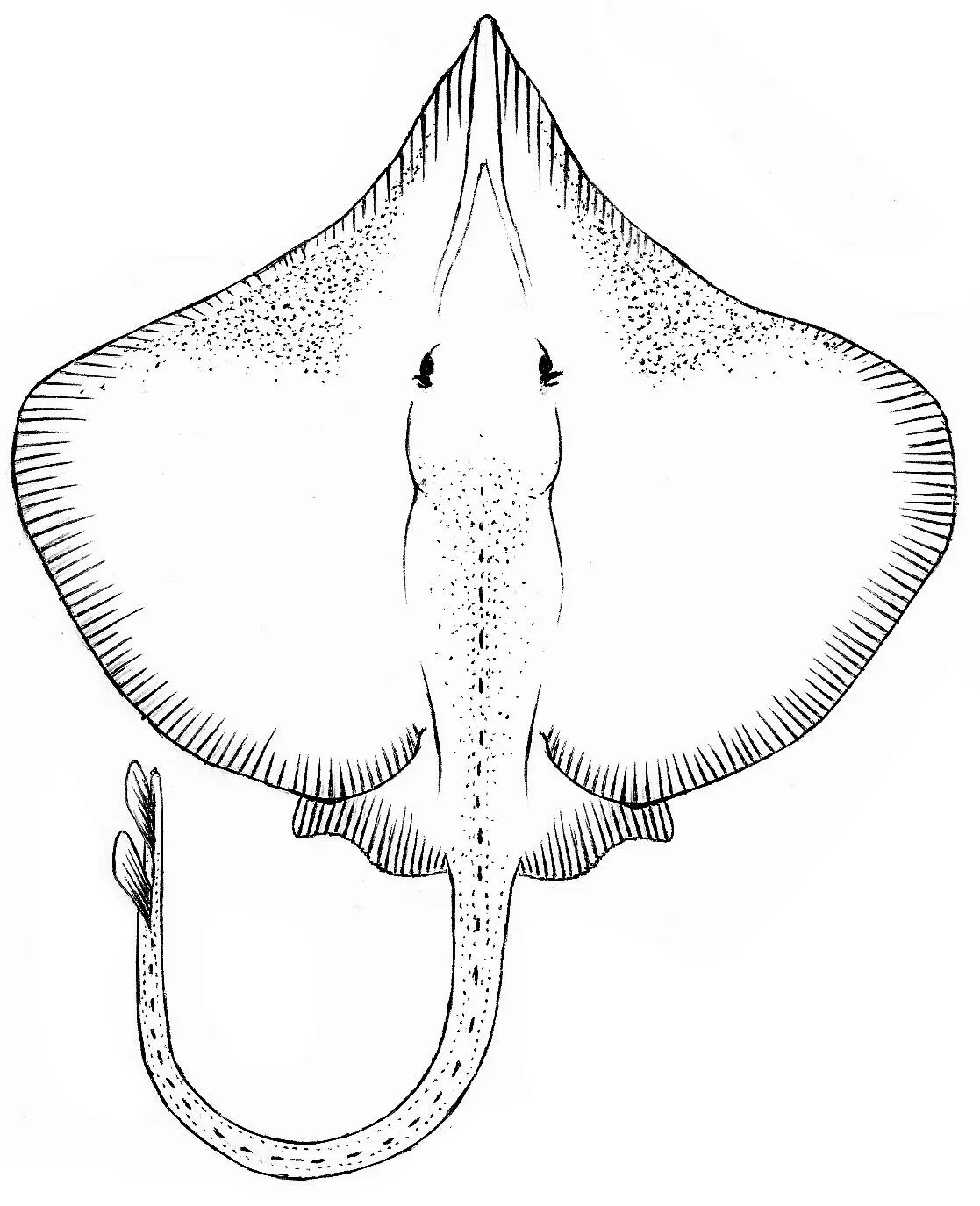
The bignose fanskate (Sympterygia acuta) is a small skate of the shallow seabed off Brazil, Uruguay and Argentina. It lays eggs in pairs and eats fish and crustaceans. The IUCN Red List classed it as Critically Endangered in 2020, with a decreasing population, mainly because of fishing pressure.
Where it lives
This skate belongs to the family Arhynchobatidae and lives in the southwest Atlantic. Its range runs from Rio de Janeiro in Brazil south to the Rio de la Plata region between Uruguay and Argentina, within subtropical waters between roughly 20 and 40 degrees south. The IUCN lists it as resident in all three countries.
It is a bottom dweller (demersal) recorded at depths of 10 to 188 m. The IUCN habitat list covers shallow, sea-floor sediments: mud, sandy mud, sand and loose rock, pebble or gravel.
Pins are Wikidata “endemic to” fields. Orange dots, when present, are GBIF occurrence tiles — survey bias included.
How it lives
Like other skates, the bignose fanskate lays eggs rather than giving birth to live young. The eggs are laid in pairs, and the shell has horn-like projections. The embryos feed only on yolk until they hatch.
A stomach study of 417 specimens found food in 301 of them. Bony fishes made up the largest share of the diet (about 48 percent by the index of relative importance), followed by decapod crustaceans such as shrimp and crabs (about 40 percent), with smaller amounts of cumaceans and isopods.
FishBase rates the species as having low resilience, with a minimum population doubling time of 4.5 to 14 years. It also gives the skate a very high vulnerability to fishing (83 out of 100).
Why it is in trouble
The 2020 assessment records a decreasing population. The listing rests on criteria A2bd, which covers a reduction in numbers judged from an index of abundance and from actual or potential levels of exploitation. The assessment gives an estimated past reduction of 80 percent.
The IUCN names fishing as the threat: harvest that catches the skate unintentionally, both in large-scale fisheries and in small-scale or subsistence fishing. It also records human food as a use of the species, and FishBase lists it as a commercial fishery species. It lives in all three countries named above, so the pressure is spread across its range.
What is being done
Protection is thin. In the 2020 assessment the IUCN recorded no recovery plan, no harvest management plan for this species, no systematic monitoring scheme and no captive breeding. Whether it occurs inside any protected area is listed as unknown.
The actions the assessment calls for include harvest and trade management, species recovery, site protection and national-level policy, together with research on population trends, harvest levels and life history.
Sources
Written for this catalog in our own words from the sources below, checked against them on 12 November 2026. Population figures are estimates and carry the year they were made. Status and assessment year: IUCN. 2026. The IUCN Red List of Threatened Species. Version 2026-1. iucnredlist.org.




