Critically Endangered
Big-headed turtle
Platysternon megacephalum
The big-headed turtle (Platysternon megacephalum) is a stream-dwelling turtle of hill country in southern China and mainland Southeast Asia, known for a head so large it can't be pulled into the shell. The IUCN Red List rated it Critically Endangered in 2021, with collecting for food and the pet trade the main pressure.
How to recognise it
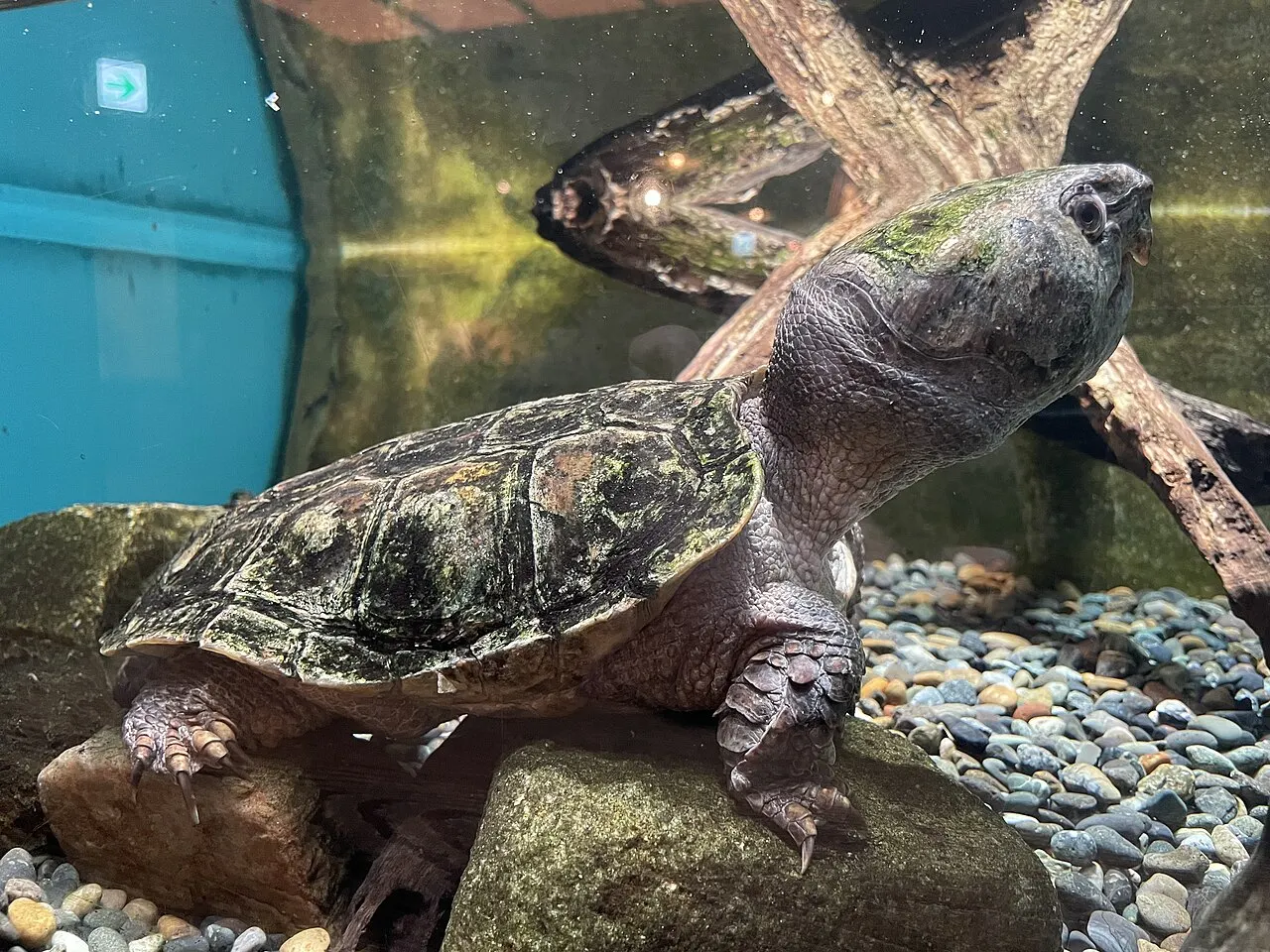
The giveaway is the head. It is out of proportion to the body, and the turtle can't withdraw it, so it relies on an armoured head, a sharp beak and powerful jaws for defence. It also has strong claws and reportedly uses its tail as a prop when climbing.
Where it lives
It occurs in Cambodia, China, Laos, Myanmar, Thailand and Vietnam. Its home is steep, clear, cool, fast-flowing streams and waterfalls in forested hills. It doesn't appear to need undisturbed forest: some self-sustaining populations in Hong Kong live in secondary forest. Across most of its range it is now rare.
Taxonomy is in flux. Older accounts recognise three subspecies, one in China, one in Myanmar and Thailand, and one in Cambodia, Laos and Vietnam. A 2023 genetic study in iScience (Gong and colleagues), which sampled 143 turtles from 67 localities, found three distinct lineages: Platysternon megacephalum, P. peguense, and an unnamed group from Baise in Guangxi, China. The Baise group had the lowest effective population size of the three, and the study argued it needs extra protection.
Pins are Wikidata “endemic to” fields. Orange dots, when present, are GBIF occurrence tiles — survey bias included.
How it lives
This turtle is reportedly active mostly at night and doesn't travel far. Recorded daily movements run from 0 to about 90 m, with males ranging farther than females. It is a weak swimmer, sometimes arching its tail like a scorpion as it paddles, and it scrambles over obstacles in and beside streams. It has been reported climbing into trees and bushes.
It was once assumed to be a strict meat eater. It is now described as an opportunistic feeder that eats mostly fruit, along with insects, molluscs, frogs, rodents and freshwater crabs. Seeds that pass through its gut may germinate better, so it could help spread the plants it feeds on.
Why it is in trouble
The 2021 Red List assessment (criteria A2cd) rates the species Critically Endangered on the basis of past decline linked to habitat quality and to exploitation. Collecting for food and the pet trade is the main pressure. Because the turtle is strongly tied to the water and has a small home range, it is easy to catch. Baited fish hooks and basket traps are among the biggest threats, and a 2021 conservation plan for Vietnam found no sign that harvesting was slowing.
Most turtles seized in Myanmar were bound for China. In 2016 almost 1,000 big-headed turtles were found at a trafficker's compound, most of them near death from neglect, and a second seizure in 2017 went far better, with nearly every turtle surviving.
The 2023 genetic paper reported field densities of 0 to 0.36 turtles per km of stream in Guangdong and Hainan, against more than 120 in Hong Kong, where poaching is low. Turtle farms are sometimes blamed for laundering wild catches as captive-bred, and farms in Myanmar and Vietnam have been reported doing this. The same genetic paper notes that captive breeding has worked on some farms, but farm animals often come from markets, so their origin is unknown.
What is being done
The species is on Appendix I of CITES, which bans international commercial trade. The Turtle Survival Alliance keeps an assurance colony at its Turtle Survival Center and reports unusually good breeding success for a turtle that is historically hard to breed in captivity. The Wildlife Conservation Society has housed seized turtles at a rescue centre at Bambwe in Myanmar and, as of 2018, had secured funding for an experimental release into a fast-flowing stream nearby.
Researchers warn that released or confiscated turtles should be genetically checked first, so animals from different lineages aren't mixed.
Sources
Written for this catalog in our own words from the sources below, checked against them on 12 November 2026. Population figures are estimates and carry the year they were made. Status and assessment year: IUCN. 2026. The IUCN Red List of Threatened Species. Version 2026-1. iucnredlist.org.




