Critically Endangered
Bertia cambojiensis
Bertia cambojiensis
Bertia cambojiensis is a large land snail with a left-coiling shell, known from southern Vietnam. For over 150 years it was believed lost, until living populations turned up again in 2012. The IUCN Red List rated it Critically Endangered in 2014, mainly because of collecting pressure.
How to recognise it
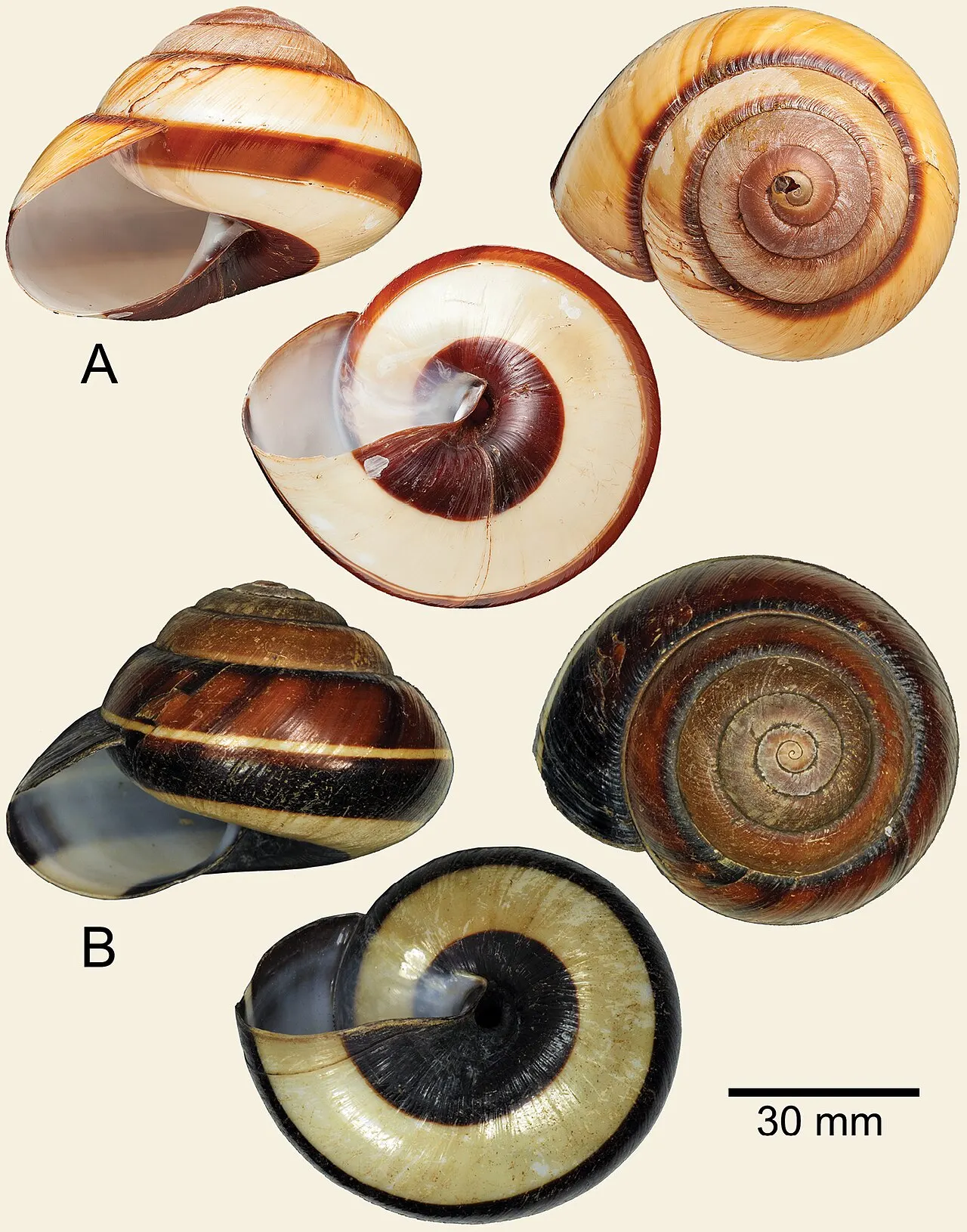
The shell is large, dome shaped and thick, and it coils to the left, which is uncommon among snails (the term is sinistral). Specimens measured in a 2019 ZooKeys paper were 49.9 to 55.7 mm tall and 64.4 to 74.5 mm wide, averaging about 52.6 by 69.7 mm. It has six to seven whorls, and the glossy upper surface ranges from cream and brown to blackish bands, with a narrow pale band around the edge.
Where it lives
Today it is known from localised forest patches in southern Vietnam, in Dong Nai, Binh Thuan, Lam Dong and Binh Phuoc provinces. The IUCN assessment calls it a lowland subtropical or tropical moist forest species known from a single location, and notes it occurs in at least one protected area. A record from Ba Vi National Park, far from this range, is considered very doubtful. No precise Cambodian locality has been recorded, though the 2019 paper thinks it likely occurs in nearby Cambodia.
The rediscovery came during a 2012 survey of Cat Tien National Park in Dong Nai, organised by Vietnam's national museum of nature and the Natural History Museum, London. A project listed by the Rufford Foundation planned surveys across the rainy and dry seasons of 2018 and 2019, using 30 sample plots of 20 by 20 m in mixed, evergreen and bamboo forest. It shows a snail moving across a rock in bamboo forest.
Pins are Wikidata “endemic to” fields. Orange dots, when present, are GBIF occurrence tiles — survey bias included.
A species lost and found
The English naturalist Lovell Reeve described it in 1860 from specimens collected by Henri Mouhot, giving the locality as Cambodia. He first called it Helix mouhoti, then renamed it Helix cambojiensis the same year. No precise locality was published for over 150 years, and the snail was believed extinct.
The 2019 paper concluded that Mouhot collected it in 1859 near Brelum, in Binh Phuoc Province, Vietnam, about 2 km from the Cambodian border.
Why it is in trouble
Shell collectors worldwide want it, and the 2019 paper reports shells offered on Chinese dealer websites in 2014 and 2015 for more than 400 euros, later falling as low as 20 euros when none were available. It is easy to spot at night on tree trunks, which makes it vulnerable to over-collection. Local people also use it as food and traditional medicine, and deforestation and habitat degradation add to the pressure. The IUCN lists the population trend as unknown, with a continuing decline.
Captive breeding groups were set up at Vietnam's national museum of nature and at the Zoological Society of London, and living cell preparations are stored at the Natural History Museum.
Sources
Written for this catalog in our own words from the sources below, checked against them on 12 November 2026. Population figures are estimates and carry the year they were made. Status and assessment year: IUCN. 2026. The IUCN Red List of Threatened Species. Version 2026-1. iucnredlist.org.




