Critically Endangered
Bellamya robertsoni
Bellamya robertsoni
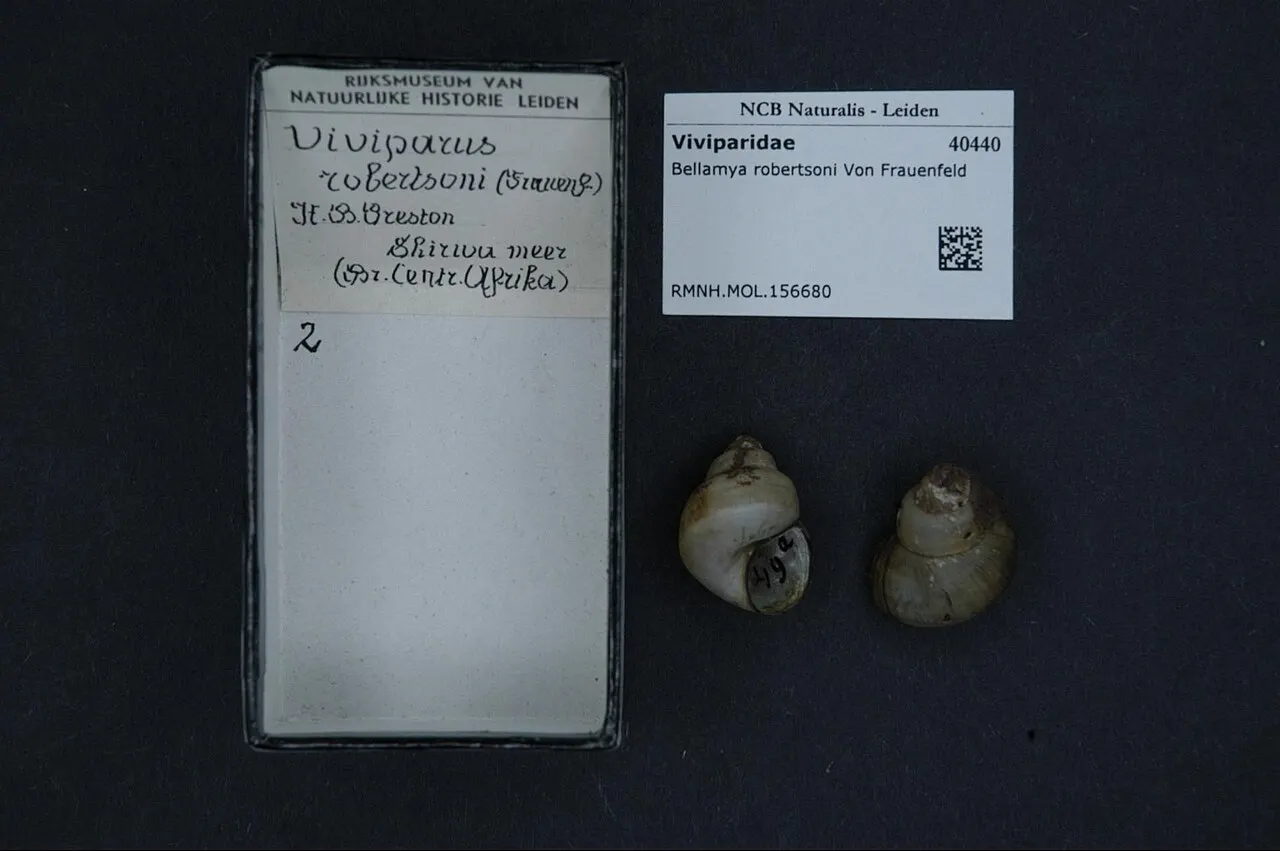
Bellamya robertsoni is a large freshwater snail recorded from Malawi, with specimens collected in Lake Malawi. The IUCN Red List rates it Critically Endangered (assessed 2018) because its range is very small and shrinking. Its population trend is unknown, and little else has been published about it.
What kind of snail it is
Bellamya robertsoni belongs to the Viviparidae, the river snails. Members of the family breathe with a gill and close their shell with a lid, the operculum. They are live-bearers: females hold the developing young in a brood pouch, and the young leave as miniature adults rather than hatching from eggs. That is the family pattern, and reproduction hasn't been described for this species specifically.
Georg von Frauenfeld described the species in 1865. It is called a large snail, but shell measurements and colour aren't given in the sources available.
Where it lives
The Red List treats the species as occurring in Malawi, in permanent freshwater lakes, down to a depth of 87 metres. Some references also give Mozambique, which shares the shoreline of Lake Malawi. Two B. robertsoni specimens in a 2014 genetic study of African Bellamya came from Lake Malawi.
The IUCN estimates its extent of occurrence at 30 square kilometres and counts a single location. That is a tiny area compared with the size of the lake.
Pins are Wikidata “endemic to” fields. Orange dots, when present, are GBIF occurrence tiles — survey bias included.
A tangled family tree
A 2014 study by Schultheiss and colleagues found that the Bellamya snails endemic to Lake Malawi are closest to those of the middle Congo River. It dated the start of their diversification to roughly 1.4 million years ago, with a wide margin of error (about 0.6 to 2.6 million years).
The same study found considerable mismatches between traditional shell-based names and genetic results across the genus, and called for a taxonomic revision. How many true species live in Lake Malawi, and where B. robertsoni fits among them, is therefore still open.
Why it is in trouble
The IUCN lists soil erosion and sedimentation, sewage, and harvesting of aquatic resources for unrecorded reasons as ongoing threats, each rated low impact. It records a continuing decline in the snail's extent of occurrence. The population trend is listed as unknown.
What is being done
No conservation measures are recorded as in place. The research the Red List notes is on threats and on population size, distribution and trends.
Sources
Written for this catalog in our own words from the sources below, checked against them on 12 November 2026. Population figures are estimates and carry the year they were made. Status and assessment year: IUCN. 2026. The IUCN Red List of Threatened Species. Version 2026-1. iucnredlist.org.




