Endangered
Bare-necked Umbrellabird
Cephalopterus glabricollis
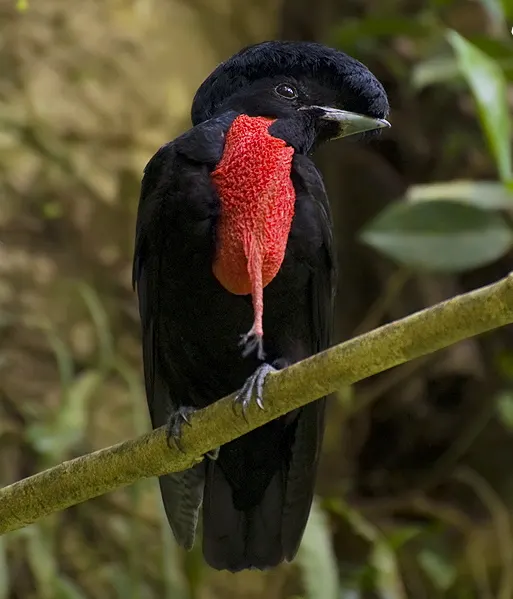
The bare-necked umbrellabird (Cephalopterus glabricollis) is a large, black cotinga of Costa Rica and Panama, named for the curled crest on its head and a bare red throat patch on the male. It is listed as Endangered (assessed 2021), with an estimated 1,900 to 7,100 mature birds.
How to recognise it
This is a large, ornate forest bird, reportedly the largest passerine in much of its range. Males are about 41 cm long and weigh around 450 g. Females are smaller, at about 36 cm and 320 g.
The male is glossy black with a long crest that curls forward over the bill. From the lower throat to the upper chest he carries a patch of bare red skin that usually hangs loose and is inflated during display. Females are duller and have a much shorter crest, reduced to a tuft at the front. Displaying males give low, far-carrying hooting calls.
Where it lives
The species is found in the Talamancan montane forests of Costa Rica and Panama. The Red List records it from both countries, with an extent of occurrence of about 35,000 square kilometres. Some references also include southern Nicaragua, but the Red List assessment does not.
It lives in moist lowland and moist montane forest, usually in the subcanopy and upper understory of mature forest, though some birds feed in regrowth. The assessment gives an elevation range of 100 to 2,100 m. It also moves up and down the mountains each year.
Pins are Wikidata “endemic to” fields. Orange dots, when present, are GBIF occurrence tiles — survey bias included.
How it lives
Fruit is the staple, mostly berries and other small fruits, with the occasional lizard, frog or insect.
Males gather at display sites, called leks, to attract females. Breeding runs from March to June in Costa Rica and from April to September in Panama.
The bird is an altitudinal migrant that follows fruit. A 2003 study in the Tilarán Mountains of Costa Rica, using transect counts and radio-tagging, found birds most abundant at about 1,400 m from March to June, when fruit peaked there. Outside the breeding season they dropped to the lowlands around 400 m, where fruit peaked.
Why it is in trouble
Forest loss is the main problem, particularly clearing for farming, ranching and grazing across most of its range. The Red List also lists road and railroad building, and the unintended effects of small-scale harvesting, as ongoing pressures. The Red List moved the bird from Vulnerable (2008) to Endangered (2012), and the population is judged to be decreasing, with a reduction of 10 to 19 percent estimated.
The migration makes protection tricky. The Tilarán study found that the radio-tagged birds left the protected area for the non-breeding season, and that the lowland habitat they used was poorly represented inside the reserves, while breeding habitat was well covered. Researchers called that gap a potential threat to the birds there.
What is being done
The species lives in several protected areas, including reserves in the Monteverde and Arenal region of Costa Rica, and conservation sites have been identified across its whole range. The assessment lists site protection and habitat restoration as the actions needed. No recovery plan or systematic monitoring scheme is in place, and no captive population exists.
Sources
Written for this catalog in our own words from the sources below, checked against them on 12 November 2026. Population figures are estimates and carry the year they were made. Status and assessment year: IUCN. 2026. The IUCN Red List of Threatened Species. Version 2026-1. iucnredlist.org.




