Critically Endangered
Neolissochilus wynaadensis
Barbodes wynaadensis
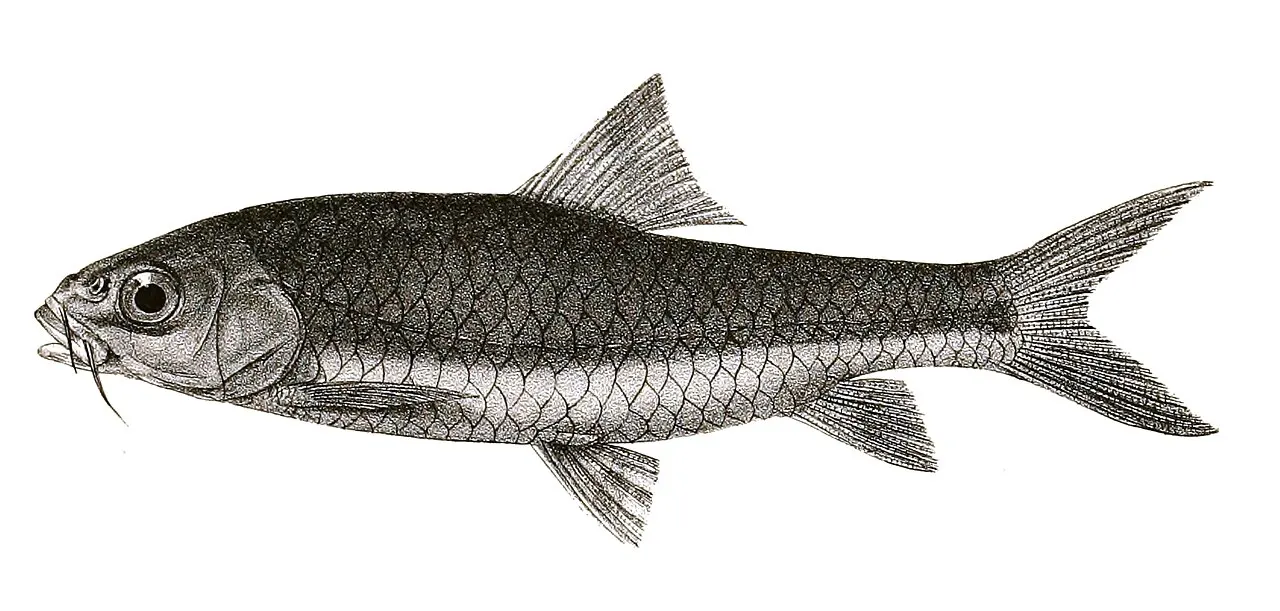
The Wayanad mahseer (Neolissochilus wynaadensis, listed by the IUCN under the older name Barbodes wynaadensis) is a river carp from fast upland streams in the southern Western Ghats of India. It was assessed as Critically Endangered in 2011, after reported declines of up to 80 percent in a decade.
How to recognise it
This is a mahseer, one of the big-bodied river carps of South Asia, though a modest member of the group. Francis Day, who described it in 1873 as Barbus wynaadensis, reported growth to about 200 mm. A reference article gives a maximum near 50 cm. Specimens collected in 2013 measured 84 to 140 mm in standard length.
The IUCN also lists it as the copper mahseer. A 2014 genetic study placed it in the genus Neolissochilus rather than Barbodes, so both names appear in the literature.
Where it lives
It is found only in upland streams of the Cauvery drainage, at roughly 400 to 1,100 metres above sea level. The type locality is a stream near Vythiri in Wayanad, Kerala. A 2014 paper in the Journal of Threatened Taxa recorded it in the Kabini River system at Thirunelli, in Wayanad Wildlife Sanctuary, in tributaries inside Mudumalai Wildlife Sanctuary in Tamil Nadu, and at several sites in Kodagu district of Karnataka, including Abbey Falls. That paper put the area it occupies at about 1,000 square kilometres. The IUCN counts three locations.
Older records from outside this area, including some from the Chaliyar system, Pune and Yunnan in China, are doubted or considered likely misidentifications.
Pins are Wikidata “endemic to” fields. Orange dots, when present, are GBIF occurrence tiles — survey bias included.
How it lives
It favours rocky pools and riffles with moderate flow and plenty of hiding places. Riffle beetles and midge larvae are described as its main food. A researcher has suggested that it travels to the upper reaches of rivers to spawn, but this has not been confirmed.
Population reports are patchy. Many collections in Wayanad between 1999 and 2004, and again in 2008, did not find it. Surveys at Thirunelli in April 2004 and October 2013 produced only three fish in total. In Kodagu the picture is better: populations are described as fairly good, and probably hundreds of fish were seen in one splash pool near Muvathoklu.
Why it is in trouble
The 2011 assessment lists sewage, run-off, roads, temperature extremes and past small dams among the pressures, and records that the habitat is still shrinking. The 2014 paper adds fertiliser, pesticide and chemical pollution from plantations, sand mining, and possible harvest by local people. The IUCN lists subsistence use as human food, though the 2014 paper says there is no data showing how much is taken. A conservation fund report also names the aquarium trade, invasive species, dams and overexploitation.
The 80 percent decline quoted for 2000 to 2010 is described in that 2014 paper as not backed by scientific data. What is clear is that the fish has gone from places where it was once collected, and that much of its range lies outside protected areas.
What is being done
Streams in sacred groves in Kodagu, known as Devarkaadu, help protect populations at Mukkodlu, Muvathoklu and Surlabi. A project led by V.K. Anoop of Kerala University of Fisheries and Ocean Studies, funded by a 23,900 dollar grant from the Mohamed bin Zayed Species Conservation Fund in 2021, planted 2,500 native trees in predicted breeding areas and studied traditional fishing knowledge.
The IUCN records that no recovery plan or systematic monitoring scheme was in place, though the species occurs in at least one protected area.
Sources
Written for this catalog in our own words from the sources below, checked against them on 12 November 2026. Population figures are estimates and carry the year they were made. Status and assessment year: IUCN. 2026. The IUCN Red List of Threatened Species. Version 2026-1. iucnredlist.org.




