Critically Endangered
Barbara Brown's titi
Callicebus barbarabrownae
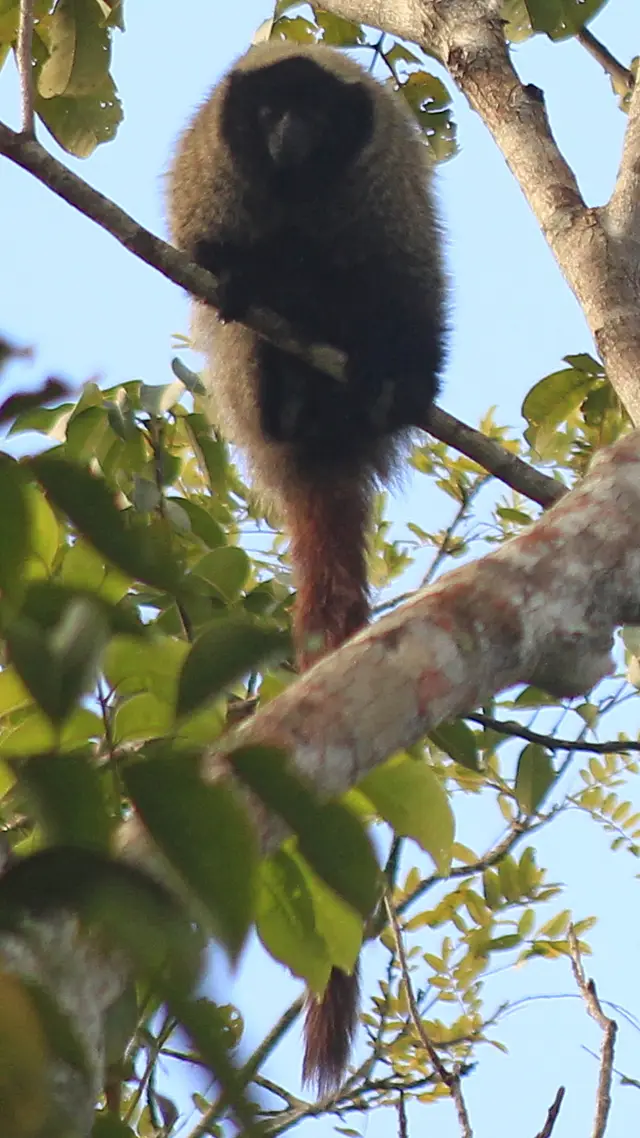
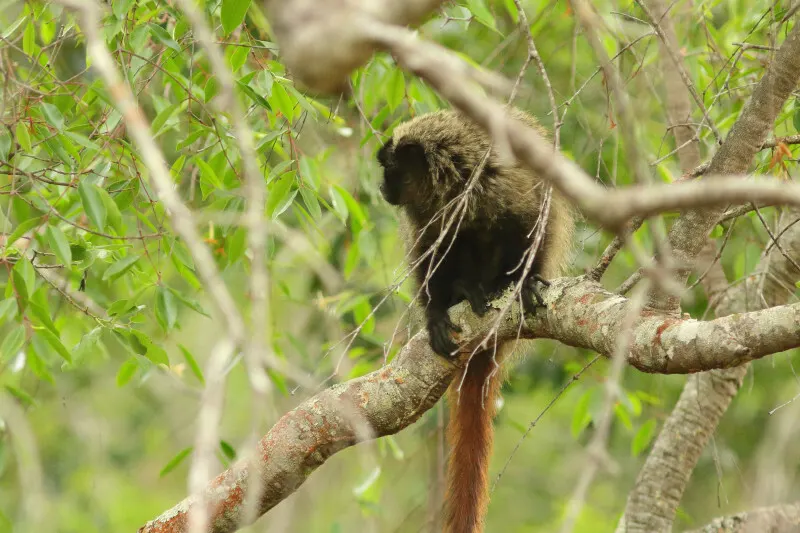
Barbara Brown's titi (Callicebus barbarabrownae), also called the blond titi monkey, is a small monkey that lives only in the dry caatinga scrub and forest of north-eastern Brazil. The IUCN Red List rates it Critically Endangered (2021 assessment) and puts the mature population at 100 to 250.
How to recognise it
It's a small New World monkey in the titi group (family Pitheciidae), also called the blond titi monkey. It was described to science only in 1990, by Philip Hershkovitz, who named it for the zoologist Barbara Brown.
Titis are mostly tree-living and monogamous, and live in family groups. Pairs are reported to sit side by side with their tails entwined. Females reportedly bear a single young once a year.
Where it lives
The species is endemic to Brazil and has been recorded in the states of Bahia and Sergipe. A survey by Printes, Rylands and Bicca-Marques, carried out from 2004 to 2005 and published in Oryx in 2011, found it mainly in dense, tree-rich caatinga and highland coastal forest in Bahia, at about 241 to 908 m above sea level. It occupied less than 30 percent of the caatinga, and its area of occupancy was put at 2,636 km2.
The IUCN lists dry shrubland and dry savanna as its habitats. Reportedly it eats fruit, leaves and insects.
Pins are Wikidata “endemic to” fields. Orange dots, when present, are GBIF occurrence tiles — survey bias included.
How many there are
Counts differ by method and year. The 2004 to 2005 survey estimated at least 260 animals in 65 groups (51 seen, 14 detected by their calls) and called that an underestimate. The IUCN gives 100 to 250 mature individuals, from an assessment dated 2015 and published in 2021, with a severely fragmented and declining population.
Newer fieldwork using recorded calls to draw groups out has found more. A project funded by the Mohamed bin Zayed Species Conservation Fund surveyed 212 sites in Chapada Diamantina National Park in 2021 to 2023 and estimated about 873 individuals there. An earlier study (2020) counted 273 adults in a single 221 km2 area near Boa Vista do Tupim. These figures cover particular areas, not the whole range, and the species remains Critically Endangered.
Why it is in trouble
The IUCN lists roads and railways, housing and urban growth, cattle ranching and farming, and power lines as ongoing threats. The Oryx survey also named hunting, attacks by dogs, electrocution on power lines and road kills, along with loss of gallery forest that links tree canopies. A river transposition project on the Rio São Francisco was flagged as a possible future pressure, though its effects would fall mostly north of the monkey's range.
Towns have already lost their monkeys. Feira de Santana and Serrinha no longer have titis. Fewer than 4 percent of the caatinga was officially protected when the survey was done.
What is being done
The IUCN's 2021 listing says the species was not known from any protected area, and international trade controls apply. Since then the grant-funded count has placed it in Chapada Diamantina National Park, described by the fund as the only priority protected area where the species is known. The results are meant to guide park management, a conservation action plan and the reconnection of remaining forest patches.
The Oryx survey called for new protected areas, reforestation to enlarge habitat and more research on the monkey's ecology and behaviour.
Sources
Written for this catalog in our own words from the sources below, checked against them on 12 November 2026. Population figures are estimates and carry the year they were made. Status and assessment year: IUCN. 2026. The IUCN Red List of Threatened Species. Version 2026-1. iucnredlist.org.