Critically Endangered
Banded Cotinga
Cotinga maculata
The banded cotinga (Cotinga maculata) is a cobalt-blue and purple fruit-eating bird of the Atlantic Forest canopy, found only in southeastern Brazil, mostly in Bahia. The IUCN Red List rated it Critically Endangered in 2019. Its lowland forest home has been cut into small, scattered remnants.
How to recognise it
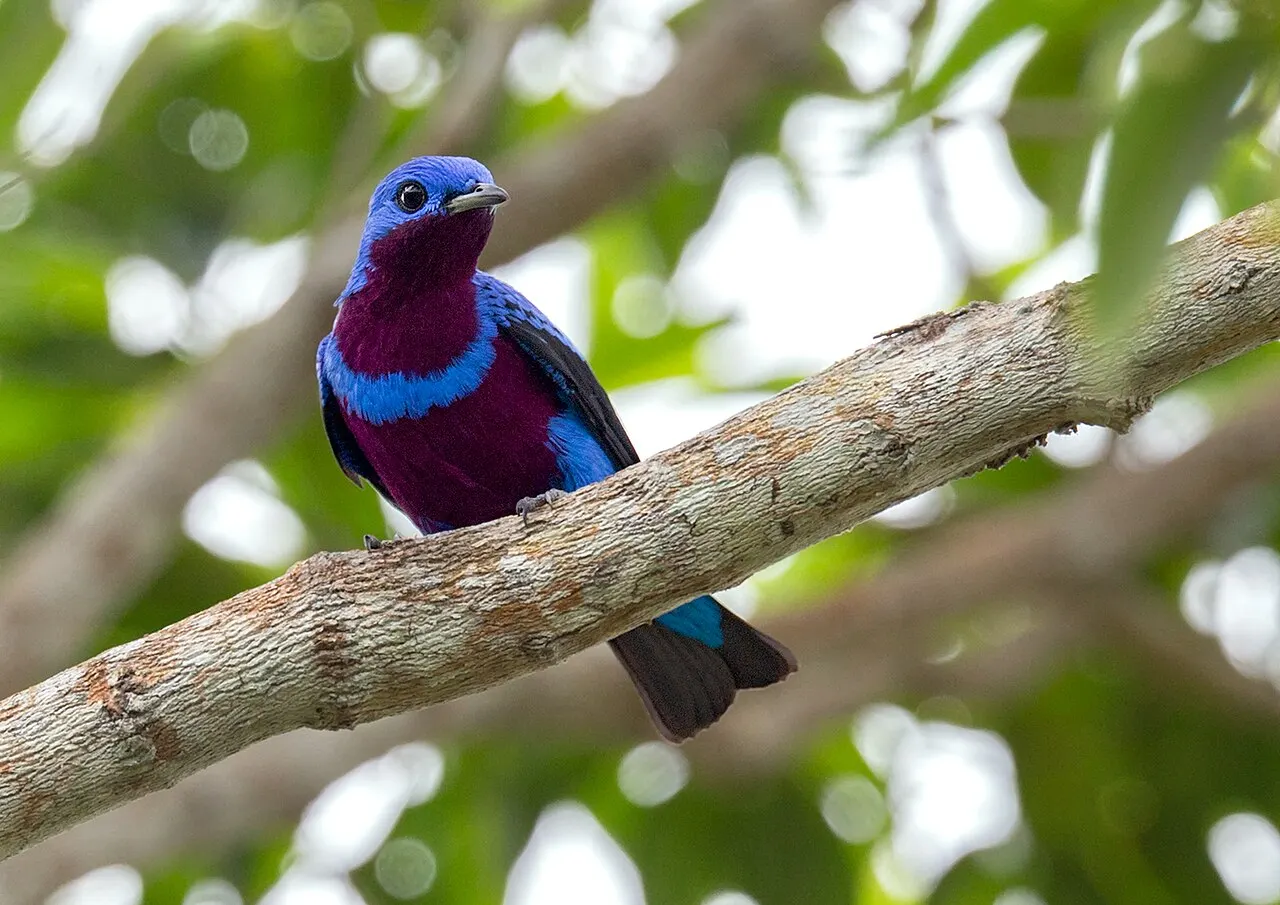
It's a medium-small cotinga, about 20 cm long. The male is deep cobalt blue, mottled black on the back, with a bright purple throat running down to mid-belly and split by a blue breast band. The wings and tail are black, and some of the wing coverts have broad blue edges.
Females look nothing like the males. They're dusky brown above, scaled whitish, and paler and buffier below, with a faint whitish eye-ring. The male's modified outer wing feathers make a slight whirring sound during display.
Where it lives
The species is endemic to Brazil. Most records are from the state of Bahia, with occasional ones from neighbouring Minas Gerais. It probably once occurred in Rio de Janeiro and Espírito Santo, and has reportedly disappeared from both.
It lives in the canopy of humid lowland Atlantic Forest, the only habitat the IUCN lists for it. The 2019 assessment gives an upper elevation limit of 270 m and describes the population as severely fragmented across an estimated 11 to 100 locations. RPPN Estação Veracel and Reserva Serra Bonita are both thought to be strongholds.
Pins are Wikidata “endemic to” fields. Orange dots, when present, are GBIF occurrence tiles — survey bias included.
How it lives
Banded cotingas eat mostly fruit, including berries of Byrsonima sericea and figs (Ficus), and also take caterpillars and other insects. They're shy and stay high in the canopy, which makes them hard to find.
The birds aren't migratory. They build a simple cup-shaped nest, and detailed breeding records are scarce.
Why it is in trouble
Loss of lowland forest is the main cause. The 2019 assessment scores small-holder farming and grazing as the largest ongoing pressures, with housing development as a smaller one and commercial and industrial clearance as a past impact that could return.
People also take the birds. The assessment records use for household goods (feathers) and for the pet and display trade, and the species is on CITES Appendix I, which restricts international trade.
Population figures conflict. Estimates of 250 to 999 mature individuals are widely quoted, while the 2019 assessment's own population field reads 50 to 249, split into 2 to 10 subpopulations with no more than 50 birds in the largest. Either way, numbers are low and still falling.
What is being done
The species occurs in at least one protected area, and the assessment lists habitat restoration and site and area management as conservation actions. It also lists surveys for undiscovered populations, monitoring from observation towers and study of its ecology as research needs. As of 2019 there was no recovery plan and no captive population.
A Brazilian reserve of about 1,581 acres, Reserva Mata do Passarinho, was established in 2007 and covers part of the species' range, according to a Kern Audubon profile.
Sources
Written for this catalog in our own words from the sources below, checked against them on 12 November 2026. Population figures are estimates and carry the year they were made. Status and assessment year: IUCN. 2026. The IUCN Red List of Threatened Species. Version 2026-1. iucnredlist.org.




