Endangered
Bahia Tapaculo
Eleoscytalopus psychopompus
The Bahia tapaculo (Eleoscytalopus psychopompus) is a shy, 11.5 cm bird of the forest floor, found only in a narrow strip of lowland Atlantic Forest in Bahia, Brazil. It is listed as Endangered on the Red List (assessed 2022), with a small, fragmented population.
How to recognise it
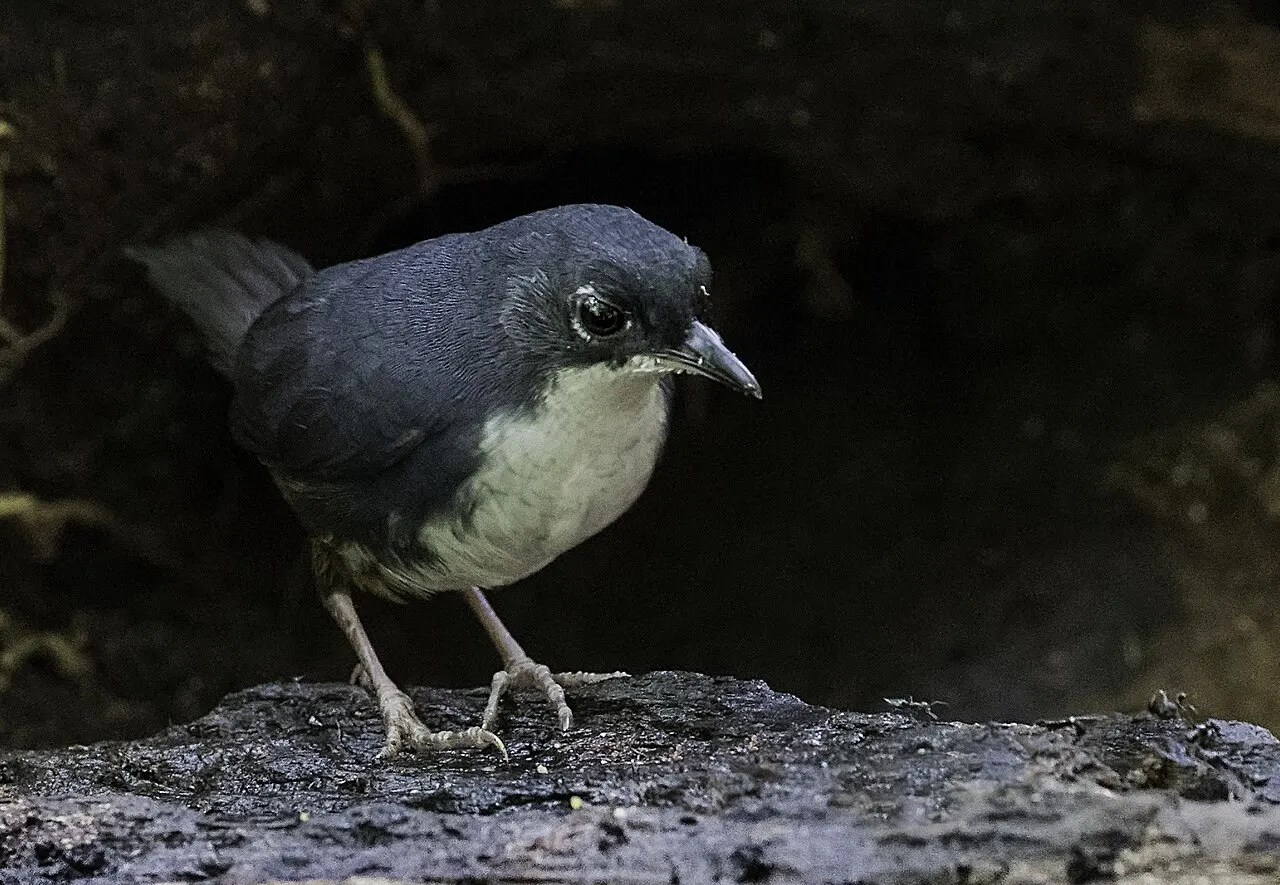
Tapaculos are secretive birds that are far easier to hear than to see. This one is about 11.5 cm long. One male weighed 17.5 g and one female 18 g. It is slate-blue above with a reddish-brown rump, white on the throat, breast and belly, and chestnut along the flanks and vent.
Its closest lookalike is the white-breasted tapaculo, which lives elsewhere and does not overlap with it. A 2018 study in The Auk, led by Lucas de Moraes, showed that the Bahia bird has unbarred flanks and thighs, while its relative has barred ones. It also has longer wings relative to its tail, and a slower song, at roughly 26 to 30 notes per second against 31 to 39. The study treated it as a valid species, with the caveat that the sample was small: six museum skins and recordings from five coastal birds.
A trilled call lasts roughly 3 to 4 seconds.
Where it lives
The species is endemic to the coast of Bahia. It is known from several municipalities, including Igrapiuna, Una, Ilheus, Marau, Taperoa and Valenca. It lives in the understory of mature lowland forest, usually in dense cover close to small streams, and the Red List also lists swamp forest and heavily degraded former forest among its habitats. It has been recorded from 15 to 220 m above sea level.
Pins are Wikidata “endemic to” fields. Orange dots, when present, are GBIF occurrence tiles — survey bias included.
How it lives
Very little is known. It favours thick tangles of vines and shrubs around fallen trunks and branches, and its diet has not been described. The only breeding clue on record is that a male and female collected in October 1983 had active reproductive organs.
Why it is in trouble
For decades it was known from just three specimens collected in the 1940s and 1980s, and it was feared extinct until targeted surveys found living birds. Since then it has turned up at several sites, but it is rare at most of them.
The Red List estimates 250 to 999 mature individuals in 2022, split into 5 to 100 small, isolated subpopulations, the largest holding up to about 50 birds. The population is judged to be declining as lowland forest continues to shrink and degrade. The assessment also names small-scale subsistence harvesting as a threat.
What is being done
Conservation sites have been identified across its whole range, and the Red List records site and area management as an action in place. It notes that the species does not occur in a protected area, and that there is no recovery plan or systematic monitoring scheme. The 2018 species study argued that settling its identity was a necessary first step for effective conservation.
Sources
Written for this catalog in our own words from the sources below, checked against them on 12 November 2026. Population figures are estimates and carry the year they were made. Status and assessment year: IUCN. 2026. The IUCN Red List of Threatened Species. Version 2026-1. iucnredlist.org.




