Endangered
Baetica ustulata
Baetica ustulata
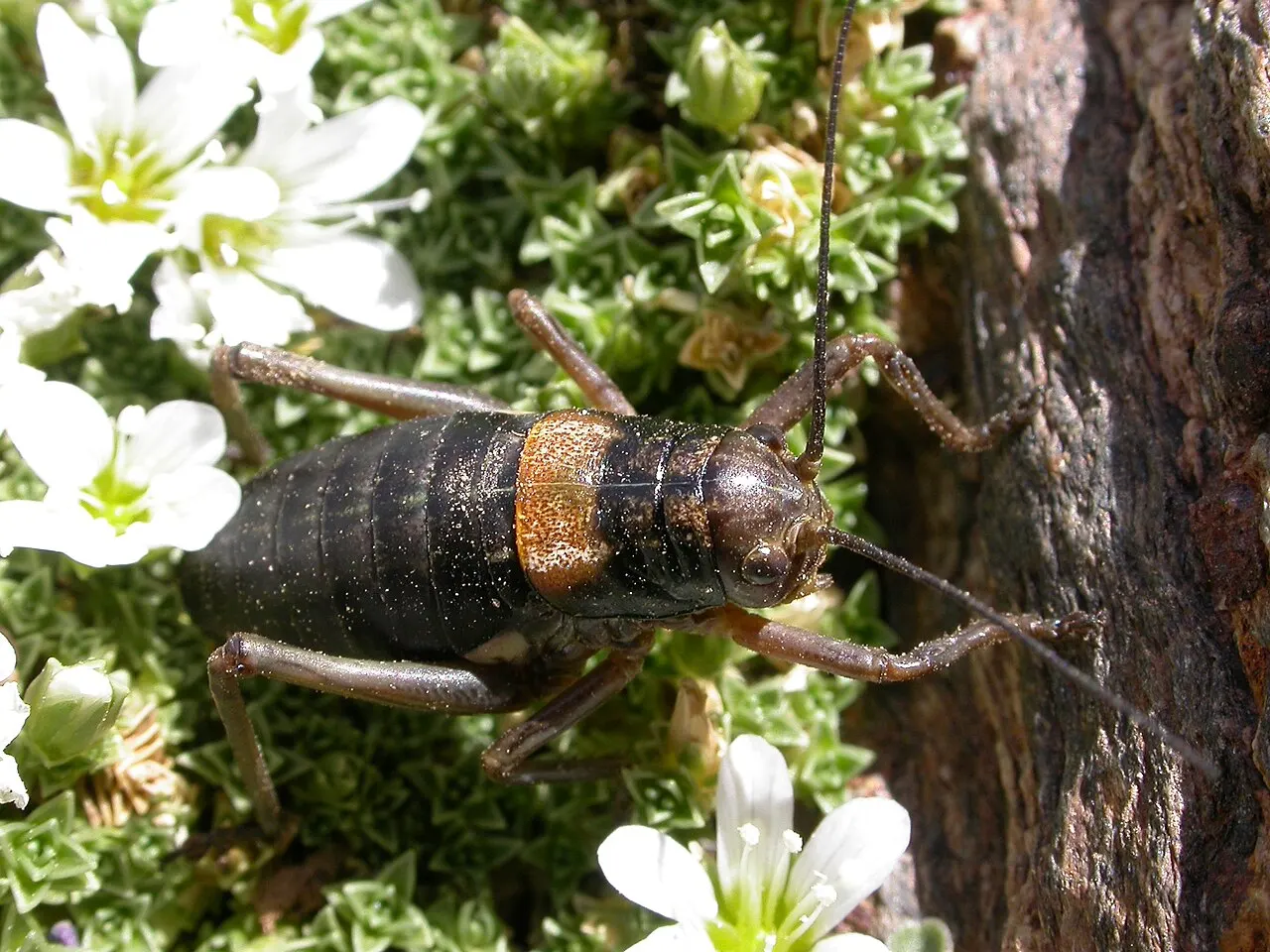
Baetica ustulata is a glossy black bush cricket found only on the high slopes of the Sierra Nevada in southern Spain. It is the sole species in its genus. The IUCN rated it Endangered in 2016, citing threats that include tourism developments, housing and changes to its mountain habitat.
How to recognise it
This is a medium-sized, stout bush cricket. Males measure 18 to 22 mm and females 22 to 26 mm, with a long curved egg-laying tube of 16 to 17 mm. The back is shiny black, while the belly, legs and rear edge of the shield behind the head are yellowish red. The legs are short, and the shield hides the forewings.
Spanish naturalists call it the chicharra de Sierra Nevada. Rambur described it in the 1830s under another genus name, Ephippiger.
Where it lives
The species is restricted to the Sierra Nevada massif, in the provinces of Granada and Almeria, at about 2,200 to 3,450 m. Most records cluster around the peaks of Mulhacen, Veleta and Caballo, the highest ground in the range.
It likes open stony ground with little plant cover, often close to the permanent snow line. It shelters under stones on acidic soils with spiny cushion plants, and inside thickets of the broom Genista baetica and low juniper.
Pins are Wikidata “endemic to” fields. Orange dots, when present, are GBIF occurrence tiles — survey bias included.
How it lives
Adults are found from July to October, and mating has been seen in July and August. The cricket is active by day, walking slowly in bright sun, and spends most of its time on the ground or under stones. Spanish studies describe it as a scavenger that feeds on dead matter and also takes animal prey, and a 2015 paper reportedly gave the first record of one eating another of its own species.
Numbers can be high where conditions suit. A 1995 study found about 500 individuals per hectare at the eastern end of the range. Groups are usually of three or fewer, though one study recorded 13 females in a thorny shrub of about a square metre.
Why it is in trouble
The species depends on a narrow band of alpine scrub that is easily damaged. Spain's red data atlas names the ski resort, tourism and building pressure as the main threats. The IUCN assessment adds recreational activities and habitat shifting and alteration, and records a decreasing population.
Survey work gives a mixed picture. By the end of 2009 the cricket had been found in 150 of 300 one-kilometre squares searched, more than five times its previously known spread. The atlas authors judged it not rare but vulnerable to habitat change. The IUCN still rates it Endangered, on criteria based on its small range.
What is being done
Almost all of its range lies inside the Sierra Nevada Natural Park and National Park. It is also covered by the EU Habitats Directive (Annexes II and V) and the Bern Convention (Appendix II). Spanish specialists have proposed tighter control of building and tourism, special protection for the broom and juniper belt between 2,200 and 3,000 m, and regular monitoring, since the cricket could serve as an indicator of local climate change.
Sources
Written for this catalog in our own words from the sources below, checked against them on 12 November 2026. Population figures are estimates and carry the year they were made. Status and assessment year: IUCN. 2026. The IUCN Red List of Threatened Species. Version 2026-1. iucnredlist.org.




