Endangered
White-clawed crayfish
White-clawed crayfish
The white-clawed crayfish (White-clawed crayfish) is a small freshwater crayfish of clean rivers and streams in western and southern Europe, and the only crayfish native to Britain. The IUCN Red List has classed it as Endangered since its 2010 assessment, as invasive crayfish and their plague drive it from one river after another.
How to recognise it
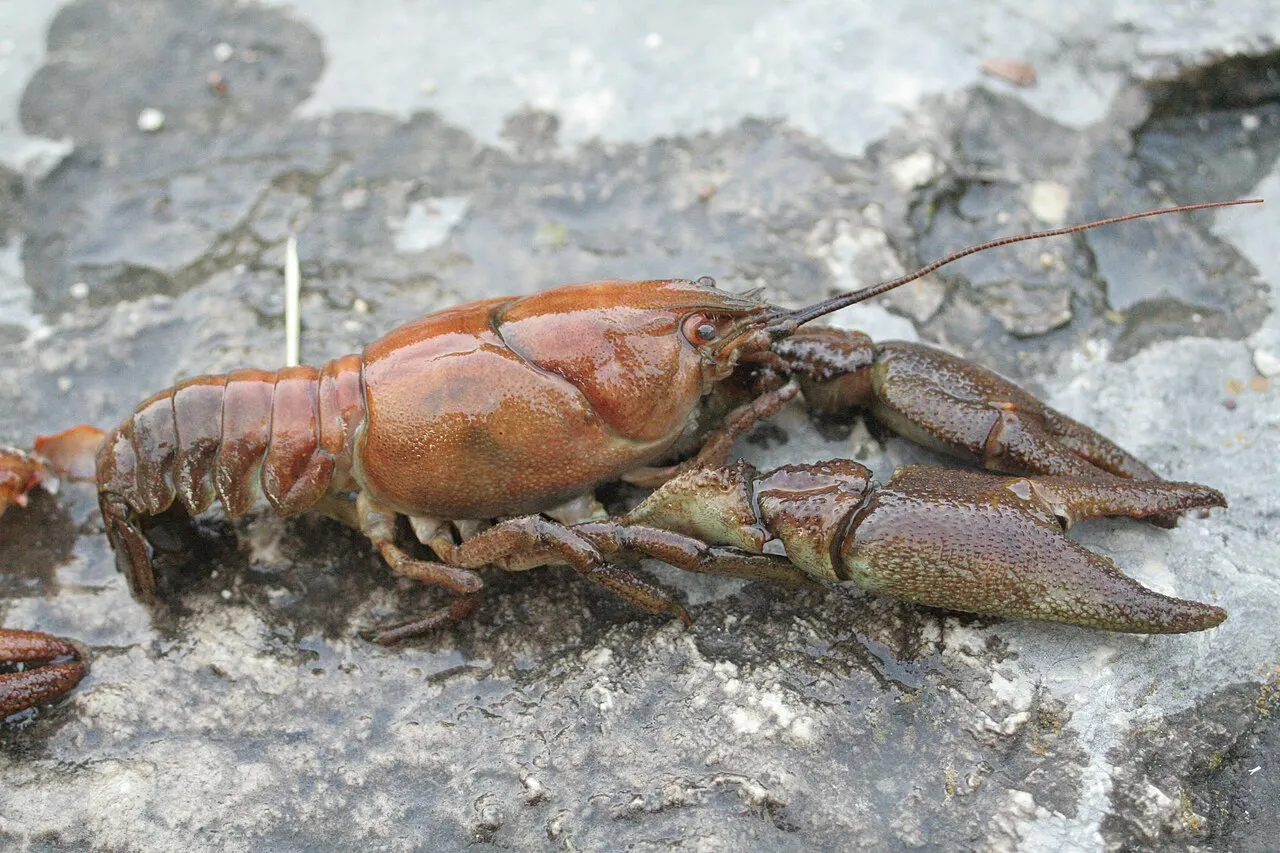
It's an olive-brown crayfish with pale undersides to its claws, which gives it both its common name and its scientific one (pallipes means pale foot). It can reach about 12 cm, though adults under 10 cm are more usual. Invasive signal crayfish grow much larger, up to roughly 20 cm.
Where it lives
It needs clean, well-oxygenated, mineral-rich water with plenty of hiding places among rocks, tree roots and submerged logs. Moderate-flow rivers and streams about a metre deep suit it, and it also lives in lakes, reservoirs and canals. It tends to avoid acidic water.
The 2010 assessment lists it from countries including Britain, France, Germany, Austria, Switzerland, Italy, Spain, Portugal and the western Balkans, with Montenegro as the eastern limit. Ireland is listed as an introduced population, though in 2010 the IUCN said the largest remaining subpopulation was there, still free of signal crayfish.
The assessment also notes that some authorities treat the species as a complex that includes a separate Italian species. Genetic work from 1998 onward has led to the southern forms being split off as Austropotamobius fulcisianus, so the strict range of A. pallipes is narrower than older maps suggest.
Pins are Wikidata “endemic to” fields. Orange dots, when present, are GBIF occurrence tiles — survey bias included.
How it lives
It is nocturnal and hides by day. It eats worms, snails, carrion, water plants and dead organic matter, and it is prey for herons, otters and dragonfly larvae.
Mating takes place in autumn. A female carries 20 to 160 eggs under her tail, though most carry fewer than 100, and the eggs hatch in spring. The young cling to their mother for two to three weeks, living on their yolk sacs. Breeding starts at three or four years old. Zoo and charity sources give lifespans of 7 or more years and 8 to 15 years.
Why it is in trouble
The biggest threat is the North American signal crayfish, introduced to Britain in the 1970s. It outcompetes the native crayfish and carries crayfish plague, a disease the white-clawed crayfish has no resistance to. Plague can wipe out a population within about two weeks. A 2010 IUCN assessment suspected a decline of 50 to 80% over ten years, based on data from England, France and Italy. In Britain, numbers are reported to have fallen by roughly 70% since the 1970s, and the species survives mostly in small upstream stretches, which are more exposed to summer drought. In 2007 and 2008 disease eliminated it from the River Frome.
Pollution adds to the pressure. Insecticide run-off and poorly treated wastewater have been linked to local extinctions, and the IUCN also lists dams, water abstraction, erosion, sewage and housing development. In late 2024, white-clawed crayfish were found dead in Northumberland's River Wansbeck from an unidentified disease.
What is being done
The main tool in Britain is the ark site: a headwater stream, pond or pit with natural barriers against signal crayfish, where a safe population can be kept. Around 100 have been set up. Under a Natural England licence, rescued animals must spend at least 28 days in quarantine first. On 24 July 2025, 43 crayfish that had finished quarantine at Birmingham Sealife Centre were released into a new ark site in Nottinghamshire, while 100 adults from a Hucknall brook went into quarantine. Testing of water for crayfish DNA had confirmed plague in some local watercourses.
Captive rearing helps too. Bristol Zoo has reared 3,500 juveniles and moved 4,500 wild animals, and the UK has five hatcheries. Some populations in Italy and Spain have evolved resistance to plague, though they may still carry the disease. The species is protected under UK and European law, with special areas of conservation designated for it, and some French Natura 2000 sites treat it as an emblem.
Sources
Written for this catalog in our own words from the sources below, checked against them on 12 November 2026. Population figures are estimates and carry the year they were made. Status and assessment year: IUCN. 2026. The IUCN Red List of Threatened Species. Version 2026-1. iucnredlist.org.




