Critically Endangered
Austrogammarus australis
Austrogammarus australis
The Dandenong amphipod (Austrogammarus australis) is a small freshwater crustacean found only in a few forest streams in the Dandenong Ranges east of Melbourne, Australia. It was once feared extinct. The IUCN Red List rated it Critically Endangered in 2014, with its population trend recorded as unknown.
How to recognise it
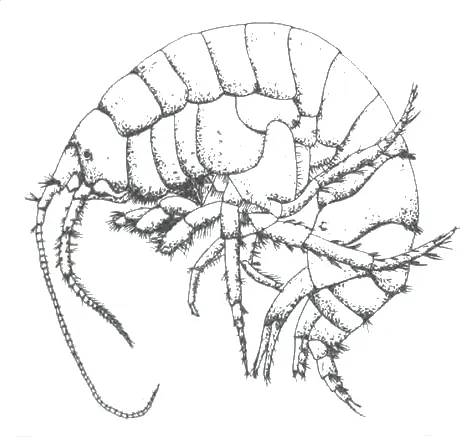
Amphipods are small, laterally flattened crustaceans, usually between one and two centimetres long. This species reportedly swims on its side and looks somewhat hairy, which sets it apart from similar amphipods sharing its streams. It belongs to the family Paramelitidae and was described by Sayce in 1901 as Gammarus australis, then placed in the genus Austrogammarus in 1983.
A close neighbour in the same hills, the Sherbrooke amphipod (Austrogammarus haasei), is a separate species that Sayce described in 1902.
Where it lives
The species lives in the upper reaches of small creeks, in leaf litter and organic debris under dense canopy, reportedly with shade over at least 75 percent of the water. Surveys found it only in the least disturbed stretches, where the streamside vegetation was native. In 1999, about two thirds of the sites where it was found lay inside national parks or other reserves.
The IUCN assessment lists Victoria as its only range and puts it at one location, with an area of occupancy of about 5 square kilometres and an extent of occurrence of about 35 square kilometres.
Pins are Wikidata “endemic to” fields. Orange dots, when present, are GBIF occurrence tiles — survey bias included.
How it lives
It reportedly feeds as a shredder, eating mostly native leaf litter and other organic matter that washes in from the forest. Surveys in the Dandenong Ranges targeted patches of organic debris, a favoured habitat of Austrogammarus amphipods.
Why it is in trouble
The last record before the 1990s was from 1911, and the animal was classed as presumed extinct in 1990. The type locality, Dandenong Creek near Bayswater, is now heavily modified, with urban drains, and the species hasn't been recorded there since.
Researchers think the loss there was most likely due to urbanisation, particularly stormwater run-off. The IUCN assessment lists housing and urban areas and run-off as threats, and records a continuing decline in the area it occupies and in its number of locations.
What is being done
A June 1995 survey of 46 sites found it at nine, in the upper reaches of Olinda, Dandenong and Monbulk creeks. A 1999 survey of 44 sites found it at 17, with abundance up to ten times higher at some sites, though the causes were uncertain and may have included natural variation, dry conditions or sampling differences. No taxon-specific survey of the ranges has been reported since 1999. It is listed under Victoria's Flora and Fauna Guarantee Act 1988, with an action statement guiding its protection.
The IUCN assessment records a recovery plan, protection over part of its range, occurrence in at least one protected area and some awareness work, and notes that water-sensitive urban design is needed. A 2022 conference study using DNA barcoding reported three genetically distinct populations of the species and five Austrogammarus species in the Dandenong Ranges area, some possibly undescribed. That work was preliminary.
Sources
Written for this catalog in our own words from the sources below, checked against them on 12 November 2026. Population figures are estimates and carry the year they were made. Status and assessment year: IUCN. 2026. The IUCN Red List of Threatened Species. Version 2026-1. iucnredlist.org.
- IUCN Red List assessment, Austrogammarus australis
- Papas and Crowther 2007, Victorian Naturalist 124(4), distribution and conservation status of two amphipods in the Dandenong Ranges
- Austrogammarus australis, encyclopedia entry
- Australian Freshwater Sciences Society conference 2022 abstract, Dandenong Amphipod barcoding




