Endangered
Australian Painted-snipe
Rostratula australis
The Australian painted-snipe is a secretive, long-billed wader found only in Australia, where it turns up unpredictably at shallow wetlands. The IUCN Red List assessed it as Endangered in 2022, with an estimated 270 to 410 mature individuals. The female is the brighter bird, and the male incubates the eggs and raises the chicks.
How to recognise it
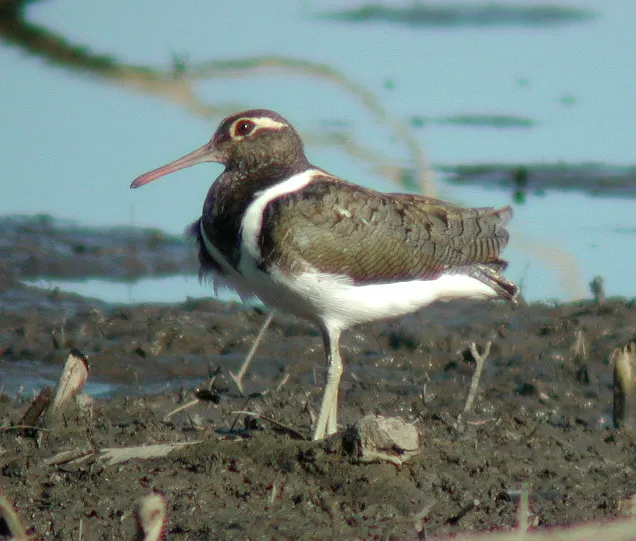
It is a stocky, long-billed wader 24 to 30 cm long, with a wingspan of 50 to 54 cm and a weight of 125 to 130 g. A cream, comma-shaped mark curls around the eye.
The female has a chocolate-brown head, neck and upper breast. The male is slightly smaller and duller, dark grey with a buff stripe on the crown and buff spots on the wings. In both sexes, a white stripe running down the side of the breast and over the shoulders is the surest field mark. Juveniles resemble adult males.
John Gould described it in 1838. It was lumped with the greater painted-snipe in 1934, but genetic analysis suggests the Australian birds have been isolated from other painted-snipes for about 19 million years.
Where it lives
It is endemic to Australia and has been recorded in every mainland state and territory. The Murray-Darling Basin, especially the Riverina, appears to have been a stronghold, and breeding records now come from far beyond it, including coastal Queensland and north-western Australia. In New South Wales, sites include the Paroo wetlands, Lake Cowal, the Macquarie Marshes and Fivebough Swamp.
Its presence at any one wetland is hard to predict. It favours shallow fresh or brackish wetlands with low, patchy cover such as lignum and canegrass, and it leaves when conditions turn unsuitable. It will also use irrigated land and seasonally flooded farmland.
Pins are Wikidata “endemic to” fields. Orange dots, when present, are GBIF occurrence tiles — survey bias included.
How it lives
Painted-snipes rest through the day under low cover and feed from dusk through the night, probing soft mud for worms, molluscs, insects and crustaceans, and taking some seeds. They are usually found in small parties, and movements are poorly known. The birds are thought to be nomadic, following floods.
Roles are reversed. A female may mate with several males, then leave each one to care for the clutch. The male incubates three or four spotted eggs for about 15 to 16 days and does most of the chick care. Nests are ground scrapes or small mounds on islets, usually in temporary wetlands that have recently flooded. Breeding runs roughly September to December, depending on conditions.
Why it is in trouble
The 2022 assessment estimates that the population has fallen by 50 to 79 percent, and projects a further fall of the same size. Taking water for farms and households, intensive farming and grazing, and drought all shrink the wetlands the birds need. Drainage, salinisation, pollution and trampling by livestock add to the damage.
State agencies also point to foxes and feral cats, pesticide use near wetlands, frequent burning and invasive weeds. Counts are shaky: the national recovery plan lists earlier estimates of 1,500 (1993), 5,000 (2000) and under 2,500 (2011), and calls all such figures unreliable because the bird is cryptic and surveys are patchy.
What is being done
Australia lists the species as Endangered. A national recovery plan, the first for the species, was registered in March 2023. Its objective is a positive population trend by 2032, measured against 2020 counts, and its strategies include protecting known habitat across whole regions, better monitoring, reducing threats, research and community awareness.
The Red List assessment says the species occurs in at least one protected area and that conservation sites have been identified across its range. New South Wales runs a targeted recovery strategy under its Saving Our Species program, with fox and cat control and fire protection for swamps.
Sources
Written for this catalog in our own words from the sources below, checked against them on 12 November 2026. Population figures are estimates and carry the year they were made. Status and assessment year: IUCN. 2026. The IUCN Red List of Threatened Species. Version 2026-1. iucnredlist.org.




