Endangered
Mount Kenya bush viper
Mount Kenya bush viper
The Mount Kenya bush viper is a small, tree-living viper known from just two forest patches in Kenya, one near Chuka on Mount Kenya and one in the Nyambeni Hills. The IUCN Red List assessed it as Endangered in 2019, citing a small, fragmented range, farming and collecting.
How to recognise it
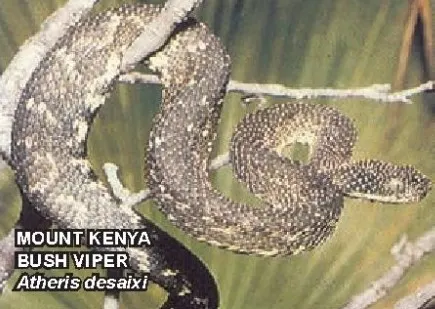
It is a stout, short-tailed viper with a charcoal or greenish-black body, speckled because each scale is tipped yellow or yellow-green. Yellow loops run along the flanks and can join into zigzags toward the rear. The belly is yellowish at the front and fades to purplish-black underneath the tail.
Adults average 40 to 60 centimetres in total length and reach at most about 70. Newborns measure 17 to 22 centimetres and are mostly yellow with a white-tipped tail, taking on adult colours at around 30 centimetres.
Where it lives
It is endemic to Kenya and has only ever been found in two distant places. One is the forest at Chuka on the south-east side of Mount Kenya, where the first specimens were collected around 1,600 metres in dense rain forest. The other is Igembe forest in the northern Nyambeni range. The IUCN records it at about 1,600 to 1,700 metres, in moist montane forest and also in plantations, and counts just two locations that are severely fragmented.
A conservation grant project in 2010 put its occupied area at under 300 square kilometres, with habitat that had been shrinking. The IUCN gives an extent of occurrence of about 2,251 square kilometres.
Pins are Wikidata “endemic to” fields. Orange dots, when present, are GBIF occurrence tiles — survey bias included.
How it lives
It is arboreal, moving slowly through foliage. The first specimens were found in clearings and along paths about two metres above the ground. Its dark, flecked pattern makes it hard to spot among leaves. Wild habits are poorly known, though it reportedly eats frogs, rodents and small birds.
Like its relatives it is venomous. When handled it strikes readily, and it can produce a loud hiss by rubbing its keeled scales together. The venom reportedly disrupts blood clotting, so a bite should be treated as a medical emergency. A pregnant female from the Nyambeni range gave birth to 13 young in August.
Why it is in trouble
The IUCN lists smallholder farming and deliberate collecting of the snake as threats, plus unintended losses from large-scale harvesting, and records its use for pets and display. A 2010 conservation grant description named over-collection and habitat destruction as the two big problems. It said foreign collectors want the species for the pet trade and zoo breeding, and that illegal exports had been recorded. Logging was cited as one cause of forest loss.
The assessment records a continuing decline and severe fragmentation. No population count exists, and the species is thought to be rare.
What is being done
It occurs in at least one protected area and is subject to international trade controls. The IUCN lists site management, trade management, harvest management, training and awareness among its actions. In 2010 a US$4,000 grant went to Jacob Ngwava at the National Museums of Kenya to map its distribution, check habitat condition and measure the impact of illegal trade.
Sources
Written for this catalog in our own words from the sources below, checked against them on 12 November 2026. Population figures are estimates and carry the year they were made. Status and assessment year: IUCN. 2026. The IUCN Red List of Threatened Species. Version 2026-1. iucnredlist.org.




