Endangered
Astyanax jordani
Astyanax jordani
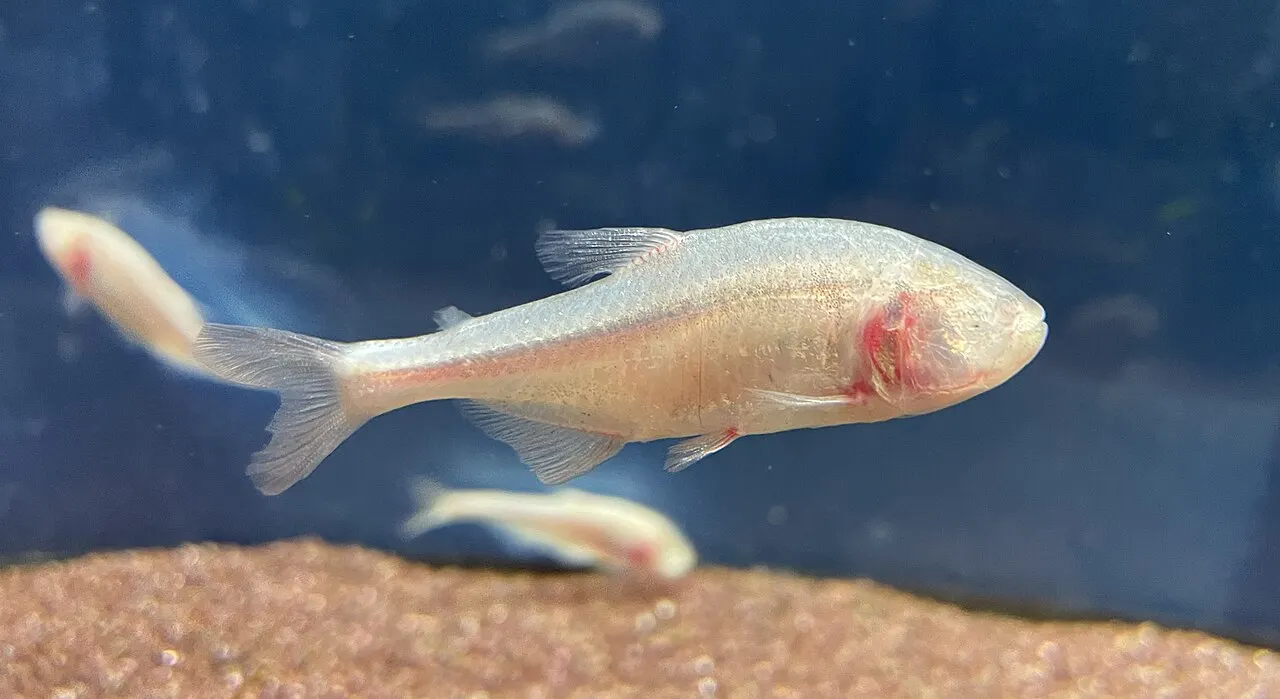
The blind cave tetra (Astyanax jordani) is an eyeless, pale cave fish from the Huasteca region of eastern San Luis Potosí and Tamaulipas, Mexico. The IUCN Red List rated it Endangered in 2019. It is also the fish behind the aquarium-trade blind tetra, though some scientists treat it as a cave form of the Mexican tetra.
How to recognise it
Cave forms of this group lose their pigment and look pinkish-white, and their eyes are reduced or gone entirely. In the dark they rely on a lateral line that is highly sensitive to pressure changes in the water, and taste buds spread across the head support a strong sense of smell and taste. The Mexican tetra, the fish they are closely allied to, reaches about 12 cm.
A fact sheet from Mexico's national university (UNAM) also lists loss of sleep and resistance to insulin among the adaptations that help these fish cope with a lightless, food-poor habitat.
Where it lives
It lives in flooded limestone caves and underground streams in the Sierra de El Abra of San Luis Potosí and Tamaulipas. UNAM counts 34 cave populations of this form, spread over three mountain ranges: Sierra de El Abra, Sierra de Guatemala and Sierra de la Colmena. The IUCN assessment, which treats this as a distinct species, counts only three locations and an extent of occurrence of about 3,852 square km.
The type locality is La Cueva Chica, a small cave about three-quarters of a kilometre north of El Pujal. Its water ranges between about 24 and 27 degrees Celsius, close to the average surface temperature in the area.
Pins are Wikidata “endemic to” fields. Orange dots, when present, are GBIF occurrence tiles — survey bias included.
How it lives
Little is documented for jordani specifically. The Mexican tetra, in the wild, feeds on crustaceans, worms, insects and some algae and plants. Cave forms reportedly store around four times more energy as fat than surface fish, which helps when food arrives irregularly.
Cave and surface fish can interbreed, and many El Abra caves hold hybrids between the eyeless form and the surface Astyanax mexicanus. Phylogenetic evidence supports treating jordani as a morph of A. mexicanus rather than a full species, and UNAM calls it a subspecies. The IUCN and some authors still list it separately, so both names appear in the literature.
A fish in the aquarium trade
Salvador Coronado, who worked for Mexico's fisheries directorate, collected the first specimens in La Cueva Chica in 1936, for C. Basil Jordan of the Texas Aquaria Fish Company in Dallas. Hubbs and Innes described them that year as Anoptichthys jordani, naming the fish for Jordan. Aquarium stock sold as blind cave tetras comes from fish collected at La Cueva Chica in 1936, and the IUCN lists use as pets and display animals among its uses.
Why it is in trouble
The assessment (criteria B1ab(i,iii), 2019) lists pumping of groundwater and surface water for agriculture, herbicides and pesticides, soil erosion and sedimentation, and small-scale harvesting as threats. UNAM adds the effect of scientific sampling on some populations. The caves are hydrologically linked, so pollution can spread between them quickly. The population trend is unknown, but the fish's range is still contracting.
At least one population is in a protected area, and the species is classed as threatened under Mexico's NOM-059 standard. It was not held in conservation breeding programmes, and had no targeted invasive-species control, at assessment time.
Sources
Written for this catalog in our own words from the sources below, checked against them on 12 November 2026. Population figures are estimates and carry the year they were made. Status and assessment year: IUCN. 2026. The IUCN Red List of Threatened Species. Version 2026-1. iucnredlist.org.
- IUCN Red List assessment, Astyanax jordani (2019)
- UNAM Instituto de Biologia, Sardinita ciega mexicana fact sheet
- Mitchell, Russell and Elliott 1977, Mexican Eyeless Characin Fishes, Texas Tech Museum Special Publication 12
- Mexican tetra, Wikipedia
- Astyanax jordani, Wikipedia
- Cavelife, Astyanax cavefish page




