Endangered
Astreopora listeri
Astreopora listeri
Astreopora listeri is a hard coral that forms mounds and crusts on shallow Indo-Pacific reefs, from East Africa and Madagascar to Indonesia and eastern Australia. It is found in many reef settings, especially shallow turbid water. The 2024 Red List assessment rates it Endangered, a change from Least Concern in 2008 and 2014.
How to recognise it
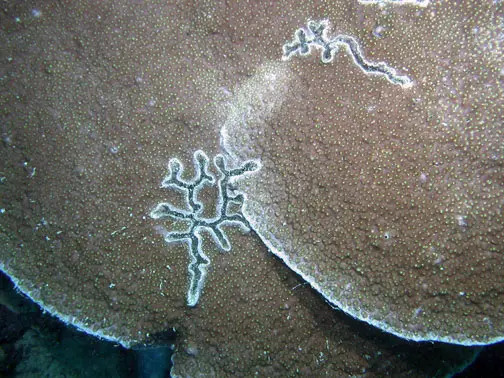
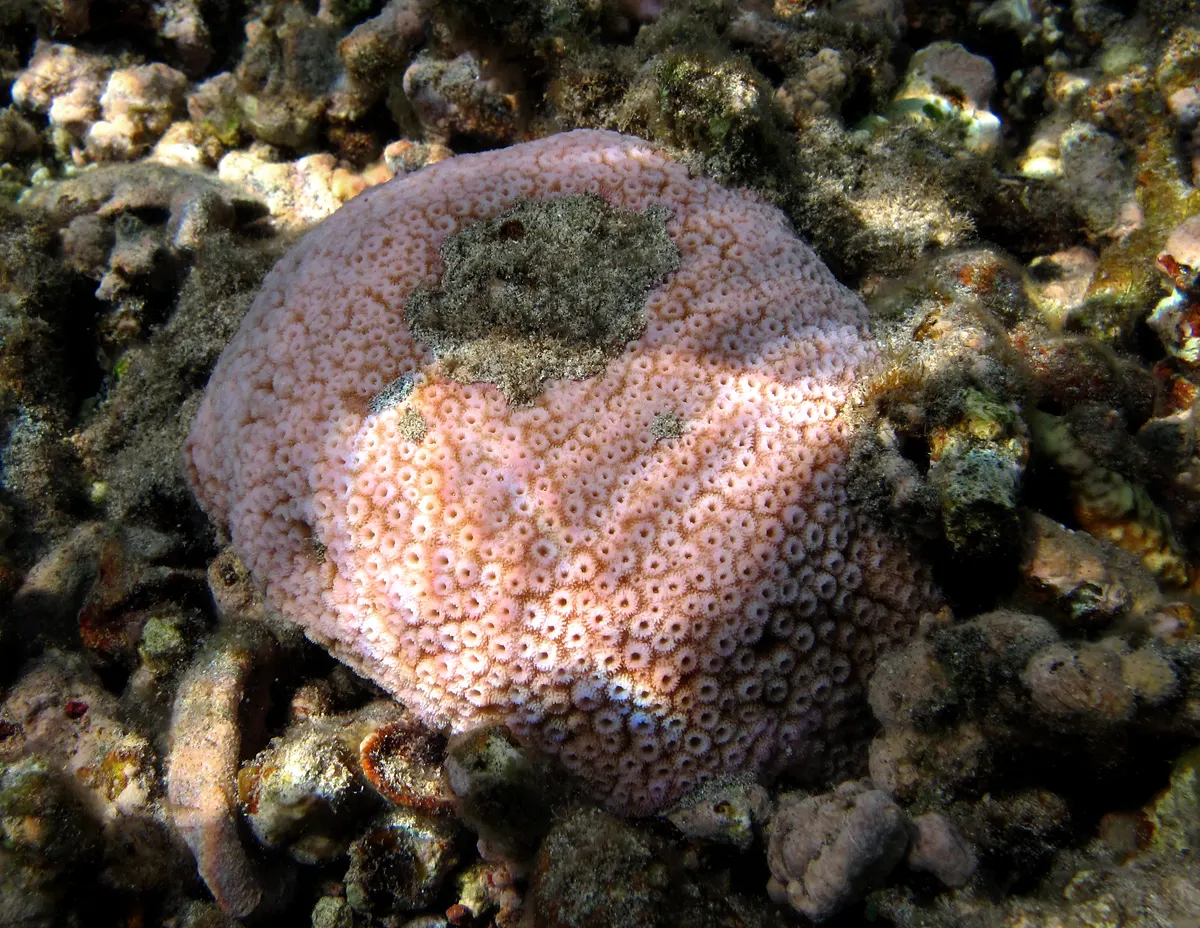
Colonies are hemispherical mounds or flattened crusts that partly spread over the reef surface. The corallites, the small cups that hold the polyps, are sunk into the skeleton and crowded without any set pattern. Each round opening is ringed by delicate, feathery spines, which gives the surface a rough, spiny feel.
Colour is usually cream, pale brown or grey. It looks like two relatives, Astreopora myriophthalma and Astreopora randalli. Bernard described it in 1896.
Where it lives
The Red List records it in 60 countries and territories, from Kenya, Tanzania and Madagascar through the Red Sea region, Sri Lanka and Indonesia to Japan, Fiji and Australia. It occurs in many kinds of reef habitat, most often in shallow, turbid water.
The Red List gives a depth range of 3 to 53 metres, mostly 5 to 20 metres. The GBIF database holds 358 records, led by Australia and American Samoa, then Réunion and Mayotte.
Sources differ on how common it is. Corals of the World says it is usually uncommon, while the 2024 Red List text calls it common.
Pins are Wikidata “endemic to” fields. Orange dots, when present, are GBIF occurrence tiles — survey bias included.
How it lives
Like other reef-building corals, it hosts microscopic algae that feed the colony, which is why it needs shallow, lit water. The Red List uses a generation length of 10 years.
A boring sponge, Cliona orientalis, reportedly sometimes lives in its skeleton and weakens the structure. Breeding season and spawning behaviour are not covered in the sources checked.
Why it is in trouble
The 2024 assessment rates it Endangered under criterion A3ce, which is based on projected loss. It estimates a future reduction of about 66 percent, driven by falling habitat quality and by pathogens, pollutants and competitors. The area it occupies is already declining.
Threats include temperature extremes, storms and flooding, sediment from erosion, coastal housing and industry, shipping lanes, tourism and recreation, and unintended effects of small-scale harvest. The genus is reportedly prone to bleaching and disease. The wider IUCN reassessment found 44 percent of 774 reef-building species threatened, using data up to 2020.
What is being done
No protection specific to this coral is reported, and it is unknown whether it occurs in a protected area. The Red List names site protection and management, habitat restoration, species recovery, captive breeding and propagation, and a genome resource bank as needed actions.
Sources
Written for this catalog in our own words from the sources below, checked against them on 12 November 2026. Population figures are estimates and carry the year they were made. Status and assessment year: IUCN. 2026. The IUCN Red List of Threatened Species. Version 2026-1. iucnredlist.org.