Critically Endangered
Assam roofed turtle
Pangshura sylhetensis
The Assam roofed turtle (Pangshura sylhetensis) is a small freshwater turtle of the Brahmaputra and Meghna river basins in northeast India, Bangladesh and Bhutan. The IUCN Red List rated it Critically Endangered in 2021. It has one of the narrowest ranges of any South Asian pond or river turtle.
How to recognise it
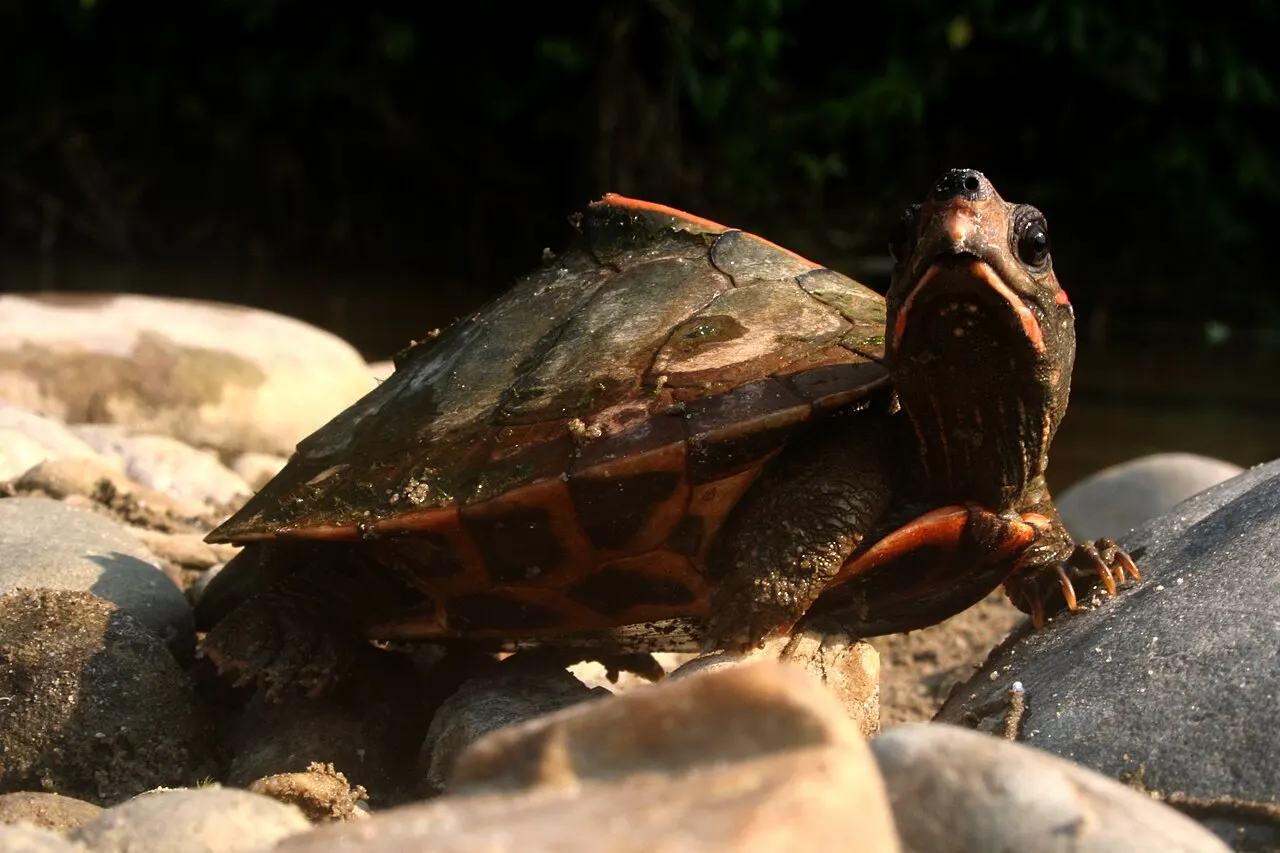
Females reach about 18.5 cm in shell length and males no more than 9.7 cm, according to the IUCN, though a larger maximum of 20.5 cm is reported elsewhere. The shell is raised and triangular, olive-brown, with a pale yellowish keel that ends in a spike. The rear edge is strongly serrated, with 26 marginal plates.
The head is small, with a weakly hooked upper jaw and a narrow pink stripe running back from each eye. It used to be placed in the genera Batagur and Kachuga, so older books use those names.
Where it lives
The core of its range is the Brahmaputra-Meghna drainage in Assam, India, plus the Terai Arc region of India and Sylhet in eastern Bangladesh. The IUCN lists it as present in India and Bhutan, possibly present in Myanmar, and possibly extinct in Bangladesh, though its text describes one population surviving in a stretch of river in the southeast.
It lives in small, clear, fast-flowing hill streams in forest, and may use nearby still water at times, at up to about 200 m elevation. It is amphibious. It basks on logs and rocks in the water, never on the bank, and dives to the middle of the stream if disturbed. Adult females favour deeper channels and pools, while juveniles and males use shallower sections. Young turtles hide among dead leaves.
Pins are Wikidata “endemic to” fields. Orange dots, when present, are GBIF occurrence tiles — survey bias included.
How it lives
Nesting runs from late October to February, with 6 to 12 eggs per clutch. Hatchlings turn up mostly in March and April. The eggs need a cool pause of roughly 6 to 8 weeks in development before they will hatch. Adults eat mostly plants, with some animal prey.
The IUCN puts maturity at around six years and a generation at about 18 years, so a population that loses breeding adults takes a long time to recover.
Why it is in trouble
The IUCN estimates a population reduction of about 80% over three generations and says the decline is continuing. It estimates the area it occupies at about 400 square kilometres, and the population is severely fragmented.
The causes it records are hunting for food at subsistence scale, silt washed into streams, dams, other changes to river habitat and disturbance from recreation. Logging in the hills destroys habitat, and local people eat the meat and eggs. Turtles are also caught accidentally in fishing gear. The species is in demand for the high-end pet trade, and in 2018 an expert reported adult females in China fetching as much as US$10,000 each.
What is being done
The species is listed on CITES Appendix II and is protected under Schedule I of India's Wildlife (Protection) Act. It has been recorded in Kaziranga National Park, Manas Tiger Reserve, Nameri Wildlife Sanctuary and Dibru-Saikhowa Wildlife Sanctuary in Assam. In Assam, nests have been collected and eggs incubated artificially.
A breeding and conservation facility for the species was opened at the Assam State Zoo in Guwahati on a World Turtle Day. The IUCN's 2021 assessment records no ex situ conservation in place, and calls for further surveys, habitat protection and captive breeding methods.
Sources
Written for this catalog in our own words from the sources below, checked against them on 12 November 2026. Population figures are estimates and carry the year they were made. Status and assessment year: IUCN. 2026. The IUCN Red List of Threatened Species. Version 2026-1. iucnredlist.org.




