Endangered
Asir Magpie
Pica asirensis
The Asir magpie is a black-and-white magpie found only in the juniper highlands of southwestern Saudi Arabia, the country's only endemic bird. The Red List rated it Endangered in 2022, estimating about 200 mature individuals. Some authorities still treat it as a subspecies of the Eurasian magpie.
How to recognise it
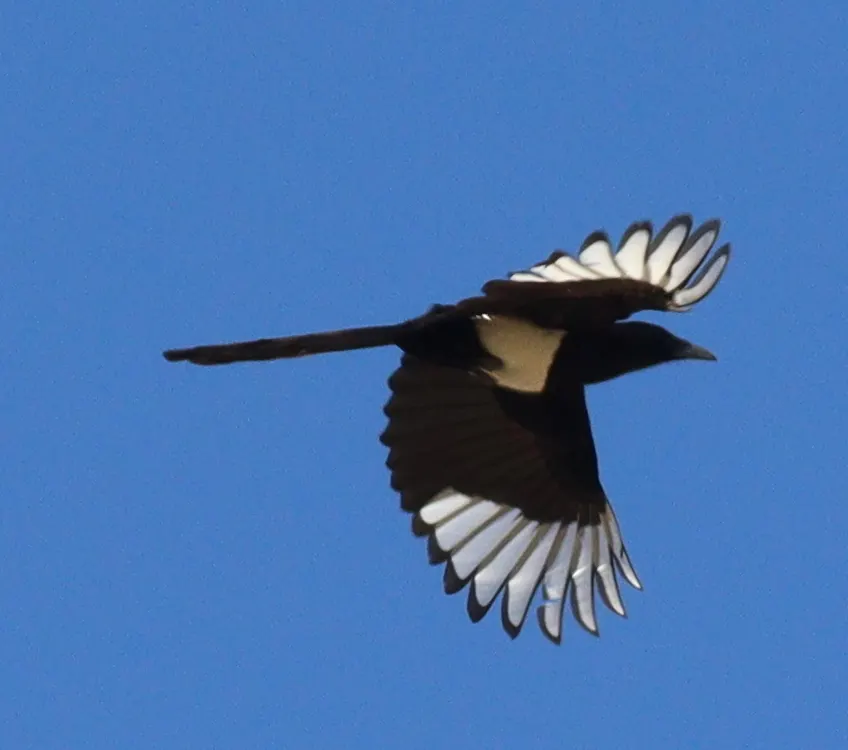
It's a large magpie, about 45 to 46 cm long and 200 to 240 g. The head, neck, back, chest, rump and feet are black, with white shoulders and belly and a black tail that glints purple to bronze-green. Next to a Eurasian magpie it has a longer, stouter bill and legs, darker plumage, less white on the scapulars and a black rump. Males and females look alike, and juveniles are duller.
It has a far-carrying contact call that foraging groups use to keep in touch, plus a lower-pitched stress call.
Where it lives
Its home is the Asir Mountains. When it was first collected in 1936 the range reportedly stretched about 400 km, from near Taif in the north to at least Abha in the south. Today most birds are confined to a strip of highland roughly 37 km long, between An-Namas and Billasmar, and it occupies an estimated 11 to 50 locations.
It mostly lives above about 2,150 m, usually between 2,400 and 3,000 m, in shady African juniper forest or dense mixed woodland. The Red List also records dry shrubland and rocky ground, and gives an elevation range of 1,850 to 3,000 m. Birds have turned up lower and farther south than expected, including nine on Jebel Al Qahar in Jazan in May 2021, at about 1,900 m.
Pins are Wikidata “endemic to” fields. Orange dots, when present, are GBIF occurrence tiles — survey bias included.
How it lives
Asir magpies live in pairs and in small groups of up to seven, probably families. They're omnivores. During breeding they reportedly eat mostly caterpillars, and for the rest of the year they take seeds, including juniper cones and figs. They also scavenge scraps at picnic sites and eat roadkill.
Pairs build a domed twig nest lined with mud, usually 3 to 8 m up in juniper or acacia, and build a new one each year. Incubation reportedly lasts 21 to 22 days, with chicks in the nest for 24 to 30 days.
Why it is in trouble
The population is tiny and still shrinking. Estimates vary. The Red List gives about 200 mature individuals in 2022, an older count gave 135 pairs (about 270 mature individuals), and later field summaries suggest around 100 pairs or fewer.
The native juniper forests are reportedly not regenerating, and tourism development, roads, urban growth and grazing keep cutting into what's left. The Red List also names drought, temperature extremes and climate change among the pressures. Feeding on human food waste may leave birds poorly nourished, and habitat fragmentation reportedly limits contact between groups.
What is being done
The Red List records habitat protection as the one action in place and lists no species recovery plan. In 2018, Saudi Aramco launched a conservation project with the Saudi Wildlife Authority and the Smithsonian Institution. The project set out to find the causes of the decline and build a conservation strategy, using population and habitat surveys, tracking devices, leg bands and DNA analysis from blood samples.
Sources
Written for this catalog in our own words from the sources below, checked against them on 12 November 2026. Population figures are estimates and carry the year they were made. Status and assessment year: IUCN. 2026. The IUCN Red List of Threatened Species. Version 2026-1. iucnredlist.org.




