Critically Endangered
Asian narrow-headed softshell turtle
Chitra chitra
The Asian narrow-headed softshell turtle (Chitra chitra) is one of the largest freshwater turtles in the world, a river specialist from Thailand, Malaysia and Java. The IUCN Red List rated it Critically Endangered in 2019, with a decreasing population, after dams, pollution and collection for food and the pet trade.
How to recognise it
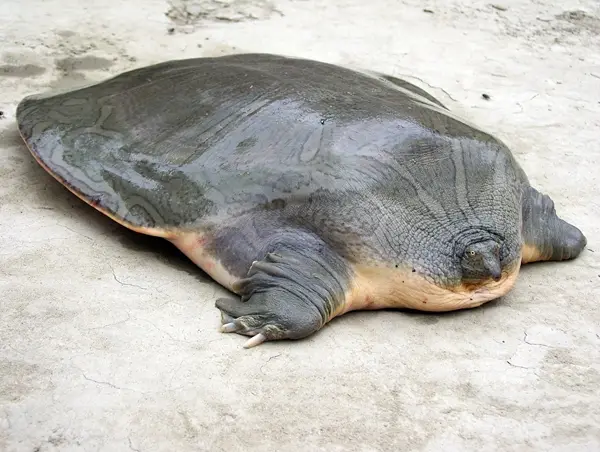
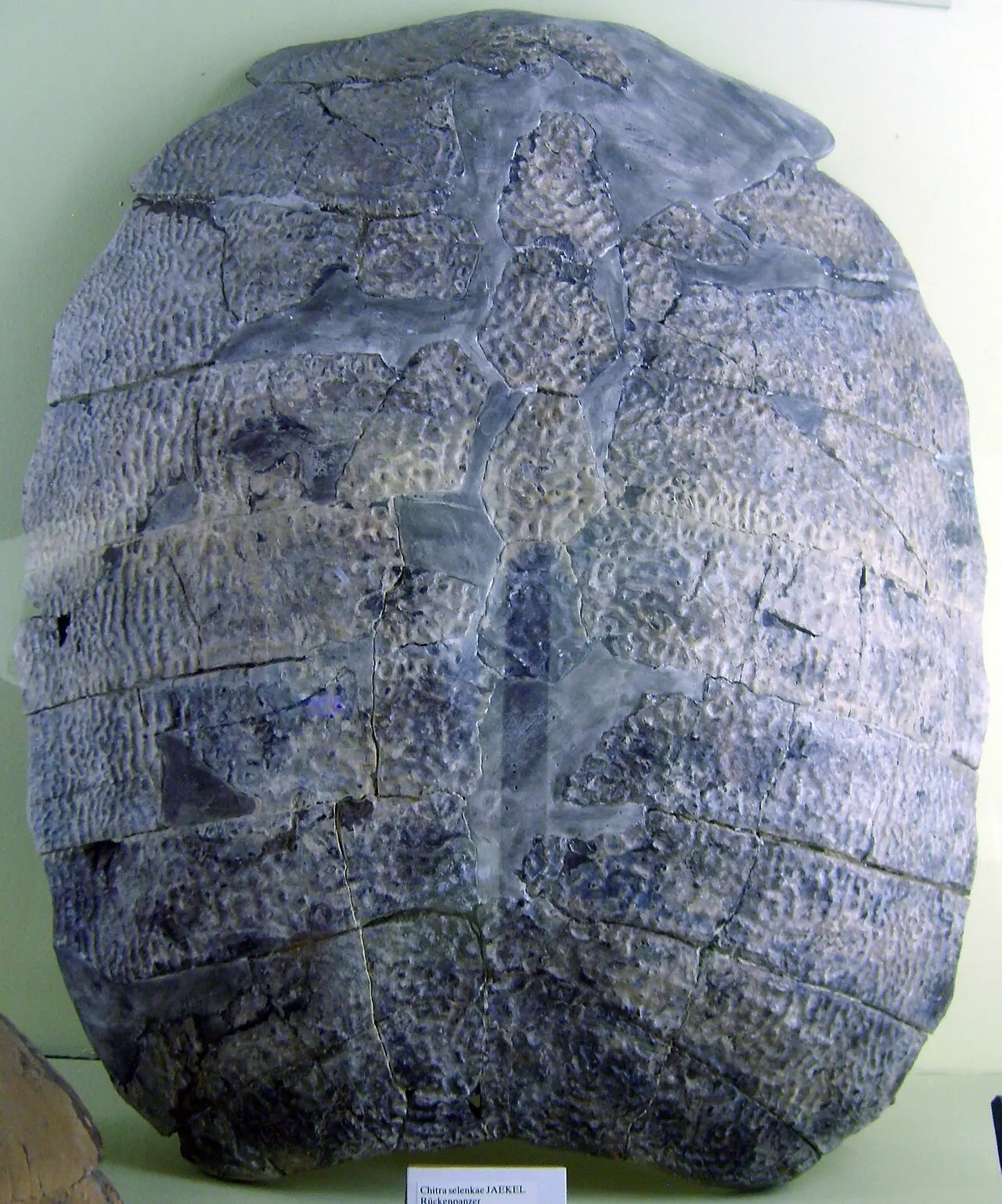
This is a giant. Straight shell length is given as about 1.4 m in a Dutch museum species account and about 1.5 m in a general reference, and big animals may weigh 100 kg or more. The shell is light to yellowish brown with irregular pale yellow, dark-edged markings, and the underside is cream to pinkish.
The head is long and narrow, and five yellow stripes run along the neck. Adult males have longer, thicker tails than adult females and juveniles. Like other softshells, it has a flexible, leathery shell rather than hard plates.
Where it lives
It lives in large, clean, flowing rivers with sandy bottoms. The IUCN lists permanent rivers and large water-storage reservoirs as its habitats, and records it from Thailand, Peninsular Malaysia, Java and Sumatra.
Two subspecies are reportedly recognised: Chitra chitra chitra in Thailand and Malaysia, and C. c. javanensis in Java and Sumatra. A 2005 survey in Tropical Natural History found the species in Thailand only in the Mae Klong and Chao Phraya river systems, and called the whole genus very rare everywhere. A new record from the Mae Ping River was published in 2002.
Pins are Wikidata “endemic to” fields. Orange dots, when present, are GBIF occurrence tiles — survey bias included.
How it lives
It eats clams, crabs and fish. It catches fish by shooting its long neck out very fast and seizing them in its mouth.
Females are reportedly mature at about 15 years. The IUCN gives a generation length of 45 years, which shows how slowly a population can rebuild once adults are lost. The species was described by Wirot Nutaphand in 1986, who reported that a large female laid more than 100 eggs.
Why it is in trouble
The IUCN assessment lists a long run of pressures. Dams and reservoirs change the river, and sedimentation, mining, sewage, run-off, herbicides and pesticides, oil spills and rubbish degrade the water. Adults and eggs are collected for food, and the turtle is also taken for the international pet trade.
The IUCN estimates a past population reduction of 80 percent, based on habitat loss and exploitation, and records that the area the species occupies is still shrinking. With late-maturing females, losing breeding adults is hard to reverse.
What is being done
The species has been in CITES Appendix I, the strictest level of trade control, since 12 June 2013. The IUCN records that it is held in captive breeding programmes and covered by international trade controls, but that it does not occur in any protected area.
Listed action needs include habitat restoration, harvest and trade management, species recovery, reintroduction, and education. No population size estimate is given.
Sources
Written for this catalog in our own words from the sources below, checked against them on 12 November 2026. Population figures are estimates and carry the year they were made. Status and assessment year: IUCN. 2026. The IUCN Red List of Threatened Species. Version 2026-1. iucnredlist.org.