Endangered
Arnoldichthys spilopterus
Arnoldichthys spilopterus
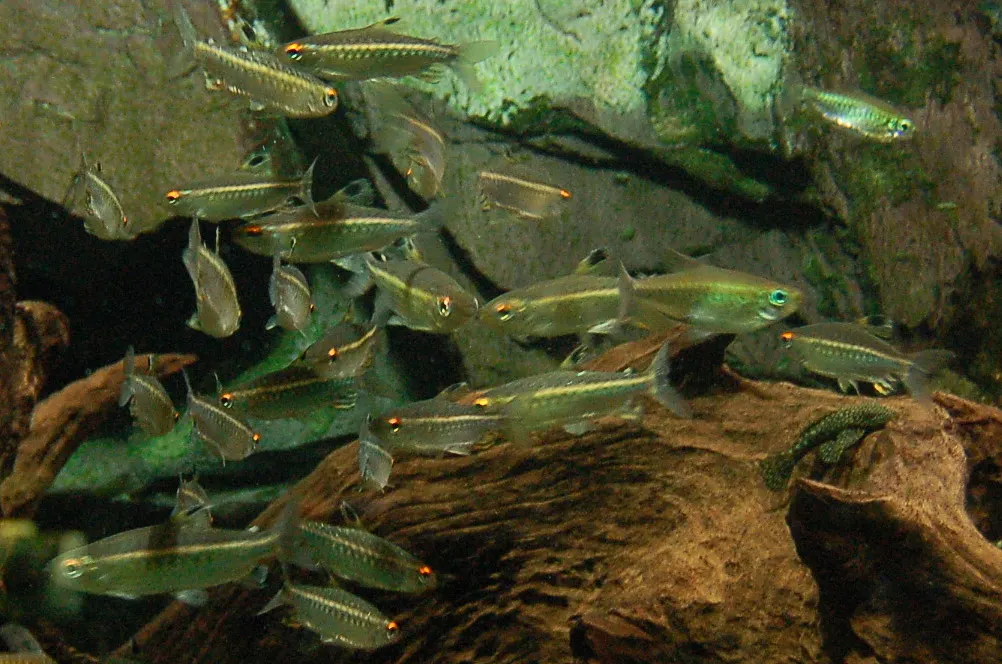
The African red-eyed tetra (Arnoldichthys spilopterus), also called the Niger tetra, is a schooling freshwater fish known only from Nigeria. The IUCN Red List assessed it as Endangered in 2020. It is known from just three locations, and habitat loss and harvesting continue to reduce it.
How to recognise it
It is a slender tetra reaching about 10 centimetres in standard length. Males are slightly more colourful and slimmer than mature females and carry dark stripes in the anal fin. In aquarium stock the male stripes are described as yellow, though some populations show red stripes. Females have a clearly separated spot in the anal fin. The species name means roughly "with a spot in the fin".
Where it lives
It is endemic to Nigeria, in the Ogun and lower Niger river systems. Despite the name Niger tetra, it does not occur in the country of Niger. It lives in streams and rivers, often in water stained brown by tannins from decaying plant matter. The IUCN lists permanent rivers and streams as its habitat, with an extent of occurrence of about 23,400 square kilometres and an occupied area of 68 to 500 square kilometres.
It is the only member of its genus, and the genus name honours the German aquarist Johann Paul Arnold. Boulenger described the fish in 1909. Some sources place it in the family Lepidarchidae, while the IUCN and GBIF place it in Alestidae.
Pins are Wikidata “endemic to” fields. Orange dots, when present, are GBIF occurrence tiles — survey bias included.
How it lives
Most of what is written about its habits comes from aquarium keepers. It eats worms, insects and crustaceans, and accepts most prepared foods in captivity. It is a peaceful, very active schooling fish, and keepers advise at least 10 together, though schooling becomes looser in older fish.
It is a free spawner with no parental care. A single female can lay up to about 1,000 eggs, which hatch in roughly 30 hours. One dealer says females hardly develop eggs without small insects in the diet.
Why it is in trouble
A hobbyist profile reports fewer than 10 known localities, while the Red List counts three. They lie in a region of ongoing deforestation and pollution. The assessment lists housing and urban development, large-scale and small-scale harvest, and continuing decline in both the area it occupies and its extent of occurrence. The fish was rated Vulnerable in 2010 and Endangered in 2020.
One German aquarium dealer blames water pollution from oil production and says collecting for the aquarium trade does not affect the wild population. The IUCN, however, records use of the species as a pet or display animal and lists harvest as an ongoing threat, so the views differ.
The fish does well once settled in an aquarium. The same dealer suggests captive breeding may one day be needed to prevent extinction.
What is being done
The assessment records ex-situ conservation, meaning captive stock, but no recovery plan, no monitoring scheme and no identified conservation sites, and none of the population is known to lie in a protected area. The measures it lists as needed are site management, site protection and harvest management.
Sources
Written for this catalog in our own words from the sources below, checked against them on 12 November 2026. Population figures are estimates and carry the year they were made. Status and assessment year: IUCN. 2026. The IUCN Red List of Threatened Species. Version 2026-1. iucnredlist.org.




